
Industry Insight: FRP vs Steel, Aluminium, and Stainless Steel — An Honest Material Comparison for Industrial Specification
Steel, aluminium, and stainless steel have been the default material choices for industrial infrastructure for generations. FRP has been quietly replacing all three across the sectors where they fail fastest. This is an honest, data-backed comparison across the properties that determine which material belongs in which application.
Published by Reinforce Technology | May 2026
The industrial materials conversation has been dominated by metals for most of modern engineering history. Steel for structural applications. Aluminium where weight matters. Stainless steel where corrosion resistance is paramount. Each of these materials has a well-understood performance profile, a well-established supply chain, and decades of design codes and fabrication standards behind it.
FRP (Fibre Reinforced Polymer) — also referred to as GRP (Glass Reinforced Polymer) in its glass fibre form — does not have that history. It has been in industrial use since the 1960s, but it entered the mainstream of infrastructure specification much more slowly than metals. The reasons are partly inertia, partly familiarity, and partly a procurement culture that evaluates materials on purchase price rather than total cost of ownership.
That is changing. The global annual cost of corrosion — the primary failure mechanism for all three common metals in aggressive industrial environments — is estimated at £2 trillion, approximately 3.4% of global GDP (NACE International, 2016). The industries driving FRP adoption are precisely the ones where metal corrosion is most operationally and commercially consequential: chemical processing, water treatment, offshore energy, renewable energy, and data centre infrastructure. In each of these sectors, FRP is not replacing metals because it is fashionable. It is replacing them because the performance and cost data, evaluated honestly over a full asset life, consistently support the substitution.
This article compares FRP directly against steel, aluminium, and stainless steel across the properties that determine material selection in industrial applications — weight, corrosion, electrical properties, thermal properties, mechanical performance, and lifecycle cost. The comparison is honest about where metals remain the better choice and where FRP is decisively superior.
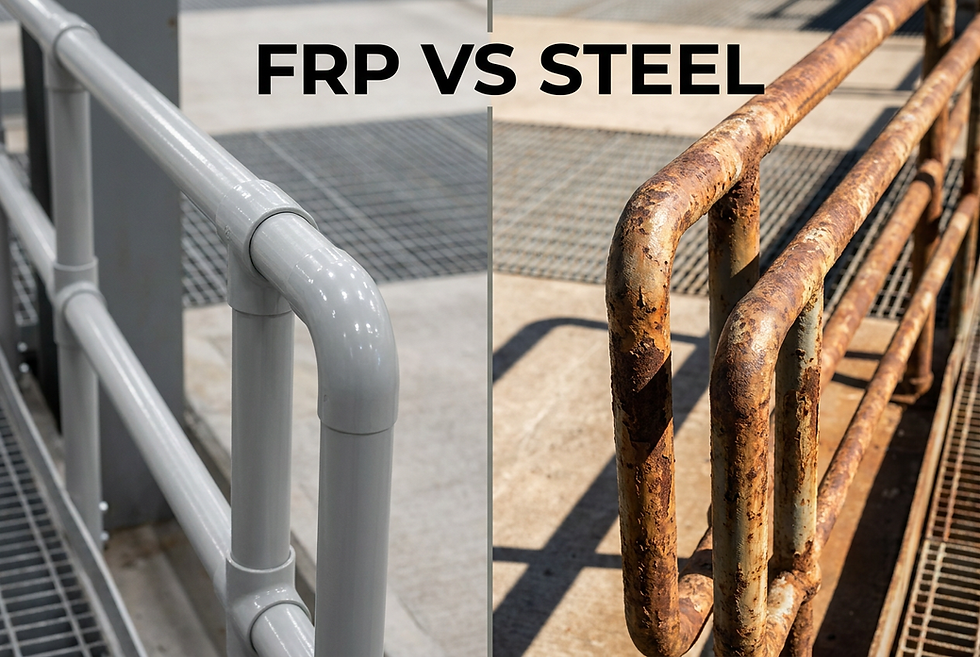
FRP vs Steel
Steel is the most widely used structural material in industrial infrastructure and the most common comparison point for FRP. The comparison is instructive because the two materials occupy fundamentally different positions on almost every performance axis relevant to secondary industrial infrastructure.
Weight
GFRP has a density of approximately 1,750 to 2,100 kg/m³ against steel's approximately 7,850 kg/m³ — making FRP roughly 75 to 80% lighter for an equivalent volume (IntechOpen, 2022). In structural terms, this weight saving translates to lower transport costs, smaller crew requirements during installation, no mechanical assistance needed for handling individual sections, and reduced dead load on the supporting structure. For overhead cable tray installations, rooftop solar frames, offshore secondary platforms, and any application where cumulative dead load matters, this is a significant practical advantage.
Corrosion
Steel corrodes. This is not a conditional statement — it is a material property. Even galvanised steel, which adds a sacrificial zinc coating, relies on that coating remaining intact to provide protection. In chemical plant environments, coastal locations, water treatment works, and the humid zones around data centre cooling infrastructure, galvanised coatings fail at cut edges and fixing points within years, initiating a corrosion cycle that compounds across the operational life of the installation.
FRP does not corrode. Its resistance is intrinsic to the composite matrix rather than dependent on a surface coating that can be breached. In the correct resin system for the specific environment, FRP provides maintenance-free corrosion resistance across a design life that consistently exceeds the operational horizon of the assets it serves (Younis, Ebead and Judd, 2018).
Electrical Properties
Steel is a conductor. FRP is a confirmed electrical insulator (IntechOpen, 2022). In electrically sensitive industrial environments — substations, chemical plants, data centres, rail infrastructure — this distinction has direct operational consequences. Steel secondary infrastructure must be earthed and bonded throughout its length, adding specialist installation labour, materials, and ongoing compliance verification. FRP requires no earthing or bonding. Steel secondary infrastructure in proximity to live electrical systems can become an accidental current path in the event of a fault. FRP cannot.
Thermal Properties
Steel has a thermal conductivity of approximately 50 W/mK. FRP has a thermal conductivity of approximately 0.3 to 0.4 W/mK — roughly one hundred times lower (IntechOpen, 2022). In applications where thermal bridging is a concern — insulated building envelopes, cold storage facilities, cryogenic infrastructure — FRP's thermal non-conductivity is a direct performance advantage. In cable management applications where high-load cables generate heat, FRP's low thermal conductivity means it does not transfer heat laterally through the cable management structure the way steel does.
Mechanical Performance
This is where the comparison becomes more nuanced. GFRP's tensile strength is comparable to or exceeds that of mild steel on a weight-for-weight basis — the specific tensile strength of GFRP is significantly higher than steel. However, GFRP has a lower modulus of elasticity than steel, meaning it deflects more under equivalent load at equivalent cross-section. FRP structural profiles designed for equivalent deflection performance will typically have larger cross-sections than steel equivalents.
FRP also exhibits linear-elastic behaviour up to failure, without the gradual yielding that steel provides before fracture. This means FRP structures must be designed with appropriate safety factors, and FRP is not appropriate for applications where ductile failure behaviour is a safety-critical design requirement — primary load-bearing structural frames, seismic design applications, and applications requiring large plastic deformation before failure. These are genuine limitations that should inform specification decisions. They do not apply to the secondary and tertiary infrastructure applications — cable trays, grating, walkways, handrails, sub-frames — where FRP is most commonly specified against steel.

FRP vs Aluminium
Aluminium is often positioned as a middle ground between steel and FRP — lighter than steel, with better corrosion resistance than ungalvanised steel, and widely used in marine, aerospace, and architectural applications. The comparison with FRP reveals a more specific set of limitations than the aluminium-versus-steel comparison.
Weight
Aluminium has a density of approximately 2,700 kg/m³ — roughly one-third the weight of steel but still 30 to 50% heavier than GFRP at equivalent volume. For most secondary infrastructure applications, the weight difference between aluminium and FRP is smaller than the difference between steel and FRP, but it remains a meaningful advantage for FRP in large-scale installations where cumulative dead load matters.
Corrosion
Aluminium forms a natural oxide layer that provides reasonable corrosion resistance in mild atmospheric environments. It performs well in dry, indoor, and mildly humid conditions. However, aluminium is susceptible to pitting corrosion in chloride environments — specifically, salt water and salt air — and to galvanic corrosion when in contact with dissimilar metals, particularly steel fasteners and fixings. In marine, offshore, and coastal environments, aluminium cable trays and structural profiles connected with steel fixings develop galvanic corrosion at every connection point, even when the aluminium body itself is performing adequately.
Aluminium is also susceptible to attack from alkalis. In chemical plant environments with alkaline process chemistry, aluminium secondary infrastructure can corrode faster than galvanised steel. FRP in the correct resin system is resistant to both chloride environments and alkali attack — providing a broader corrosion resistance envelope than aluminium across the full range of industrial chemical environments.
Electrical Properties
Aluminium is electrically conductive — approximately four times more conductive than steel by volume. It carries the same earthing and bonding requirements as steel in electrically sensitive environments, and the same galvanic corrosion risk at dissimilar metal interfaces. FRP's non-conductivity advantage applies as fully against aluminium as against steel in data centre, substation, chemical plant, and rail applications.
Cost
Aluminium typically costs more per kilogram than galvanised steel and less per kilogram than FRP on a purchase price basis. However, aluminium's susceptibility to galvanic corrosion at steel fixing points — which are ubiquitous in structural applications — means its real-world corrosion performance in mixed-metal installations is often worse than its material properties in isolation would suggest. The lifecycle cost advantage of FRP over aluminium in corrosive mixed-metal environments follows the same logic as the FRP versus steel comparison: lower maintenance cost over the asset life offsets the higher purchase price within 8 to 15 years.

FRP vs Stainless Steel
Stainless steel is the metal most commonly specified in applications where corrosion resistance is the primary requirement — food processing, pharmaceutical manufacturing, marine, and high-purity water treatment. It provides significantly better corrosion resistance than mild or galvanised steel and better performance than aluminium in most chemical environments. The comparison with FRP is therefore the most substantive, and in several respects the most revealing.
Corrosion
Stainless steel's corrosion resistance is provided by a passive chromium oxide layer that forms naturally on the surface. This layer is robust in many environments but is not universal. Stainless steel is susceptible to chloride-induced pitting corrosion — a failure mode that is highly relevant in marine, coastal, and saline process environments, and that can penetrate deep into the metal structure before it is visually apparent. Grade 316 stainless steel provides improved chloride resistance over 304 but is not immune to pitting in concentrated salt or chloride environments.
Stainless steel is also susceptible to crevice corrosion — attack in the narrow gaps at fixing points, flanged connections, and overlapping surfaces where the passive layer cannot be maintained. In cable tray and grating applications, where many fixing points and section interfaces are present, crevice corrosion is a documented failure mode for stainless steel in wet or chloride-laden environments.
FRP has no passive layer to breach and no susceptibility to pitting or crevice corrosion. Its chemical resistance is not dependent on a surface condition that can be disrupted — it is a bulk material property consistent throughout the full cross-section. In the chloride environments where stainless steel's limitations are most significant — offshore platforms, coastal industrial facilities, marine infrastructure — FRP provides corrosion resistance that stainless steel cannot guarantee.
Weight
Stainless steel has a density of approximately 7,900 to 8,000 kg/m³ — marginally heavier than carbon steel and approximately four times heavier than GFRP. The weight advantage of FRP over stainless steel is essentially the same as over carbon steel, with all the same practical implications for transport, installation, and structural loading.
Cost
Stainless steel carries a significant material cost premium over mild steel — typically 3x to 5x higher on a per-kilogram basis depending on grade and market conditions. Against FRP's typical 1.5x to 2x premium over mild steel, stainless steel is often the more expensive upfront choice. Yet FRP is still frequently dismissed on cost grounds when the comparison is actually with mild steel rather than stainless. When the correct comparison is made — FRP against the stainless steel that would otherwise be specified for its corrosion resistance — FRP's purchase price is frequently lower, or at worst comparable, before any lifecycle maintenance savings are counted.
The Summary: Where FRP Is the Stronger Specification
The comparison across weight, corrosion, electrical properties, and lifecycle cost points consistently in one direction for secondary and tertiary industrial infrastructure in demanding environments. FRP is not appropriate for every application — primary structural frames requiring ductile failure behaviour, high-compressive-load elements, and short-lifespan assets in genuinely benign conditions are areas where metals remain the rational choice. But those applications represent a relatively narrow slice of the total secondary infrastructure procurement decisions made across UK industrial, energy, and infrastructure projects.
For the broader category — cable trays, grating, walkways, handrails, sub-frames, fencing, drainage, and structural profiles in corrosive, humid, chemically active, or electrically sensitive environments across asset lives of 15 years or more — FRP outperforms all three metals on the metrics that determine total cost of ownership. It is lighter than steel, aluminium, and stainless steel. It does not corrode in the environments where all three metals corrode fastest. It is non-conductive where all three metals require earthing and bonding. Its lifecycle cost, supported by independent peer-reviewed analysis, is lower than steel across a 25-year operational horizon in any environment where corrosion is a factor.
The default to metals in these applications is not a performance decision. It is a familiarity decision. And the familiarity argument becomes harder to sustain every year that the lifecycle cost evidence accumulates, the corrosion maintenance bills arrive, and the FRP installations specified a decade ago continue to perform without intervention.
Reinforce Technology FRP Products
Reinforce Technology supplies FRP structural profiles, cable trays, grating, handrails, solar frames, fencing, and drainage systems for industrial and infrastructure applications across the UK and internationally. Our products are available in polyester, vinyl ester, and epoxy resin systems to match the specific chemical environment of each application.
We work with structural engineers, procurement teams, EPC contractors, and facilities managers across chemical processing, water treatment, offshore energy, renewable energy, data centre, nuclear, and rail sectors. Contact us to discuss your project and the correct FRP specification for your specific environment and application.
Final confirmation of material suitability for any specific application remains the responsibility of the appointed project engineer. Reinforce Technology provides technical guidance and material recommendations based on information supplied to us, but specification sign-off should always sit with the qualified professional responsible for the design. We are happy to provide full technical data sheets and application-specific support to assist with that process.
References
IntechOpen (2022) 'Fibre-Reinforced Polymer (FRP) in Civil Engineering', in IntechOpen Engineering Series. Available at: https://www.intechopen.com/chapters/84203 [Accessed: May 2026]. [GFRP density 1,750–2,100 kg/m³ vs steel 7,850 kg/m³; thermal conductivity 0.3–0.4 W/mK vs steel ~50 W/mK; GFRP confirmed electrical insulator].
Iris Publishers (2020) 'Global Impact of Corrosion: Occurrence, Cost and Mitigation', Green Journal of Earth Sciences, doi: 10.33552/GJES.2020.03.000618. Available at: https://irispublishers.com/gjes/fulltext/global-impact-of-corrosion-occurrence-cost-and-mitigation.ID.000618.php [Accessed: May 2026].
NACE International (2016) International Measures of Prevention, Application and Economics of Corrosion Technology (IMPACT). Houston, TX: NACE International. Available at: http://impact.nace.org/economic-impact.aspx [Accessed: May 2026]. [Global annual corrosion cost US$2.5 trillion; corrosion-resistant materials identified as highest-leverage intervention].
ScienceDirect (2025) 'Sustainable composites for metal replacement: Environmental assessment and material selection of fiber-reinforced polymer across industries',
ScienceDirect. doi: 10.1016/S2667-3789(25)00051-3 [Accessed: May 2026].
Younis, A., Ebead, U. and Judd, S. (2018) 'Life cycle cost analysis of structural concrete using seawater, recycled concrete aggregate, and GFRP reinforcement', Construction and Building Materials, 175, pp. 135–144. doi: 10.1016/j.conbuildmat.2018.04.183. [~50% lifecycle cost saving GFRP vs steel over 100-year study period].


Comments