
Solar energy and farming.
On the same land.
At the same time.

Reinforce Technology manufactures and supplies FRP agrivoltaic mounting systems for UK livestock operations. A soil-safe, 30+year agricultural environment using sustainable materials.
What is agrivoltaics
Generating power without losing your land
Agrivoltaics — also called dual-use solar or agri-PV — means placing solar panels and active farming on the same land footprint simultaneously. Not solar on unused land. Not panels on barn rooftops. The panels and the livestock occupy the same ground, at the same time.
For UK farmers and landowners, agrivoltaics offers a long-term income stream from solar generation without removing land from agricultural production. Sheep graze beneath the panels. Grass continues to grow. The land never stops being a farm.
The structural system that makes this possible needs to withstand a demanding agricultural environment for decades. That is where FRP changes the equation entirely.

Standard sheep grazing configuration
The RT standard agrivoltaic system is a fixed-tilt FRP mounting frame designed for sheep grazing beneath an active solar array. All dimensions confirmed for UK agricultural deployment.
Front Clearance
Min 1000mm
Minimum Sheep Clearance at low side
Rear Hight
Customisable
Depending on Solar Panel size
Post Section
100X100mm
Depending on Solar Panel size
Ground fixing
Cement
Cast-in footing for stability
Material
FRP
Fibre reinforced polymer throughout
Design Life
30+ Years
No corrosion, no maintenance
Why FRP in agriculture
Steel corrodes. FRP does not.
In a standard solar farm, corrosion is an engineering inconvenience. In an active agricultural environment, it is a soil health, animal welfare, and whole-life cost problem. FRP removes it entirely.
Minimal Soil Contamination

The FRP structural frame is entirely non-metallic, introducing no iron oxides or zinc compounds into surrounding soil. Fixing hardware such as bolts and washers uses minimal stainless or galvanised steel contact points — a fraction of the metallic soil exposure of a fully steel structure. Over a 40-year project life on actively farmed land, this distinction directly protects soil health, crop quality, and land restoration at decommissioning.
Non-conductive by design

FRP carries no electrical conductivity in the structural frame. In a wet agricultural environment with livestock present, a non-conductive structure eliminates conductivity risk around animals and farm workers, removing a safety consideration that metallic frames require active management of.
30-year maintenance-free life

No painting, no re-galvanising, no rust treatment across the entire project lifetime. FRP performs identically in year 40 as it does in year one, outlasting the solar panels it supports and eliminating recurring structural maintenance cost entirely.
Clean decommissioning

At end of project life, FRP posts extract cleanly from concrete footings without the fracture and corrosion risk associated with steel pile removal. Land restoration to full agricultural use is straightforward, supporting planning authority requirements for land reversibility.
Animal-safe surface
.png)
FRP maintains a smooth, consistent surface throughout its life with no sharp corroded edges developing over time. Sheep can graze and rub against structural members without welfare risk, removing a progressive hazard that steel frames present as they age in agricultural conditions.
Lightweight installation

FRP is significantly lighter than steel at equivalent structural performance. On agricultural land where heavy plant access is restricted to protect soil structure and drainage, lighter installation equipment means reduced ground compaction and less surface damage during construction.
Why FRP in agriculture
Steel corrodes. FRP does not.
Sheep grazing is the RT standard agrivoltaic configuration, fully specced and ready to quote. Every other requirement — different livestock, different panels, different site conditions — is handled as a bespoke project. Just talk to us.
Expanding Range
Additional agrivoltaic system configurations are in development. Register your interest and we will be in touch when each system becomes available.
Vertical bifacial
East-west vertical panel orientation for crop growing between rows. Maximum light penetration to ground level.
Sheep Grazing
Full reference system with confirmed dimensions, FRP specification, and concrete footing detail. Ready for structural certification and immediate project deployment across UK agricultural sites.
Front Clearance
1000mm
Rear Hight
Customised
Pannel Tilt
Customised
Post Section
100 x 100 mm
Ground Fixing
Concrete Footing
Elevated canopy
High clearance structure for cattle, machinery access, or arable cropping beneath the array.
Crop row interleave
Wide inter-row spacing designed specifically for vegetable or arable crop production between panel rows.
Bespoke Configuration
Every site and every operation is different. RT sizes the structural specification to your exact needs. Whatever your requirement, speak to the team first and we will design around it.
Cattle
Live Stock
Panel configuration
Site conditions
Row spacing
Size to Bread and hurd
Any
Customised
Any
Crop Rotation Specification
Polytunnel integration
FRP structural system combining solar generation with protected growing environments beneath.
Have a different requirement?
Every site is different. Every agricultural operation is different. If your project does not fit the standard sheep configuration, contact the RT team and we will size a system specifically around your needs — livestock type, crops, site conditions, panel specification, or anything else.
FRP versus steel in agricultural solar
Why FRP in agriculture
In a standard solar farm, galvanised steel is acceptable. In an active agricultural environment, the comparison shifts significantly.

Agrivoltaic systems for UK farmland: what you need to know
Agrivoltaics in the UK is growing rapidly. Planning authorities across England and Wales are approving dual-use solar projects at scale, with sheep grazing beneath solar arrays now a well-understood and accepted land use combination for planning purposes.
The structural system is the foundation of a successful agrivoltaic project. It determines clearance for livestock, light penetration to the ground for grass growth, structural performance over a 40-year asset life, and the condition of the land at decommissioning. These considerations do not apply in standard ground-mount solar. In agrivoltaics, they are critical.


Why FRP is the correct material for agrivoltaic structures
Steel is the default material for solar mounting structures globally. In a standard solar farm on non-agricultural land, it performs adequately. The moment that land is actively farmed beneath the array, the material calculus changes.
Agricultural environments are aggressive. Animal urine, fertiliser application, high ground moisture, and decades of exposure degrade galvanised steel coatings progressively. The zinc protection that galvanising relies upon depletes in aggressive soil conditions, exposing the underlying steel. In a solar farm scheduled for 35 to 40 years of operation, this degradation is a structural and environmental risk, not a theoretical concern.
FRP reduces this risk significantly at material level. The structural frame — every column, rail, and purlin — is entirely non-metallic and non-corrosive in any agricultural exposure condition. Fixing hardware such as bolts and washers introduces minimal localised steel contact points, but the overall metallic soil exposure is a fraction of a fully steel structure. Its structural performance does not change across a 40-year timeframe. It does not require the maintenance interventions that steel demands. For agrivoltaic projects on UK farmland, it is the technically correct material choice.
Agrivoltaics and UK planning
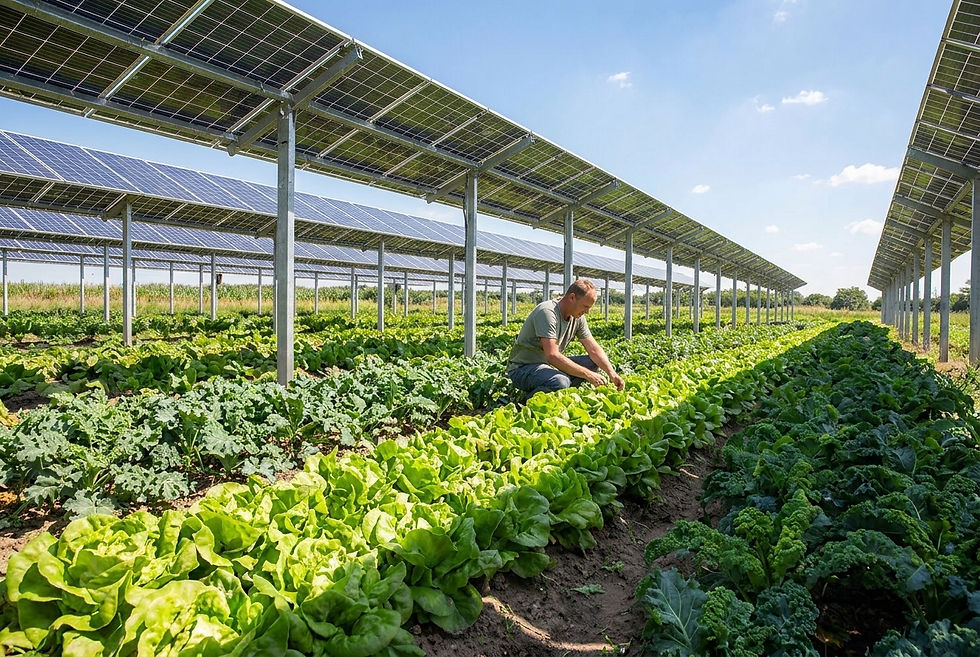
Sheep grazing beneath solar arrays has sufficient planning precedent in England and Wales that local planning authorities have established frameworks for assessment. Projects that demonstrate genuine concurrent agricultural use, maintain ground cover beneath the array, and commit to land reversibility at decommissioning have a strong planning track record.
Getting started with an agrivoltaic project
The starting point for any agrivoltaic project is a conversation about the site, the livestock operation, the grid connection, and the landowner's objectives. Reinforce Technology works with landowners, farmers, and developers at all stages of project development, from initial feasibility through to structural supply and installation support.
Contact the RT team to discuss your site and receive a tailored structural specification and indicative quotation.
How Agrivoltaic systems get funded
Several UK schemes support agrivoltaic and land management projects. These are public schemes, you apply directly, we are not a broker.
Capital Grants 2026
Capital items for environmental land management. Check eligibility for fencing and grazing infrastructure.
Sustainable Farming Incentive 2026
Ongoing payments for sustainable land practices, can align with grazing beneath panels.
Farming Innovation Programme
R and D grants for productivity and sustainability trials, best fit for testing a new system.