
5G Standalone Now Covers 83% of the UK. The Secondary Infrastructure of That Network Needs to Last 25 Years. Here Is Why FRP Is the Specification.
5G standalone networks now cover 83% of the UK population. Mobile data consumption exceeded 1.2 billion gigabytes per month in 2025, growing 18% year on year. 5G traffic grew 53% in a single year. The UK's telecommunications infrastructure is expanding at pace, and every mast, cabinet, and equipment enclosure in that expansion sits outdoors, in weather-exposed environments, for 20 to 25 years. The secondary infrastructure specification decisions being made on that rollout are the ones that determine whether the network performs for its full operational life. Here is where FRP fits.
Published by Reinforce Technology | 7 July 2026
The UK's 5G rollout is entering a new phase. Ofcom's Connected Nations 2025 report confirmed that 5G standalone networks cover 83% of the UK population from at least one operator, with combined 5G coverage reaching 94 to 97% on Ofcom's high-confidence measure (Ofcom, 2025). 5G traffic grew 53% year on year, reaching 348 petabytes per month, and mobile data consumption now exceeds 1.2 billion gigabytes monthly (Ofcom, 2025). The transition from 5G non-standalone, which piggybacks on 4G infrastructure for signalling, to 5G standalone, which runs on a dedicated 5G core, is the most significant infrastructure transformation in the UK mobile network since the original 4G rollout, and it requires new physical infrastructure across thousands of sites.
The economic case for completing that rollout is substantial. BT estimates that industrial use of AI and machine learning enabled by 5G standalone could generate more than £88 billion in economic value for the UK alone (RCR Wireless, 2025). The government's Mobile Market Review, launched in February 2026, cites a potential £230 billion in new economic opportunities unlocked by improved mobile networks (ISPreview, 2026). The 5G Innovation Regions programme has awarded over £46 million across 10 UK regions to test advanced 5G use cases in manufacturing, transport, agriculture, and healthcare (GOV.UK, 2026). The infrastructure being built to carry these applications will be operational into the 2040s and 2050s. The secondary materials used in that infrastructure will be expected to perform for the same period.
Telecommunications infrastructure is not a glamorous secondary specification environment. Mast bases, equipment cabinets, cable management runs, and access platforms at remote telecoms installations rarely attract the material science attention given to energy or water infrastructure of comparable scale. But they share the same fundamental challenge: outdoor exposure, electrical sensitivity, long operational lives, and minimal maintenance access. And they share the same solution: FRP secondary infrastructure that is non-conductive, radar and signal transparent, corrosion-immune, and maintenance-free across the full operational horizon of the network it supports.

Why Telecoms Infrastructure Creates Specific Secondary Material Demands
Telecommunications infrastructure operates in a set of environmental conditions that combine several specific secondary material demands simultaneously. Understanding each one is the starting point for specifying correctly.
The most specific and distinctive demand is radar and signal transparency. A mobile network mast or 5G small cell works by transmitting and receiving radio frequency signals. Secondary structural materials in close proximity to the antenna systems, including equipment cabinet enclosures, access platforms around mast structures, and cable management within or adjacent to antenna arrays, must not interfere with those signals. Steel is a conductor and a reflector. Metal secondary infrastructure in proximity to antenna systems can reflect, scatter, or attenuate the radio frequency signals that the installation is designed to transmit, degrading network performance in ways that may be difficult to diagnose and expensive to remediate after installation. FRP is radar transparent and signal transparent. It does not reflect, scatter, or attenuate radio frequency signals at any point in the spectrum used by mobile networks, from the 700 MHz spectrum used for rural 5G coverage to the 26 GHz millimetre wave bands used for high-capacity urban 5G standalone deployments (IntechOpen, 2022).
The second demand is non-conductivity. Mast and small cell installations include high-voltage power supply runs from the grid connection to the active radio equipment, plus the coaxial and fibre cables carrying data between the baseband unit and the remote radio heads at the antenna. This combination of power and data cables in close proximity to the transmission and reception systems of a mobile network creates an environment where earthing and bonding requirements for conductive cable management are both technically demanding and genuinely consequential for network interference management. FRP cable management is non-conductive throughout, eliminating earthing and bonding requirements and removing a potential source of electromagnetic interference from the cable management system itself (IntechOpen, 2022).
The third demand is outdoor exposure across a 20 to 25-year operational life. Mobile masts and small cell installations are predominantly outdoor assets, exposed to the full range of UK weather conditions, including the coastal and upland environments where network coverage extension is most needed and where corrosion of galvanised steel secondary components is most aggressive. The Shared Rural Network, the £1 billion joint programme between the four operators and the UK government, is specifically extending coverage to rural and remote areas where weather exposure is most severe and maintenance access is most difficult (GOV.UK, 2025). FRP secondary infrastructure at rural telecoms sites provides corrosion-immune, maintenance-free performance across 20 to 25-year operational lives in precisely the environments where galvanised steel accumulates its fastest maintenance liabilities.
Where FRP Is Specified in Telecommunications Infrastructure
1. Mast Base Structures and Equipment Cabinet Enclosures
The ground-level infrastructure at a mobile mast installation includes the equipment cabinets housing the baseband units, power systems, and battery backup that keep the mast operational during grid outages, plus the cable management routing power and fibre from the grid connection and backhaul network to the cabinet and up the mast structure to the antenna. This ground-level infrastructure sits in the most weather-exposed part of the installation, in direct contact with the soil, precipitation, and atmospheric conditions of the site, across the full operational life of the network asset.
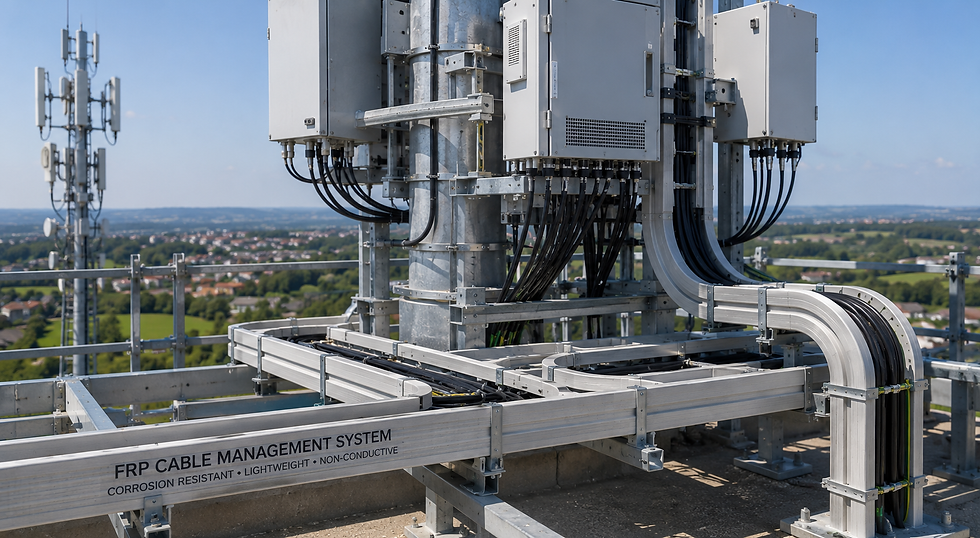
FRP cable management at mast base level provides radar and signal transparent, non-conductive cable routing that does not interfere with the transmit and receive performance of the antenna systems above, is corrosion-immune in the outdoor ground-level environment of both urban and rural mast installations, and requires no maintenance recoating or structural assessment across the 20 to 25-year design life of the installation. FRP structural profiles for equipment cabinet base frames provide corrosion-resistant, non-conductive support for the cabinet assemblies that house the active network equipment, without the earthing and bonding requirements that metal cabinet frames demand in proximity to the high-voltage power systems within.
2. Small Cell and Urban 5G Infrastructure
The transition to 5G standalone requires a densification of the network with small cells, low-power base stations deployed on street furniture, building facades, and dedicated small cell poles at much higher density than traditional macrocell masts. A 5G standalone network capable of delivering the ultra-low latency and high throughput of full 5G requires small cells spaced at intervals of 100 to 300 metres in urban environments, creating a massive new category of low-profile outdoor infrastructure installations across UK towns and cities.
Small cell installations in urban environments face specific secondary material challenges. They are mounted on street furniture, building facades, and purpose-built poles where aesthetic requirements and planning consent conditions constrain the visibility and physical profile of the installation. They are in proximity to pedestrians, vehicles, and the electromagnetic environment of busy urban streets. FRP structural profiles and cable management for small cell installations provide non-conductive, corrosion-immune, radar-transparent secondary infrastructure that can be specified in the colours and finishes required for urban planning consent while avoiding the electromagnetic interference that metal secondary components could introduce into a dense urban 5G network.
3. Remote and Rural Network Infrastructure
The Shared Rural Network programme is building new masts in some of the most remote and weather-exposed locations in the UK, extending 4G and 5G coverage to areas of Scotland, Wales, Northern Ireland, and rural England where conventional network economics have historically made deployment commercially unviable. These installations are in upland, coastal, and agricultural environments where maintenance access is operationally expensive, where weather exposure is most severe, and where the corrosion of galvanised steel secondary components proceeds at the fastest rate encountered in any UK telecoms environment.
FRP cable management and structural profiles at remote rural mast installations provide the longest-interval maintenance-free performance available for outdoor telecoms secondary infrastructure, in precisely the environments where maintenance access costs are highest. A remote rural mast installation that requires a maintenance contractor to travel significant distances to recoat corroding cable management at year 10 is an operational cost that the Shared Rural Network's financial model did not include. FRP secondary infrastructure at the same installation generates no such visit, across the full 20 to 25-year operational life of the network asset.
4. Rooftop and Building-Mounted Antenna Infrastructure
Urban 5G densification increasingly uses rooftop and building-mounted antenna installations, where access is constrained by building operations, tenant agreements, and the logistics of rooftop working. Secondary cable management and structural support for building-mounted 5G antenna systems operates in the combined outdoor and urban pollution environment of a city rooftop, often in proximity to air handling units, cooling systems, and other building services infrastructure. FRP cable management on rooftop telecoms installations is radar transparent, non-conductive, corrosion-immune in the urban atmospheric pollution environment, and requires no maintenance access across the operational life of the antenna installation, avoiding the tenant disruption and building access costs that maintenance interventions on occupied buildings generate.
The Non-Magnetic Advantage in Telecoms Environments
FRP is non-magnetic as well as non-conductive. This property, distinct from radar transparency but related to it, is relevant in telecoms infrastructure where precision RF measurement and calibration equipment is used during installation and maintenance of antenna systems. Steel and other ferromagnetic materials near antenna systems can affect the performance of RF measurement equipment and complicate the precision calibration that 5G standalone antenna installations require for optimal beam forming and network performance.
FRP structural and cable management infrastructure near antenna systems does not interact with the magnetic field environment of RF calibration equipment. Antenna systems installed on FRP secondary structural supports can be calibrated and measured more accurately than equivalent systems on steel frameworks, simplifying the commissioning process and reducing the risk of calibration errors that affect network performance across the operational life of the installation.
The Lifecycle Cost Position for Telecoms Secondary Infrastructure
Mobile network operators are asset managers at scale. EE and Three jointly manage approximately 14,500 shared mast sites across the UK. Vodafone and O2 jointly manage around 14,200 shared sites. Each of those sites has secondary infrastructure, cable management, equipment cabinet supports, and mast base structural elements, that is expected to perform for 20 to 25 years with minimal maintenance intervention in outdoor environments (Connection Technologies, 2026). At the scale of 28,000 shared mast sites across the four operators, the aggregate maintenance cost of secondary steel infrastructure that requires recoating at year 10 and structural assessment at year 15 is a very large number that does not appear in the original capital cost of the network rollout.
FRP secondary infrastructure at those sites generates no such maintenance events across its operational life. The peer-reviewed lifecycle cost evidence finding approximately 50% cost savings for GFRP versus steel over long study periods reflects the same fundamental dynamic as telecoms infrastructure: the higher purchase price of FRP is offset by the elimination of maintenance costs that steel accumulates across decades of outdoor exposure in demanding environments (Younis, Ebead and Judd, 2018). At the scale of a national 5G rollout, that offset is a substantial number, and it is a number that mobile network operators managing large site portfolios are well positioned to recognise and act on.
5G standalone is the infrastructure the UK's digital economy depends on for the next two decades. The secondary materials used in its deployment, the cable management, the equipment cabinet supports, the structural frames at rural mast bases, the rooftop cable management runs in urban densification, are the materials that determine whether that infrastructure delivers across its full operational life with minimal intervention. FRP is the specification that meets all of the specific demands of the telecoms environment simultaneously: radar transparent, non-conductive, non-magnetic, corrosion-immune, and maintenance-free across 20 to 25 years in outdoor UK conditions.
Reinforce Technology FRP Products for Telecommunications Infrastructure
Reinforce Technology supplies FRP cable trays, structural profiles, grating, and perimeter fencing for telecommunications infrastructure applications across the UK, including 5G mast installations, small cell deployments, Shared Rural Network sites, and rooftop antenna infrastructure. Available in polyester and vinyl ester resin systems, radar transparent and non-conductive throughout. Contact us to discuss your telecoms project and the correct FRP specification for your specific network infrastructure application.
Final confirmation of suitability for any specific telecommunications application, including RF transparency verification for specific frequency bands, remains the responsibility of the appointed project engineer. Reinforce Technology provides technical guidance and material recommendations based on information supplied to us, but specification sign-off should always sit with the qualified professional responsible for the design.
References
Connection Technologies (2026) UK Mobile Network Deployment 2026: Coverage and Impact. Available at: https://connection-technologies.co.uk/blog/uk-mobile-network-deployment [Accessed: 7 July 2026]. [EE and Three MBNL: 14,500 shared sites; Vodafone and O2 CTIL: 14,200 shared sites; 5G available in over 100 towns and cities for EE].
GOV.UK (2025) Shared Rural Network. Available at: https://www.gov.uk [Accessed: 7 July 2026]. [£1 billion joint programme between four operators and government; 95% 4G geographic coverage target].
GOV.UK (2026) Digital and Technologies Sector Plan: Year One Update. Available at: https://www.gov.uk/government/publications/digital-and-technologies-sector-plan-year-one-update [Accessed: 7 July 2026]. [£46 million awarded across 10 5G Innovation Regions; 5G applications in manufacturing, transport, agriculture and healthcare].
IntechOpen (2022) 'Fibre-Reinforced Polymer (FRP) in Civil Engineering', in IntechOpen Engineering Series. Available at: https://www.intechopen.com/chapters/84203 [Accessed: 7 July 2026]. [Non-conductive, non-magnetic, and radar transparent properties of GFRP; no interference with electromagnetic signals].
ISPreview (2026) Government Launch Review of UK Mobile Network Market to Help Boost 5G. Available at: https://www.ispreview.co.uk [Accessed: 7 July 2026]. [Mobile Market Review launched February 2026; £230 billion economic opportunity from improved mobile networks].
NACE International (2016) International Measures of Prevention, Application and Economics of Corrosion Technology (IMPACT). Houston, TX: NACE International. Available at: http://impact.nace.org/economic-impact.aspx [Accessed: 7 July 2026].
Ofcom (2025) Connected Nations UK Report 2025. Available at: https://www.ofcom.org.uk [Accessed: 7 July 2026]. [5G standalone coverage 83% of UK population; 5G traffic grew 53% year on year to 348 PB/month; mobile data consumption 1.2 billion GB/month, up 18% year on year].
RCR Wireless (2025) Ofcom: 5G Accounts for 28% of UK Connections. Available at: https://www.rcrwireless.com [Accessed: 7 July 2026]. [BT estimate: £88 billion economic value from AI and ML enabled by 5G standalone].
Younis, A., Ebead, U. and Judd, S. (2018) 'Life cycle cost analysis of structural concrete using seawater, recycled concrete aggregate, and GFRP reinforcement', Construction and Building Materials, 175, pp. 135-144. doi: 10.1016/j.conbuildmat.2018.04.183.


Comments