
Strawberries Under Solar Panels Produce Up to 24% More Class 1 Fruit. Here Is Why Soft Fruit Agrivoltaics Is One of the Strongest Cases in UK Farming.
Strawberries under agrivoltaic panels produce 7 to 24% more class 1 fruits. Raspberries show improved berry quality, higher antioxidant content, and reduced heat stress in summer. Blueberries benefit from the cooler, more humid microclimate that panel shade creates. UK research is confirming what European trials have demonstrated for years: soft fruit and solar panels are among the most agronomically compatible combinations in agrivoltaics. And FRP mounting infrastructure is the specification that keeps the soil beneath them clean across 30 years of production.
Published by Reinforce Technology | July 2026
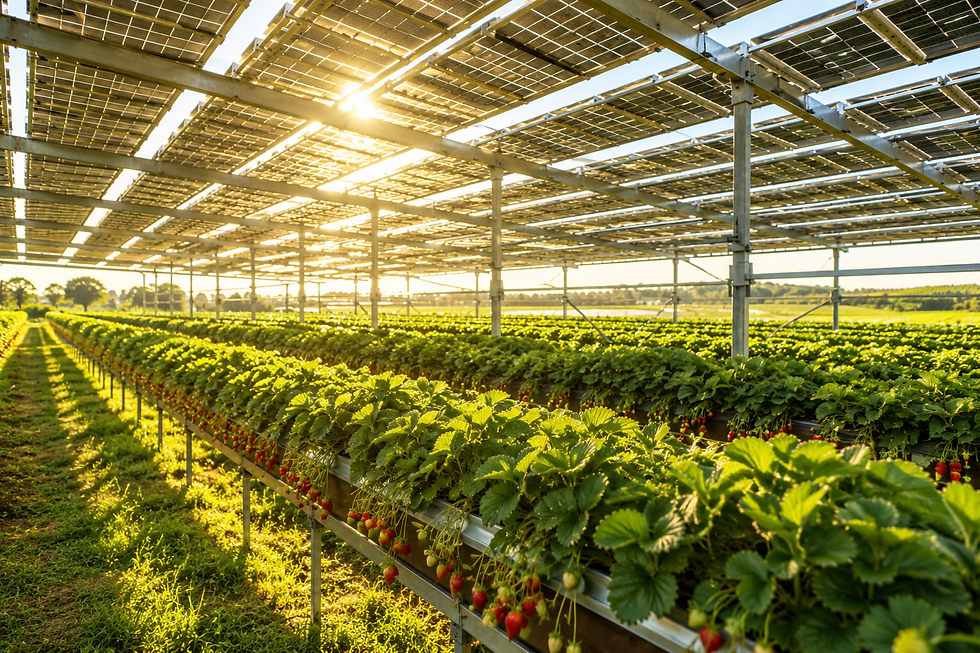
Soft fruit is the highest-value crop category where agrivoltaic production has the strongest evidential base. A trial using Voltiris agrivoltaic panels above strawberry production found that strawberries produced between 7 and 24% more class 1 fruits across two varieties, with an average 4% higher yield across all classes. A peak plant temperature difference of 5°C was recorded between the agrivoltaic strawberries and the control, reducing the heat stress that causes sunscald damage, shortened shelf life, and yield losses in hot summer conditions (Growsave, 2025). Independent research published in June 2025 found that strawberries under partial shading showed higher yields per plant, greater soluble solids content, and larger maximum fruit weights compared to unshaded controls (ScienceDirect, 2025).
For raspberries, a peer-reviewed study published in Frontiers in Horticulture in February 2026 examined how different agrivoltaic panel layout types affect raspberry microclimate in summer, finding that panel shade significantly reduces the vapour pressure deficit that causes moisture stress during heat events — the physiological mechanism behind fruit shrinkage and yield loss in hot summers (Frontiers, 2026). Dutch research by GroenLeven in collaboration with Wageningen University found that agrivoltaic systems above raspberries, currants, and strawberries each require different panel configurations optimised for the specific light transmission, temperature, and humidity requirements of each variety, and that well-configured agrivoltaic systems could support both energy generation and maintained or improved soft fruit production simultaneously (EastFruit, 2023).
In the UK, the University of Greenwich has been conducting government-funded research on retrofitting agrivoltaic installations to existing greenhouses and polytunnels for strawberry cultivation. Transparent solar panels have been fitted to berry greenhouses in Kent as part of a research programme (Atlantic Renewables, 2025). UKRI's Farming Innovation Programme funded the Electric Berry project, running from June 2023 to May 2025, which demonstrated solar PV systems retrofitted to soft fruit polytunnels, with plans to extend beyond strawberries into raspberries and other soft fruit (UKRI, 2025). The UK research pipeline for soft fruit agrivoltaics is active and growing, and the commercial case — rooted in both the yield evidence and the energy cost savings for energy-intensive protected horticulture — is becoming progressively stronger.
Why Soft Fruit and Solar Panels Are a Natural Combination
The agronomic case for soft fruit agrivoltaics is rooted in the specific growing requirements of the crop category and how solar panels modify the microclimate above and around them. Strawberries, raspberries, and blueberries share a set of physiological characteristics that make partial shading from solar panels beneficial rather than detrimental under UK summer conditions.
All three crops are vulnerable to heat stress when temperatures exceed their optimal growing range. Strawberries experience sunscald damage, reduced fruit size, and shortened shelf life when exposed to prolonged direct radiation in hot weather. Raspberries show fruit shrinkage, colour development problems, and reduced soluble solid content in hot, dry conditions. Blueberries are sensitive to high soil temperatures and water stress that reduce fruit set and berry size. The UK's increasingly hot summers, with 2025 the warmest and sunniest year on record and 2026 delivering a June Red warning heatwave, are making heat stress management in soft fruit growing progressively more important and more commercially significant (Met Office, 2026).
Solar panels above the crop intercept a proportion of incoming solar radiation, reducing the direct radiation load on the fruit and canopy below. This is precisely the shading mechanism that reduces heat stress, lowers peak plant temperature, and creates the cooler, more humid microclimate that soft fruit crops benefit from in hot summer conditions. The partial shade that a solar panel provides is not the same as the deep shade of a tree canopy: it is a light modulation that reduces the intensity of direct radiation while maintaining sufficient diffuse light for photosynthesis and fruit development. Getting the panel configuration, height, and spacing right for each soft fruit variety is the design challenge that the current UK and European research programmes are addressing.
The water management dimension compounds the yield benefit. Agrivoltaic panels reduce soil evapotranspiration by up to 30%, retaining soil moisture beneath the array that would otherwise be lost to direct solar radiation (GreenMatch, 2025). For soft fruit crops whose yield and quality are highly sensitive to water stress, this moisture retention reduces irrigation demand, cuts the energy cost of irrigation pumping, and provides a buffer against the dry summer conditions that are becoming more frequent in the UK's key soft fruit producing regions across East Anglia and the South East.

Why FRP Mounting Infrastructure Is Critical for Soft Fruit Agrivoltaics
Soft fruit agrivoltaics has a specific FRP requirement that differs from other agrivoltaic applications in one important dimension: the soil and root zone sensitivity of the crops involved is extremely high. Strawberries, raspberries, and blueberries are all sensitive to soil chemistry changes that would not significantly affect a grass sward or a root vegetable crop. The metallic contamination that galvanised steel mounting frames introduce into the soil — zinc from coating depletion, iron oxide from corrosion as the coating fails — accumulates in the root zone of crops that are directly sensitive to elevated zinc and heavy metal concentrations in the soil.
For organic certified soft fruit production, this contamination risk is a direct certification threat. Soil Association certification for soft fruit requires demonstrable soil health management and the absence of prohibited inputs. A certifier finding elevated zinc in soil samples from the root zone of an organic strawberry or raspberry crop, attributable to corroding mounting frames, is looking at a potential certification failure that no amount of good farming practice can offset, because the source of the contamination is structural infrastructure that cannot be quickly removed or remediated.
FRP mounting frames produce no zinc, no iron oxide, and no metallic contamination of any kind at any point across a 30-year operational life. The soil beneath FRP mounting frames in a soft fruit agrivoltaic system is chemically unaffected by the infrastructure above it from installation day to year thirty. For soft fruit producers whose premium is built on organic certification, traceability, or simply the quality of fruit grown in clean soil, FRP is not the premium specification option. It is the only specification option that does not put that quality case at risk (IntechOpen, 2022).
The non-conductivity of FRP is relevant in soft fruit agrivoltaic systems for the same reason it is relevant in other agrivoltaic applications: irrigation systems operating in proximity to solar DC cable management create a specific electrical risk that non-conductive mounting infrastructure eliminates. Strawberry and raspberry production under agrivoltaic arrays relies on the same drip and overhead irrigation systems used in conventional protected horticulture, operating in close physical proximity to the DC cables from the solar array. FRP cable management and mounting frames are non-conductive and eliminate the accidental current path risk that metallic infrastructure in the same configuration would create.
The Dual Income Model for UK Soft Fruit Agrivoltaics
The financial case for soft fruit agrivoltaics in the UK combines two high-value income streams from the same land. Soft fruit commands the highest retail premiums of any UK fresh produce category, with organic strawberries, raspberries, and blueberries retailing at substantial premiums over conventional equivalents. The energy income from an agrivoltaic solar installation on the same land generates a predictable, long-term electricity revenue that is independent of soft fruit commodity price fluctuations. And the on-farm energy consumption of protected horticulture — polytunnel heating, irrigation pumping, packing and refrigeration — is directly offset by the solar generation, cutting the energy costs that have made UK protected horticulture increasingly difficult to operate profitably as energy prices have risen.
The combination creates a financially resilient farming model. In years when soft fruit prices are strong, both income streams are positive. In years when soft fruit prices are pressured by imports or weather-related oversupply, the energy income provides a floor that conventional soft fruit farming lacks. The agrivoltaic installation is financed against a 25 to 30-year energy income that exists regardless of what the soft fruit market does in any individual season.
FRP mounting infrastructure contributes to that financial model by eliminating the maintenance costs that galvanised steel would otherwise introduce across the 30-year operational horizon. A mounting frame that requires recoating at year 10, structural assessment at year 15, and partial replacement at year 20 adds unplanned capital expenditure to a financial model built on predictable, low-cost operation across three decades. FRP mounting frames add nothing after the installation is complete, allowing the dual income model to deliver its full financial return across its full designed life (Younis, Ebead and Judd, 2018).
Reinforce Technology FRP Products for Soft Fruit Agrivoltaic Installations
Reinforce Technology supplies FRP pultruded structural profiles and cable management systems for agrivoltaic installations across the UK, including sites incorporating soft fruit production under and around the solar array. Our profiles are independently tested by SGS and TÜV Rheinland, available in polyester and vinyl ester resin systems with UV-stable formulations for the full 30-year operational life of the installation. No soil contamination, no corrosion products, no maintenance access required across 30 years of premium soft fruit production beneath the panels.
Contact us to discuss your soft fruit agrivoltaic project and the correct FRP specification for your crop, soil, and certification requirements.
Final confirmation of structural suitability for any specific agrivoltaic application remains the responsibility of the appointed project engineer. Confirmation of compatibility with specific organic certification requirements should be verified with the relevant certification body. Reinforce Technology provides material guidance based on information supplied to us and is happy to provide full technical data sheets and application-specific support to assist with that process.
References
Atlantic Renewables (2025) How Agrivoltaics is Revolutionising UK Farming: The Solar-Powered Agricultural Renaissance. Available at: https://www.atlanticrenewables.co.uk [Accessed: July 2026]. [University of Greenwich government-funded research on agrivoltaic polytunnel retrofitting; transparent panels fitted to Kent berry greenhouses].
EastFruit (2023) Agrovoltaics on Raspberries, Blackberries, Currants and Asparagus in the Netherlands. Available at: https://east-fruit.com [Accessed: July 2026]. [GroenLeven commercial agrivoltaic raspberry, currant, and strawberry production; Wageningen University research on variety-specific panel configurations].
Frontiers in Horticulture (2026) 'Agrivoltaic layout types drive changes in raspberry summer microclimate', Frontiers in Horticulture. doi: 10.3389/fhort.2026.1716398. Available at: https://www.frontiersin.org/journals/horticulture/articles/10.3389/fhort.2026.1716398/abstract [Accessed: July 2026]. [Peer-reviewed; panel layout types affect raspberry microclimate; VPD reduction reduces moisture stress in hot conditions; February 2026 publication].
GreenMatch (2025) Agrovoltaics: Solar Energy for Sustainable Farming. Available at: https://www.greenmatch.co.uk/blog/agrovoltaics-solar-energy-for-sustainable-farming [Accessed: July 2026]. [30% reduction in soil water evaporation under agrivoltaic panels].
Growsave (2025) Two Approaches to Agrivoltaics. Available at: https://www.growsave.co.uk/blog/two-approaches-to-agrivoltaics/ [Accessed: July 2026]. [Voltiris agrivoltaic trial: 7 to 24% more class 1 strawberry fruits; 4% higher overall yield; 5°C peak plant temperature reduction].
IntechOpen (2022) 'Fibre-Reinforced Polymer (FRP) in Civil Engineering', in IntechOpen Engineering Series. Available at: https://www.intechopen.com/chapters/84203 [Accessed: July 2026]. [Non-conductive and non-corroding properties; no chemical contamination at ground contact].
Met Office (2026) 2025 is Double-Record Breaker: UK's Warmest and Sunniest Year on Record. Available at: https://www.metoffice.gov.uk [Accessed: July 2026].
ScienceDirect (2025) 'Current trends and challenges of agrivoltaic systems towards sustainable production of temperate fruit crops', ScienceDirect. doi: 10.1016/S0304-4238(25)00259-6 [Accessed: July 2026]. [Strawberries under PV shading: higher yield per plant, greater soluble solids, larger maximum fruit weight; raspberries: increased anthocyanin and phenol content under shading; published June 2025].
UKRI (2025) Electric Berry — Farming Innovation Programme. Available at: https://farminginnovation.ukri.org/case-studies/electric-berry/ [Accessed: July 2026]. [UKRI-funded agrivoltaic polytunnel strawberry demonstration project June 2023 to May 2025; planned extension to raspberries and other soft fruit].
Younis, A., Ebead, U. and Judd, S. (2018) 'Life cycle cost analysis of structural concrete using seawater, recycled concrete aggregate, and GFRP reinforcement', Construction and Building Materials, 175, pp. 135-144. doi: 10.1016/j.conbuildmat.2018.04.183.


Comments