
UK Planning Reform Cuts 12 Months From Infrastructure Approvals. The Specification Decisions That Determine 30-Year Performance Are Being Made Right Now.
On 3 July 2026, the government confirmed that mandatory pre-application consultation requirements for Nationally Significant Infrastructure Projects will be scrapped from 24 July. Up to 12 months cut from the planning process. Up to £1 billion saved this Parliament. The UK's infrastructure pipeline is about to move faster than it has in a generation. The question that the planning reform does not answer is whether the projects entering construction will be specified correctly for the 30 years that follow. That is where FRP comes in.
Published by Reinforce Technology | 5 July 2026
The Planning and Infrastructure Act 2025 has delivered its most significant practical reform. From 24 July 2026, Nationally Significant Infrastructure Projects — wind farms, solar installations, nuclear plants, water reservoirs, data centres, new roads, and airport expansions — will no longer face mandatory statutory pre-application consultation requirements. The government confirmed the change on 3 July, stating it will cut up to 12 months from planning approval timelines and potentially save industry £1 billion this Parliament (GOV.UK, 2026). As of 3 July, 41 NSIP projects have already been determined — 95% more than at the same point in the previous Parliament (GOV.UK, 2026).
Energy minister Michael Shanks was direct about the purpose: "Britain cannot afford to wait years for the clean energy infrastructure needed to strengthen our energy security and grow the economy. Every turbine, every solar panel, every cable we connect helps protect families from volatile fossil fuel markets and paves the way for a new era of clean energy for our country" (New Civil Engineer, 2026). Housing secretary Steve Reed framed it as national ambition: "This government is determined to make the UK a world leader in building infrastructure" (GOV.UK, 2026).
Onshore wind projects seeking permission through the Town and Country Planning Act are also being freed from mandatory pre-application consultation requirements for the first time since 2015 (GOV.UK, 2026). Data centres can now opt in to the NSIP regime for the first time, with three data centre proposals already directed into the regime at Wapseys Wood in Buckinghamshire, Ampthill Road in Bedford, and New Barn Lane in Dartford (Construction Digital, 2026). The pipeline is expanding. The process is accelerating. And the specification decisions being made on every project entering construction under the reformed system are the decisions that will define those assets' performance for the next 30 years.
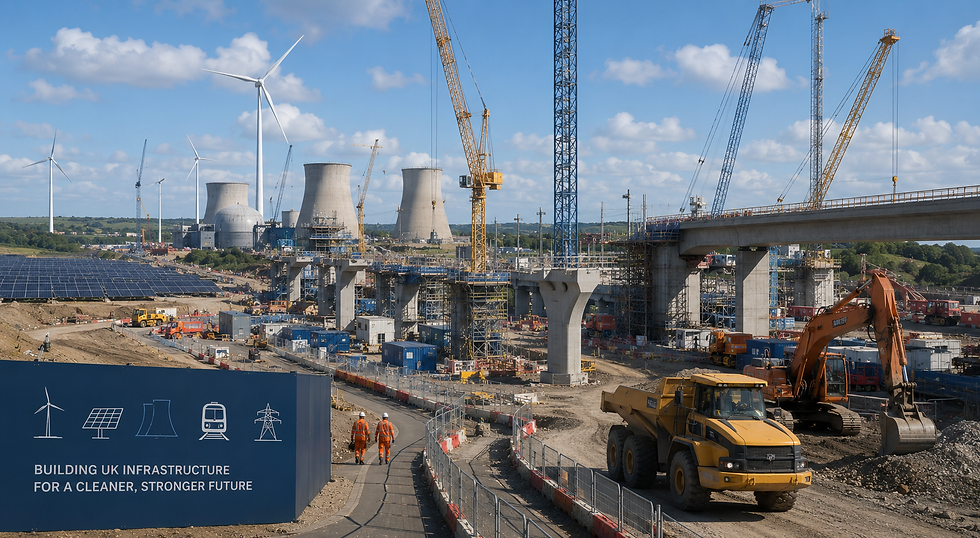
Planning reform does not change what infrastructure assets need from their secondary materials. It changes how quickly those assets enter the construction phase where secondary material decisions are made. A solar farm that took two years longer to get through planning still needs mounting frames, cable management, grating, and fencing that perform for 30 years in a demanding outdoor or coastal environment. A data centre that moved through the NSIP regime in months rather than years still needs cable management that is non-conductive, lightweight, and maintenance-free for the full 25-year operational life of the facility. Planning speed is a planning achievement. Specification quality is a different achievement, and it belongs to the engineers, procurement teams, and asset owners who make the decisions that planning reform has just accelerated toward.
What Planning Reform Accelerates — and What It Does Not Change
The Planning and Infrastructure Act reforms address a specific and well-documented problem: the UK's planning system had become one of the most time-consuming and costly in the developed world for major infrastructure. Delays to large projects were costing an average of £1.5 million a month even at the early planning stages (GOV.UK, 2026). The pre-application consultation requirement, intended to ensure community and stakeholder engagement before applications were submitted, had in practice become a lengthy and expensive process that added time and cost without consistently improving the quality of applications or outcomes. Scrapping the mandatory requirement while replacing it with earlier, structured technical support from the Planning Inspectorate addresses the delay without eliminating meaningful engagement.
What planning reform does not change is any of the physical and operational requirements that determine whether a clean energy or infrastructure asset performs across its designed service life. A wind farm consented in 18 months rather than 30 months still operates in the same coastal or upland environment. A solar farm that enters construction six months earlier still needs cable management that is corrosion-immune in the agricultural or coastal exposure of its site and non-conductive in its high-voltage DC cable environment. A data centre that moved through the NSIP regime in a streamlined process still needs lightweight, non-conductive, maintenance-free secondary cable management across the dense overhead installations of a hyperscale AI facility. Planning speed is a procurement benefit. It is not a specification benefit. The two are entirely separate achievements, and only one of them determines 30-year performance.
The Projects Entering Construction Under the Reformed System
The NSIP categories that will benefit most directly from the 24 July reform are the categories where FRP secondary infrastructure is most relevant: renewable electricity generators (solar farms, wind farms, offshore wind), nuclear power plants, water reservoirs and water infrastructure, and now data centres. Each of these project categories has a distinct secondary infrastructure demand and a distinct reason why FRP outperforms steel alternatives in the environments they occupy.
Solar Farms and Wind Farms
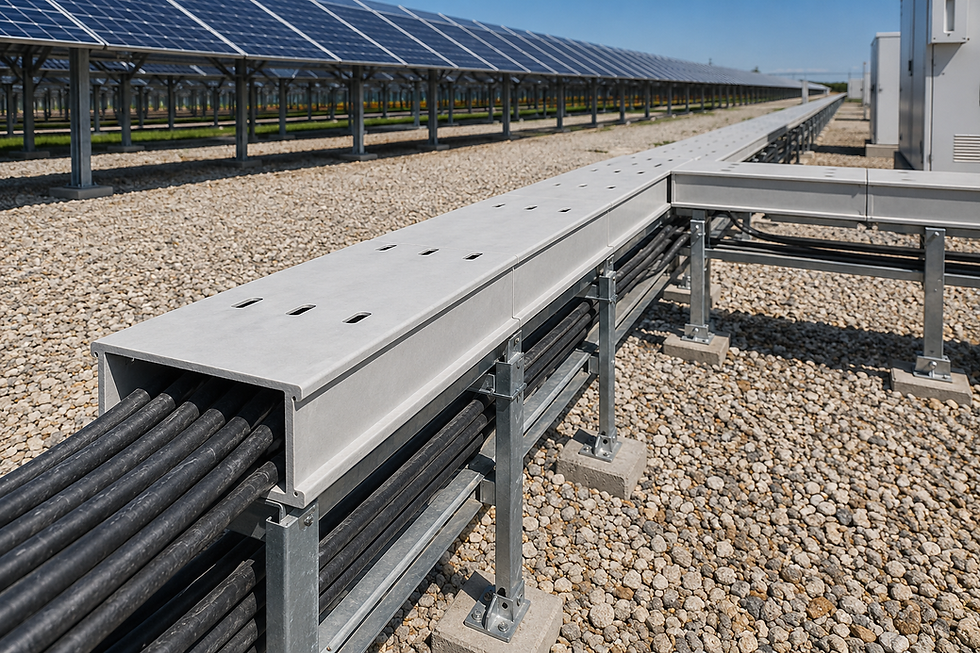
Ground-mount solar and onshore wind projects are the largest category of NSIP applications by volume and the primary beneficiaries of both the pre-application consultation removal and the freeing of onshore wind from mandatory consultation for the first time since 2015. UK ground-mount solar grew 90% in 2025, and the 713 projects that received NESO grid connection offers on 10 June 2026 are now advancing toward construction under a planning system that has simultaneously become faster. The secondary infrastructure of each of those projects — cable trays routing DC power from panels to inverters, mounting frames, walkways, and perimeter fencing — is being specified now, under construction programmes that the planning reform is compressing further.
FRP cable trays and mounting profiles for solar farms are non-conductive in the high-voltage DC environment, corrosion-immune in the outdoor and coastal environments of the UK solar pipeline, and maintenance-free across the 30-year operational horizon that every project's financial model depends on. The specification decision that determines whether those assets deliver across their designed life is being made at the same pace as planning decisions are now being accelerated to. Faster planning makes correct secondary specification more urgent, not less — because the consequence of getting it wrong at construction stage compounds across every year of the operational life that follows.
Nuclear Infrastructure
Sizewell C, which received final investment decision in July 2025 and reached financial close in November 2025, is already in active construction — involving massive earthworks and sea defence installations on the Suffolk coast (Blackridge Research, 2026). Hinkley Point C is currently Europe's largest construction site. The nuclear environment is among the most demanding for secondary structural materials: non-sparking and non-magnetic properties matter in proximity to radiation survey equipment and safety instrumentation, chemical resistance to the cooling water and process environments of nuclear plant operations is essential, and the 60-year operational design life of a nuclear power station means that secondary materials that require maintenance or replacement before that horizon generate access events in a radiologically controlled environment where every access event is regulated, logged, and expensive.
FRP structural profiles and grating in nuclear environments provide non-magnetic, non-conductive, corrosion-resistant secondary structural infrastructure across design lives that match the operational horizon of the facilities they serve, without the corrosion maintenance events that steel generates in the cooling water and outdoor coastal environments of UK nuclear sites.
Water Infrastructure
Water reservoirs and treatment works are specifically named in the NSIP category that the 24 July reform addresses. The £104 billion Ofwat investment programme is the largest water capital programme in UK history, and water infrastructure entering the NSIP regime benefits directly from planning timelines now cut by up to 12 months. Water treatment environments are among the most corrosive in civil infrastructure, with chlorine dosing, hydrogen sulphide, and persistent humidity creating conditions that secondary galvanised steel infrastructure cannot reliably match across 50 year operational design lives. FRP grating, cable trays, and structural profiles in water treatment environments provide maintenance free secondary infrastructure across 50 year design lives in the precise chemical environments where steel accumulates its fastest maintenance liabilities.
Data Centres
The government's decision to allow data centres to opt in to the NSIP regime is a specific and significant planning policy development. Three data centres are already in the NSIP process. The UK data centre market is forecast to grow at 22% annually through 2031, with over £47 billion of investment announced since 2023. Data centre cable management, in dense overhead installations where FRP's lightweight advantage reduces structural loading, non conductivity eliminates earthing and bonding in high voltage environments, and maintenance free performance is essential in a facility that operates continuously, is precisely the application where the FRP specification case is clearest and the planning reform's acceleration of construction timelines creates the most immediate specification decision pressure.
Faster Planning, Better Specification — Why Both Matter
The Civil Engineering Contractors Association's response to the planning reform captured the supply chain's position precisely: "Faster planning must not undermine community engagement or project development. The key test will be whether these reforms provide greater certainty while still allowing for early and meaningful dialogue with communities, local government, statutory consultees, and the supply chain" (New Civil Engineer, 2026). The supply chain dimension is the one that directly involves secondary material specification — because the supply chain decisions made during the pre-application and early construction phases determine what goes into the asset, and what goes into the asset determines what it costs to operate across its designed life.
A construction programme that is now 12 months shorter has a procurement schedule that is correspondingly compressed. Secondary infrastructure specification decisions that previously had time to be revisited and benchmarked against whole-life cost data now need to be made earlier, with greater certainty, at a point in the programme where changing specifications is more difficult and expensive. The CECA's concern about meaningful supply chain dialogue in a faster system is a specification quality concern as much as a community engagement concern. Getting secondary infrastructure specification right the first time, on a faster programme, is the challenge that the planning reform creates for every project team working under the reformed NSIP regime.
FRP secondary infrastructure specification is the decision that protects the investment that planning reform is designed to accelerate. Faster planning gets assets into the ground sooner. Correct specification ensures those assets perform for the full 30 to 50-year operational horizon that the planning approval has just made possible. Planning reform and FRP specification are both part of the same answer: building UK infrastructure faster and better, for the families whose energy bills and water quality and economic opportunities depend on both.
Reinforce Technology and the UK Infrastructure Pipeline
Reinforce Technology supplies FRP cable trays, structural profiles, grating, solar frames, perimeter fencing, and drainage systems for the full range of NSIP-category infrastructure across the UK — solar farms, wind farms, nuclear facilities, water treatment works, and data centres. All products manufactured in certified facilities under a full quality management system, with complete material traceability documentation for project QA and regulatory submissions, and embodied carbon data available to support compliance with the UK Net Zero Carbon Buildings Standard.
Contact us to discuss your project and the correct FRP specification for the specific secondary infrastructure demands of your application, environment, and operational horizon.
Final confirmation of suitability for any specific application remains the responsibility of the appointed project engineer. Reinforce Technology provides technical guidance and material recommendations based on information supplied to us, but specification sign-off should always sit with the qualified professional responsible for the design.
References
Blackridge Research (2026) Top 10 Construction Projects in the UK (2026). Available at: https://www.blackridgeresearch.com/blog/latest-list-new-upcoming-mega-infrastructure-construction-projects-uk-united-kingdom [Accessed: 5 July 2026]. [Sizewell C £38bn; final investment decision July 2025; financial close November 2025; active construction with earthworks and sea defence installations].
Construction Digital (2026) UK Gov: Overhauls Planning Rules to Speed Infrastructure. Available at: https://constructiondigital.com/articles/uk-gov-overhauls-planning-rules-to-speed-infrastructure [Accessed: 5 July 2026]. [Data centres can now opt in to NSIP regime; three directed in at Wapseys Wood, Bedford, and Dartford].
GOV.UK (2026) Fastest Infrastructure Building in a Generation as Planning Rules Overhauled. Available at: https://www.gov.uk/government/news/fastest-infrastructure-building-in-a-generation-as-planning-rules-overhauled [Accessed: 5 July 2026]. [Mandatory pre-application consultation scrapped from 24 July; up to 12 months cut; £1bn saving this Parliament; 41 NSIPs determined, 95% more than same point last Parliament; 82,000 jobs from major projects; 150+ decisions targeted].
IntechOpen (2022) 'Fibre-Reinforced Polymer (FRP) in Civil Engineering', in IntechOpen Engineering Series. Available at: https://www.intechopen.com/chapters/84203 [Accessed: 5 July 2026].
NACE International (2016) International Measures of Prevention, Application and Economics of Corrosion Technology (IMPACT). Houston, TX: NACE International. Available at: http://impact.nace.org/economic-impact.aspx [Accessed: 5 July 2026].
New Civil Engineer (2026) Government Scrapping Mandatory Pre-Application Consultation Requirements for NSIPs. Available at: https://www.newcivilengineer.com/latest/government-scrapping-mandatory-pre-application-consultation-requirements-for-nsips-03-07-2026/ [Accessed: 5 July 2026].
[Confirmed 3 July 2026, effect from 24 July; Michael Shanks quote; CECA quote on supply chain dialogue; East West Rail first to benefit from restructured process].
ScienceDirect (2025) 'Sustainable composites for metal replacement: Environmental assessment and material selection of fiber-reinforced polymer across industries', ScienceDirect, doi: 10.1016/S2667-3789(25)00051-3. Available at: https://www.sciencedirect.com/science/article/pii/S2667378925000513 [Accessed: 5 July 2026]. [Pultruded GFRP manufacturing emissions approximately 60 to 70% lower per tonne than primary steel, cradle-to-gate].
Younis, A., Ebead, U. and Judd, S. (2018) 'Life cycle cost analysis of structural concrete using seawater, recycled concrete aggregate, and GFRP reinforcement', Construction and Building Materials, 175, pp. 135-144. doi: 10.1016/j.conbuildmat.2018.04.183.


Comments