
FRP vs Steel: A Precise Material Properties Comparison for Secondary Infrastructure Specification
FRP and steel are both structural materials. They are not interchangeable structural materials. Each has properties that make it the correct choice in specific applications and conditions, and each has properties that make it the wrong choice in others. Understanding the material differences precisely is the foundation of every correct specification decision. Here is that comparison, in the terms that matter for secondary infrastructure in demanding UK environments.
Published by Reinforce Technology | 6 July 2026
Material selection in secondary infrastructure is rarely as rigorously evaluated as material selection for primary structural elements. Engineers and procurement teams devote significant attention to the structural specification of the beams, columns, and frames that carry load in a building or civil structure. The cable trays, grating, walkways, and secondary structural profiles that run alongside, beneath, and through those primary structures are often specified by default — and in many cases, that default is galvanised steel, specified because it has always been specified, rather than because it is the optimal material for the specific environment and operational horizon of the application.
FRP (Fibre Reinforced Polymer), specifically pultruded glass fibre reinforced polymer (GFRP), is a structural material with a set of properties that are in several important respects fundamentally different from steel. Not uniformly better — steel has properties that FRP cannot match in certain applications — and not uniformly worse. The comparison between the two materials is specific to the property being evaluated and the environment in which that property matters. This blog sets out that comparison precisely, for the properties that are most relevant to secondary infrastructure in UK energy, water, industrial, and transport applications.
Density and Weight
This is the most straightforward comparison. Pultruded GFRP has a density of approximately 1,750 to 2,100 kg/m³. Structural steel has a density of approximately 7,850 kg/m³. For an equivalent cross-sectional volume, GFRP is approximately 75 to 80% lighter than steel (IntechOpen, 2022). In terms of structural sections, a standard FRP I-beam that carries the same load as a steel section in a specific application will typically be substantially lighter than the steel equivalent, though the specific comparison depends on the loading condition and section geometry.
The practical implications of this weight difference are significant for secondary infrastructure installation and design. FRP sections can typically be handled and positioned by one or two operatives without mechanical lifting assistance. Steel sections of equivalent structural capacity require crane or forklift support. This reduces installation time, reduces plant mobilisation cost, and in confined or access-restricted environments such as operational water treatment works, live substations, or offshore platforms, may be the decisive factor in whether installation is logistically achievable without major site shutdown. On soft or sensitive soils, including agricultural land used for agrivoltaic installations, lighter sections also reduce foundation specification and soil compaction.
Tensile Strength and Modulus of Elasticity
This is the most nuanced part of the comparison and the area where the most common misunderstanding arises. FRP is not uniformly weaker than steel, nor is it uniformly stronger. The comparison depends on which mechanical property is being evaluated.
Pultruded GFRP has a tensile strength in the longitudinal direction of approximately 200 to 350 MPa for standard glass fibre profiles, with higher-performance formulations reaching 400 to 500 MPa. Structural steel (S275 grade) has a yield strength of 275 MPa and an ultimate tensile strength of approximately 430 MPa. On a direct tensile strength comparison, FRP and steel are broadly comparable in structural sections, with FRP sometimes outperforming standard structural steel on ultimate tensile strength in the longitudinal direction (Almutairi, 2023).
The critical difference is modulus of elasticity. Structural steel has a modulus of approximately 200 GPa, meaning it is highly stiff and deflects very little under load relative to its strength. Pultruded GFRP has a modulus of approximately 17 to 50 GPa — substantially lower than steel (IncomePultrusion, 2025). This means FRP sections deflect more under the same load than equivalent steel sections. In applications where deflection limits, rather than strength limits, govern the structural design, steel's higher stiffness is a genuine advantage that requires larger or differently configured FRP sections to achieve the same deflection performance.
The practical implication is that FRP is well-suited to tension-dominated and axially loaded secondary applications — cable tray support spans, walkway framing, fencing posts, secondary structural sections — where strength rather than stiffness governs the design. It is less suited to applications where very large span-to-depth ratios are required and where stiffness is the critical design parameter. Correct FRP secondary structural design accounts for this by selecting appropriate section sizes and span configurations, typically resulting in slightly larger sections than steel equivalents but with the weight still substantially lower.
Corrosion
This is the most important comparison for secondary infrastructure in demanding environments, and the one where the difference between FRP and steel is most consequential for whole-life cost. It is also a binary difference rather than a matter of degree.
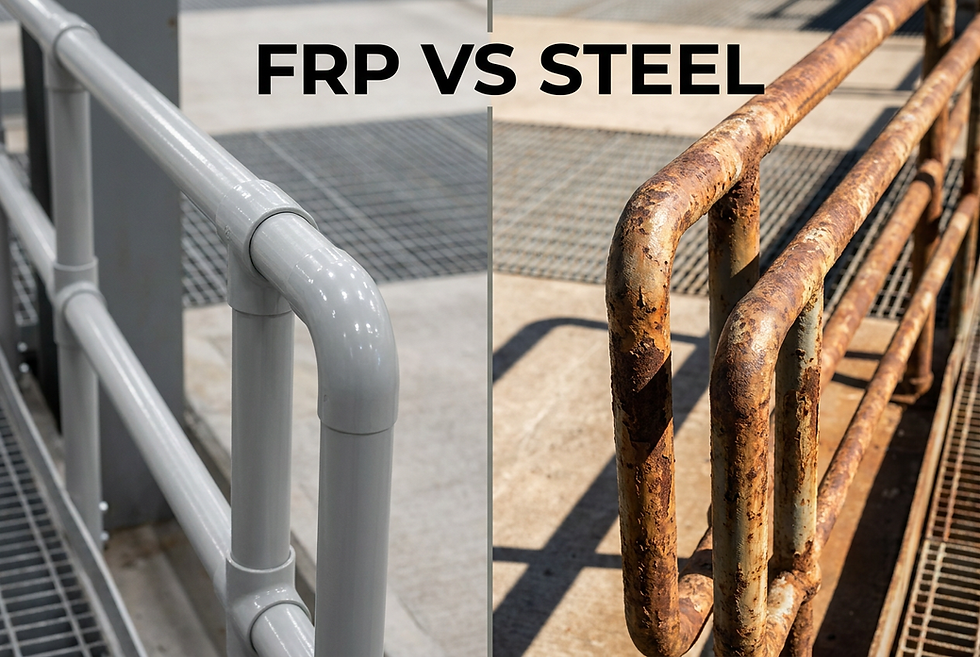
Steel corrodes. The mechanism is electrochemical — in the presence of moisture and oxygen, iron atoms at the metal surface oxidise to form iron oxide, releasing electrons and generating a measurable electrical current at the corrosion interface. This process is accelerated by chloride ions (salt air and saltwater), acids, alkalis, and elevated temperatures. Galvanising provides protection by placing a zinc layer over the steel surface that corrodes preferentially — sacrificing itself to protect the steel beneath. The zinc coating has a finite life, determined by coating thickness and the aggressiveness of the environment, and fails first at cut edges, fixing points, and weld interfaces where coating continuity is disrupted.
FRP does not corrode. It has no metallic substrate, no electrochemical corrosion mechanism, and no surface coating to fail. The resistance to chemical, moisture, and atmospheric attack is intrinsic to the polymer matrix throughout the full cross-section of the material. Vinyl ester resin systems resist continuous immersion in acids at pH as low as 1 and alkalis up to pH 13, covering the full range of industrial chemical processing environments (IncomePultrusion, 2025). Saltwater immersion causes no degradation to properly formulated GFRP, a property that accounts for FRP's established position in marine and offshore infrastructure. The design life of FRP in corrosive environments is typically 50 years — compared with 10 to 15 years for galvanised steel coatings in the same conditions before recoating is required (NACE International, 2016).
Electrical Conductivity
Steel is an electrical conductor. It requires earthing and bonding in proximity to live electrical systems, adding specialist installation labour, materials, and ongoing compliance verification to any project where secondary steel infrastructure is installed near electrical equipment. In the event of a cable insulation fault, a conductive steel cable tray can carry fault current and become energised, creating a secondary electrical hazard at the tray surface.
GFRP is an electrical insulator. It has volume resistivity of 10¹² to 10¹⁶ Ω·m, classifying it as a non-conductor across the full range of voltages encountered in industrial and energy infrastructure. No earthing or bonding is required. In high-voltage DC environments, where fault current in a conductive cable tray can sustain an arc that AC systems would naturally extinguish, non-conductive FRP cable management eliminates the arc propagation risk entirely (IntechOpen, 2022). In environments where electrical interference with sensitive instrumentation matters, FRP's non-magnetic and non-conductive properties eliminate the interaction that steel creates with electromagnetic fields.
Thermal Expansion
Structural steel has a coefficient of thermal expansion of approximately 12 parts per million per degree Celsius. Pultruded GFRP has a longitudinal coefficient of thermal expansion of approximately 6 to 8 parts per million per degree Celsius — roughly half that of steel. This means FRP secondary structural sections expand and contract less with temperature changes than equivalent steel sections, generating less thermal stress at connection points over diurnal and seasonal temperature cycles. In the context of the UK's increasingly extreme temperature range, with summer highs now regularly exceeding 35°C following a record June 2026 heatwave and winter lows still reaching well below zero, lower thermal expansion in secondary structural sections reduces the fatigue accumulation at connections that repeated thermal cycling generates in steel.
Fire Performance
This is the area where a straightforward assessment consistently favours steel. Steel is non-combustible. Standard pultruded GFRP is combustible — it will burn when exposed to flame, though it typically self-extinguishes when the flame source is removed. Standard GFRP does not meet the fire performance classifications required for secondary structural applications in buildings where fire resistance is a design requirement, or in applications where fire performance certification is mandated by the relevant standard or specification.
Fire-retardant FRP formulations incorporating flame-retardant additives are available and provide significantly improved fire performance, with self-extinguishing behaviour documented in testing to recognised classifications. These formulations are the correct specification for applications where fire performance is a requirement — offshore topsides, underground railway infrastructure, buildings subject to fire safety regulations, and battery storage enclosures. For outdoor applications, industrial sites, and environments where fire performance is not a primary design driver, standard GFRP formulations are appropriate and the fire limitation is not a relevant constraint.
When Steel Is the Correct Choice
An honest material comparison requires stating when the alternative is the better specification, not just when the material being discussed is. Steel is the correct specification for secondary infrastructure where fire performance is an absolute requirement and fire-retardant FRP is either unavailable in the required configuration or does not meet the specific classification required. It is the correct choice for applications where very high stiffness, rather than strength, is the primary design driver and where the deflection behaviour of FRP would require unacceptably large sections. It is the correct choice where the purchase price constraint is absolute and the lifecycle cost of maintenance in a relatively benign environment is genuinely low. And it is the correct choice for primary structural applications in buildings and civil structures where the established design codes, higher compressive strength, and ductile failure mode of steel make it the standard against which FRP secondary structural design must be justified.
The specification decision between FRP and steel is not a universal verdict in favour of either material. It is an evaluation of which material's properties best match the specific requirements of the application: its environment, its operational horizon, its electrical context, its fire performance requirements, and its whole-life cost position. In the secondary infrastructure of outdoor, corrosive, electrically sensitive, or long-life industrial environments, that evaluation consistently produces FRP as the conclusion. In fire-critical, primary structural, or very stiffness-dominated applications, it does not.
Understanding the comparison in these specific terms — rather than defaulting to either material without evaluation — is the foundation of secondary infrastructure specification that performs correctly across the full designed operational life of the asset it serves.

Reinforce Technology FRP Products
Reinforce Technology supplies pultruded FRP structural profiles, cable trays, grating, solar frames, perimeter fencing, and drainage systems for secondary infrastructure applications across the UK. Available in polyester, vinyl ester, and epoxy resin systems, with fire-retardant formulations for fire-performance applications. Full mechanical data sheets, resin system guidance, and material traceability documentation provided for project specifications.
Contact us to discuss your project and whether FRP is the correct specification for your specific application, environment, and operational horizon.
Final confirmation of suitability for any specific application, including structural design and fire performance requirements, remains the responsibility of the appointed project engineer. Reinforce Technology provides technical guidance and material recommendations based on information supplied to us, but specification sign-off should always sit with the qualified professional responsible for the design.
References
Almutairi, A.D. (2023) cited in Reinforce Technology (2026) FRP / GRP vs Steel: The Complete Comparison for UK Infrastructure Projects. Available at: https://www.reinforcetechnology.com/post/frp-vs-steel-comparison-uk-infrastructure [Accessed: 6 July 2026]. [GFRP density approximately 1,750 to 2,100 kg/m³; 70 to 80% lighter than steel].
IncomePultrusion (2025) FRP vs Steel: Performance, Cost, and Application Comparison Guide. Available at: https://incomepultrusion.com/frp-vs-steel-comparison/ [Accessed: 6 July 2026]. [FRP modulus of elasticity 17 to 50 GPa versus steel 200 GPa; tensile strength comparison; vinyl ester resistance to pH 1 to pH 13].
IntechOpen (2022) 'Fibre-Reinforced Polymer (FRP) in Civil Engineering', in IntechOpen Engineering Series. Available at: https://www.intechopen.com/chapters/84203 [Accessed: 6 July 2026]. [Non-conductive properties; volume resistivity 10¹² to 10¹⁶ Ω·m; 75% lighter than steel; corrosion immunity].
NACE International (2016) International Measures of Prevention, Application and Economics of Corrosion Technology (IMPACT). Houston, TX: NACE International. Available at: http://impact.nace.org/economic-impact.aspx [Accessed: 6 July 2026].
ScienceDirect (2025) 'Sustainable composites for metal replacement: Environmental assessment and material selection of fiber-reinforced polymer across industries', ScienceDirect, doi: 10.1016/S2667-3789(25)00051-3. Available at: https://www.sciencedirect.com/science/article/pii/S2667378925000513 [Accessed: 6 July 2026]. [Pultruded GFRP manufacturing emissions approximately 60 to 70% lower per tonne than primary steel, cradle-to-gate, EuCIA data].
Younis, A., Ebead, U. and Judd, S. (2018) 'Life cycle cost analysis of structural concrete using seawater, recycled concrete aggregate, and GFRP reinforcement', Construction and Building Materials, 175, pp. 135-144. doi: 10.1016/j.conbuildmat.2018.04.183.


Comments