
UK Ports Are in the Largest Expansion Programme in a Generation. The Marine Environment Makes Secondary Infrastructure Specification Critical.
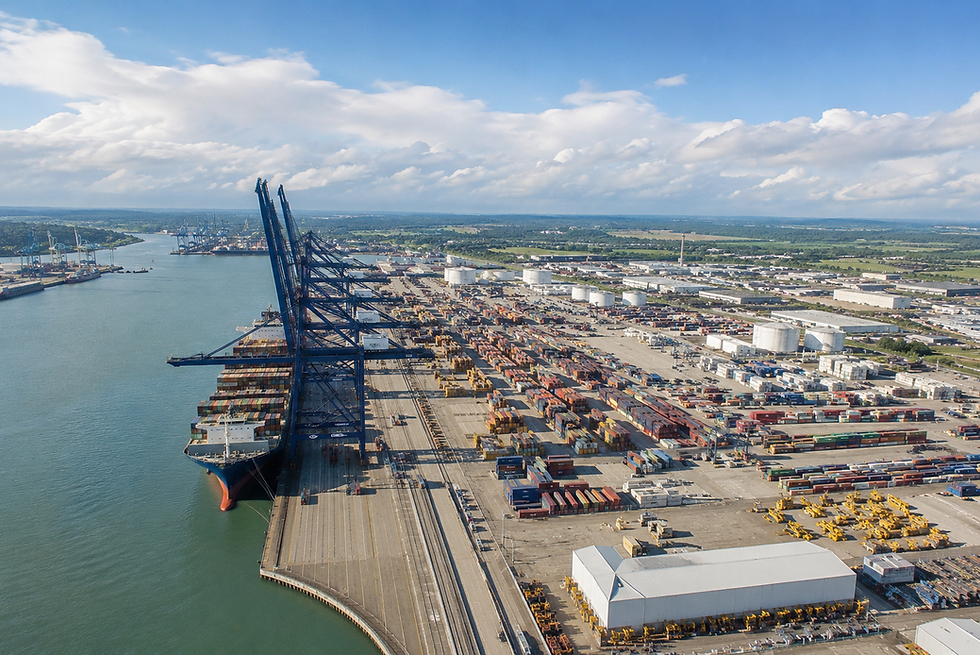
UK ports are in the middle of the largest combined expansion and modernisation programme in a generation. DP World's £1 billion London Gateway extension, Belfast Harbour's £90 million deepwater quay, Forth Ports' £50 million Port of Leith berth, and the Port of Immingham's new RoRo terminal are all advancing simultaneously. Every port and marine terminal being built or upgraded in the UK operates in the most corrosive environment in infrastructure. Here is why FRP is the secondary infrastructure specification the sector needs.
Published by Reinforce Technology | June 2026
The UK government published a revised National Policy Statement for Ports in June 2025, streamlining the planning process for port expansion and signalling that port infrastructure is a national economic priority (GOV.UK, 2025). The policy shift was backed by capital commitment. At London International Shipping Week in September 2025, over £1.1 billion of joint government and industry maritime investment was announced, including £700 million of private sector funding and £448 million of public investment to reduce emissions from UK shipping (Ports Europe, 2025). Private commitments included £300 million from Peel Ports for developments at Liverpool, Hunterston, and Great Yarmouth, £250 million from NatPower Marine for shore power infrastructure, and £150 million from the Port of Tyne for its North Side expansion (Ports Europe, 2025).
The physical construction activity across the UK port estate reflects this investment. DP World's London Gateway expansion adds two further 400-metre all-electric berths and a second rail terminal, creating over 1,000 construction jobs and 400 permanent roles. Belfast Harbour's £90 million dual-purpose deepwater quay accommodates the world's largest cruise vessels while expanding capacity for offshore wind turbine assembly and installation. Forth Ports opened a new deep water riverside berth at the Port of Leith in April 2025 after a £50 million investment, designed to play a pivotal role in delivery of the Inch Cape Offshore Wind Farm. The Port of Immingham's new RoRo terminal, a joint investment by Associated British Ports and Stena Line exceeding £200 million, is subject to completion by 2026 (British Ports Association, 2025).
Every one of these assets, and the wider UK port and marine terminal estate they sit within, operates in the most corrosive environment that infrastructure encounters. Salt air, tidal immersion, persistent marine moisture, chemical loading from cargo handling, and the biological fouling of marine organisms at and below the waterline combine to create conditions that degrade secondary steel infrastructure faster and more comprehensively than almost any other UK setting. The secondary infrastructure specification decisions being made on these projects now will determine whether the assets perform across their 30 to 50-year operational lives or accumulate maintenance liabilities in the years after construction is complete.
Why Port and Marine Environments Are the Most Demanding for Secondary Infrastructure
The corrosion environment of a UK port or marine terminal combines several of the most aggressive mechanisms for secondary steel degradation simultaneously, in a way that few other infrastructure settings match. Salt air at quayside provides constant chloride ion deposition across exposed surfaces, accelerating the electrochemical corrosion of galvanised steel coatings at a rate substantially faster than inland environments. Tidal immersion and splash zones alternate between wet and dry exposure in cycles that are among the most damaging conditions for galvanised coatings, because the wet-dry cycling drives corrosion at the fastest possible rate rather than allowing any partial stabilisation that continuous immersion sometimes produces.
Marine biological fouling adds a further mechanism not present in other corrosive environments. Barnacles, algae, and other marine organisms colonise steel surfaces at and below the waterline, creating localised anaerobic conditions that generate hydrogen sulphide and accelerate corrosion beneath the fouling layer in ways that are invisible until the fouling is removed and the corrosion damage assessed. Chemical loading from cargo handling, including petroleum products, fertilisers, and bulk chemicals at specialist terminals, adds site-specific chemical exposure on top of the baseline marine environment.
The NACE International IMPACT study estimated the global annual cost of corrosion at approximately £2 trillion, around 3.4% of global GDP, with marine and offshore environments identified as among the highest-cost categories for corrosion management (NACE International, 2016). Port and marine terminal operators are among the heaviest users of corrosion protection systems for secondary steel infrastructure, and among the most frequent re-specifiers when those systems fail ahead of the asset's designed maintenance interval. The maintenance cost of galvanised steel secondary infrastructure in an active UK port environment is not a distant liability. It is a budget line that accumulates from the first tide cycle after installation.
Where FRP Is Specified in Port and Marine Terminal Infrastructure
1. Quayside Walkways, Access Platforms, and Grating
Quayside walkways, maintenance access platforms, and drainage grating in port and marine terminal environments are the most directly exposed secondary infrastructure on any site. They operate at or near the splash zone, in persistent salt air, subject to tidal wetting, chemical contamination from vessel operations and cargo handling, and the vehicle and pedestrian loading of an active port operations environment. Galvanised steel grating and walkway systems in these conditions require inspection, recoating, and partial replacement at intervals that are substantially shorter than equivalent inland installations, precisely because the marine environment attacks zinc coatings from every direction simultaneously.
FRP moulded grating provides anti-slip access flooring whose surface performance does not degrade in salt water, chemical contamination, or biological fouling conditions. The integral grit surface, bonded into the panel during manufacture rather than applied as a separate coating, maintains consistent slip resistance in the wet, salt-contaminated conditions of quayside operations throughout the full service life of the installation. FRP walkways and access platforms are corrosion-immune in the marine environment, lightweight enough to be repositioned or replaced without heavy lifting equipment, and non-conductive in the proximity of the shore power electrical systems that the UK's maritime decarbonisation programme is installing across the port estate (IntechOpen, 2022).
2. Cable Management for Shore Power and Port Electrical Systems
The UK government's maritime decarbonisation programme, backed by £271 million announced in March 2026, is driving installation of shore power infrastructure across UK ports that allows vessels to connect to grid electricity while berthed, eliminating the idling diesel generators that currently make a significant contribution to port air quality and carbon emissions (Open Access Government, 2026). Shore power systems require cable management infrastructure routing high-voltage supply from the port electrical network to quayside connection points, in the same salt air and tidal exposure environment as the rest of the port secondary infrastructure.
FRP cable trays for shore power cable management provide non-conductive cable routing that eliminates the earthing and bonding requirements of steel cable trays in proximity to high-voltage electrical systems, corrosion-immune performance in the marine environment where galvanised steel cable management corrodes fastest, and a 50-year maintenance-free design life that matches the operational horizon of the port infrastructure it serves (IntechOpen, 2022). As shore power becomes a standard requirement across the UK port estate, the volume of outdoor marine-environment cable management being specified at quayside will increase substantially, and FRP is the specification that performs for the full duration.
3. Fencing and Perimeter Security
Port and marine terminal perimeter fencing operates in a salt air environment while also serving as critical national infrastructure security. FRP mesh perimeter fencing is non-conductive in proximity to the port's electrical systems, corrosion-immune in the coastal environment where galvanised steel fencing corrodes progressively from the base upward, and has no scrap metal value, removing the metal theft risk that affects unattended perimeter fencing on large port estates where security coverage may be intermittent across long boundary runs. FRP fencing is also radar and signal transparent, relevant for the CCTV, radar-based intrusion detection, and maritime communications systems that port security infrastructure increasingly incorporates.
4. Structural Profiles for Offshore Wind Marshalling and Assembly
Belfast Harbour's dual-purpose quay and Forth Ports' Port of Leith investment are both explicitly designed to support offshore wind turbine assembly and installation operations. Ports serving as marshalling and assembly hubs for offshore wind are among the most demanding secondary infrastructure environments in UK construction: the combination of marine exposure, large-scale heavy plant operations, and the electrical and chemical environments of wind turbine component handling creates conditions where conventional secondary steel infrastructure requires inspection and maintenance at intervals that the pace of offshore wind delivery cannot always accommodate.
FRP structural profiles for access platforms, secondary framing, and cable management in offshore wind marshalling environments provide corrosion-immune, non-conductive, lightweight structural sections that perform without maintenance in the conditions that galvanised steel struggles with from year one. At the scale of the UK's offshore wind marshalling port programme, the aggregate maintenance cost saving from FRP secondary infrastructure specification versus galvanised steel across multiple port sites is measurable in millions of pounds across the operational life of the assets.

The Lifecycle Cost Case in the Context That Matters Most
Port and marine terminal infrastructure is among the longest-lived in the UK asset estate, with operational design lives of 30 to 50 years standard for new quay construction and civil works. The secondary infrastructure within and around those civil works, the walkways, cable management, structural platforms, and fencing, is expected to perform for the same period in the most corrosive outdoor environment the UK offers. The lifecycle cost case for FRP secondary infrastructure in this context is the strongest available, because the corrosion mechanisms operating against galvanised steel are the most aggressive, the maintenance access in a live port environment is the most operationally expensive, and the design life of the asset is the longest.
A peer-reviewed lifecycle cost analysis found approximately 50% cost savings for GFRP versus steel over a 100-year study period, driven primarily by the elimination of corrosion-related maintenance and replacement cycles (Younis, Ebead and Judd, 2018). In a port environment, where the corrosion rate is higher than in inland settings and each maintenance event requires coordination with live port operations, the break-even point at which FRP's lower lifetime cost offsets its higher purchase price is substantially earlier than the 8 to 12 years typical of inland industrial environments. FRP secondary infrastructure at a UK port or marine terminal is not a premium specification. It is the specification that costs less over the asset's designed operational life, in the environment where that matters most.
Reinforce Technology FRP Products for Ports and Marine Terminals
Reinforce Technology supplies FRP grating, cable trays, structural profiles, and perimeter fencing for port and marine terminal applications across the UK. Available in polyester, vinyl ester, and epoxy resin systems, with vinyl ester the standard recommendation for direct marine exposure and tidal or splash zone applications. All products are corrosion-immune in salt water, salt air, and the chemical environments of active port operations, with 50-year design lives in marine environments independently supported by material data.
We work with port operators, marine contractors, EPC contractors, and procurement teams across the UK's port expansion and decarbonisation programme. Contact us to discuss your port or marine terminal project and the correct FRP specification for your specific quayside environment and operational requirements.
Final confirmation of suitability for any specific marine or port application remains the responsibility of the appointed project engineer. Reinforce Technology provides technical guidance and material recommendations based on information supplied to us, but specification sign-off should always sit with the qualified professional responsible for the design.
References
British Ports Association (2025) Port Investments. Available at: https://www.britishports.org.uk/investments/ [Accessed: June 2026]. [DP World London Gateway £1bn expansion; Belfast Harbour £90m deepwater quay; Forth Ports £50m Port of Leith berth; Port of Immingham RoRo Terminal £200m+].
GOV.UK (2025) New Vision for UK Ports Will Propel Prosperity in Britain's Coastal Communities. Available at: https://www.gov.uk/government/news/new-vision-for-uk-ports-will-propel-prosperity-in-britains-coastal-communities [Accessed: June 2026]. [Revised National Policy Statement for Ports published June 2025; streamlined planning for port expansion; ports as national economic priority].
IntechOpen (2022) 'Fibre-Reinforced Polymer (FRP) in Civil Engineering', in IntechOpen Engineering Series. Available at: https://www.intechopen.com/chapters/84203 [Accessed: June 2026]. [Non-conductive and corrosion-immune properties; 75-80% lighter than steel].
NACE International (2016) International Measures of Prevention, Application and Economics of Corrosion Technology (IMPACT). Houston, TX: NACE International. Available at: http://impact.nace.org/economic-impact.aspx [Accessed: June 2026]. [Global annual cost of corrosion £2 trillion, 3.4% of global GDP; marine and offshore identified as highest-cost categories].
Open Access Government (2026) £271m UK Funding to Decarbonise Shipping. Available at: https://www.openaccessgovernment.org/271m-uk-funding-to-decarbonise-shipping/206060/ [Accessed: June 2026]. [£271m Clean Maritime Demonstration Competition and ZEVI fund; shore power infrastructure investment across UK ports].
Ports Europe (2025) UK Launches £1.1bn Maritime Investment to Boost Ports, Coastal Jobs. Available at: https://www.portseurope.com/uk-launches-1-1-bln-maritime-investment-to-boost-ports-coastal-jobs/ [Accessed: June 2026]. [£700m private; £448m public; £300m Peel Ports; £250m NatPower Marine; £150m Port of Tyne].
Younis, A., Ebead, U. and Judd, S. (2018) 'Life cycle cost analysis of structural concrete using seawater, recycled concrete aggregate, and GFRP reinforcement', Construction and Building Materials, 175, pp. 135-144. doi: 10.1016/j.conbuildmat.2018.04.183.


Comments