
FRP Cable Trays in Solar and Energy Infrastructure: The Deep-Dive Specification Case
Cable management is the infrastructure that connects generation to the grid, inverter to panel, and battery to bus bar across every solar and energy asset in the UK's clean power pipeline. It operates outdoors, in proximity to high-voltage systems, for 25 to 30 years without the option of easy replacement in a live electrical environment. The material it is made from is one of the most consequential secondary specification decisions on any energy project. Here is the deep-dive case for FRP.
Published by Reinforce Technology | 29 June 2026
The UK solar market grew 90% in ground-mount installations in 2025, completing 2.5 GWp of utility-scale capacity, the largest single-year growth on record (Solar Power Portal, 2026). A further 800 MWp was deployed in Q1 2026 alone. The 713 projects that received NESO grid connection offers on 10 June 2026 cover 37 GW of solar, wind, battery storage, and hydro, all advancing toward construction programmes that must deliver by 2030. Every one of those projects requires cable management infrastructure, and every metre of that infrastructure is a specification decision that will govern the project's operational performance for 25 to 30 years in a live electrical environment where replacement is never straightforward and often genuinely costly.
Cable management in solar and energy infrastructure is not a commodity procurement line. It is a component that sits in direct proximity to high-voltage DC systems, outdoor and often coastal UV and salt air exposure, and the full range of UK weather across decades of continuous operation. In that context, the choice between FRP and steel cable trays is not a cost comparison. It is a risk management decision, a maintenance budget decision, and increasingly, a compliance decision as embodied carbon reporting requirements make the manufacturing emissions of secondary materials a documented project metric.
The global fiberglass cable tray market was valued at approximately £1.0 billion in 2025 and is projected to reach £1.4 billion by 2034 at a compound annual growth rate of 5.2%, with renewable energy infrastructure identified as the primary growth driver alongside harsh industrial applications (Intel Market Research, 2026). The market is growing because the evidence that FRP cable trays outperform steel alternatives across the total cost of ownership of a solar or energy asset has accumulated to the point where it is driving specification change at scale. This blog sets out that evidence for the specific applications and environments of UK solar and energy infrastructure.
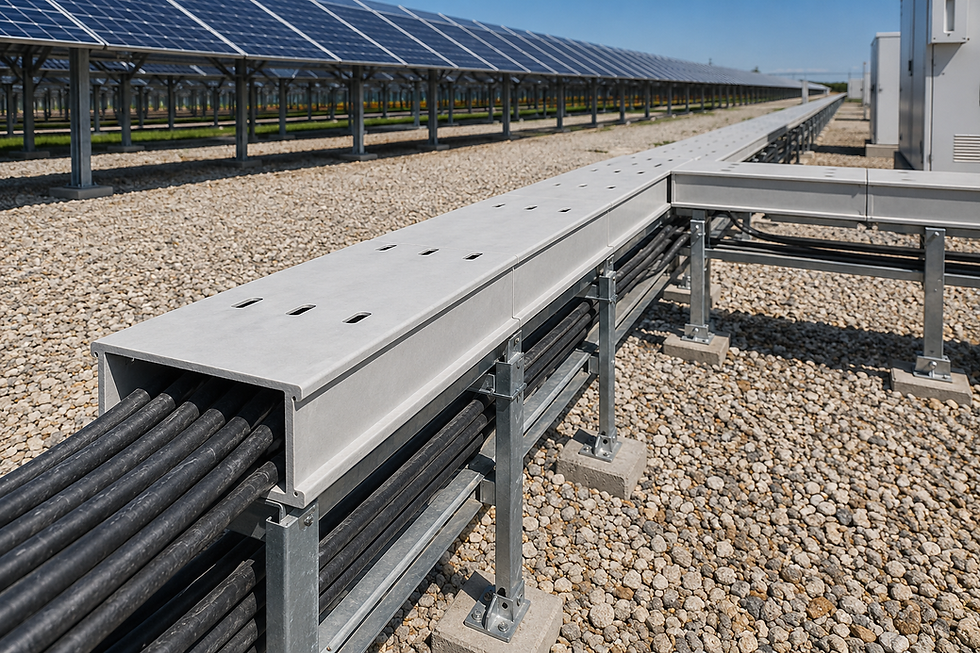
Why Solar and Energy Environments Are Demanding for Cable Management
The environments that UK solar and energy infrastructure occupies are among the most demanding for secondary cable management. Understanding each environment in specific terms is the starting point for specifying the correct FRP product for each application.
Ground-mount solar farms in coastal and agricultural locations face persistent salt air and UV at ground level, combined with the agrochemical exposure of the land they sit on if agrivoltaic systems are involved. DC cable runs from panel arrays to string inverters, and from inverters to the site substation, can extend to hundreds or thousands of metres across a large utility-scale site. These cable runs sit at or near ground level, exposed to weather from above and ground moisture from below, across a 30-year operational life during which the only access opportunity for maintenance is during scheduled engineering windows that must be balanced against revenue-generating generation hours.
Grid substations and battery storage facilities combine the electrical sensitivity of high-voltage AC and DC systems with the outdoor exposure common to most energy infrastructure. Cable management in substation environments routes control, protection, and telecommunications cables between switchgear bays, relay rooms, and the wider transmission infrastructure, in conditions that range from coastal salt air at many UK grid connection sites to the persistent humidity of enclosed equipment buildings.
Offshore wind platforms face the most aggressive corrosion environment in UK energy infrastructure. Salt water spray, wave splash, persistent humidity, and marine biological fouling combine to create conditions where galvanised steel cable management degrades faster than in any other UK setting. Cable management on offshore wind topsides and transition pieces routes DC and AC cables from nacelle to platform to export cable connection, in the environment where maintenance access is most constrained and most expensive across the asset's 25-year operational life.
The Non-Conductivity Argument — Why It Matters More in DC Systems
FRP cable trays are electrically non-conductive. This property eliminates the earthing and bonding programme that steel cable management requires in proximity to electrical systems, removing a specific category of installation labour, materials, and ongoing compliance verification from the project. For AC electrical infrastructure, this is a meaningful but manageable difference. For high-voltage DC systems, which form the core of every solar farm's electrical architecture, it is a more significant and specific safety advantage.
DC electrical systems do not self-extinguish in the way that AC systems do. When AC current flows through an unintended path, the natural zero crossing of the alternating current provides 50 opportunities per second to interrupt the arc. DC current does not zero cross. A DC arc, once established through a conductive path, will sustain itself until the circuit is interrupted by a protective device or until the fault current path is physically broken. In a solar farm where high-voltage DC from the panel array can reach 1,500 V between conductors, the consequence of a cable insulation fault propagating through a conductive steel cable tray is a sustained DC arc with significantly greater energy release than an equivalent AC fault (IntechOpen, 2022).
FRP cable trays cannot carry that fault current. They have no conductive path for the arc to propagate through. The fault current remains in the cable and is interrupted by the overcurrent protection designed for the purpose, rather than propagating along the tray structure to create a secondary fault location. This is not a marginal safety advantage. It is the elimination of a specific and documented DC arc propagation risk that conductive cable management introduces into every solar farm and battery storage installation where DC cable management is required.
The Corrosion Case — Environment by Environment
Ground-Mount Solar Farms
Ground-mount solar farm cable management sits in the outdoor ground-level environment of the UK's solar pipeline, concentrated in the coastal, agricultural, and mixed-exposure locations that characterise the East Anglian, South West, and South East solar belt. Galvanised steel cable trays in these environments begin to corrode at cut edges and fixing points from the first season of operation, with the rate of zinc depletion accelerating in coastal salt air and decelerating slightly in inland locations but never stopping. On agrivoltaic installations, the agrochemical exposure from fertilisers, pesticides, and soil acids compounds the baseline outdoor corrosion rate at every ground-level contact point.
FRP cable trays in the same environment have no corrosion mechanism. The resistance to UV, moisture, salt air, and agricultural chemical exposure is intrinsic to the vinyl ester or polyester resin matrix of the tray body, consistent through the full cross-section, and does not depend on a surface coating that can be disrupted or depleted. Across a 30-year solar farm operational life, this difference translates directly into zero corrosion-related maintenance events for FRP against the inspection, recoating, and eventual structural replacement programme that galvanised steel accumulates in these environments (NACE International, 2016).
Grid Substations and Battery Storage
Substation and battery storage environments combine outdoor exposure with the specific humidity and chemical conditions that electrical equipment operation generates. Control building cable management, often assumed to be in a protected indoor environment, is frequently exposed to the temperature and humidity cycling of equipment buildings that are not climate-controlled and that breathe with the ambient conditions of coastal or industrial sites. Battery enclosure cable management adds the specific chemical atmosphere of lithium-ion or other battery technologies to the baseline humidity exposure.
FRP cable trays in vinyl ester resin provide the chemical resistance required for battery enclosure environments, alongside the non-conductivity and UV resistance needed for the outdoor sections of the cable management run. Fire-retardant FRP formulations, tested to recognised fire performance classifications, are available for battery enclosure applications where fire performance is a specification requirement.
Offshore Wind Platforms
Offshore cable management operates in the most corrosive environment in UK energy infrastructure. Salt water spray at wave height, persistent marine humidity, and biological fouling at and below the waterline create conditions that galvanised steel coatings cannot sustain across a 25-year asset life. Maintenance access on an offshore platform requires vessel mobilisation, weather windows, and specialist access arrangements that make each maintenance event substantially more expensive than equivalent onshore work.
FRP cable trays in epoxy or vinyl ester resin provide the corrosion immunity and UV resistance required for offshore topside environments, with no maintenance requirements across the full 25-year operational life of the platform. The elimination of corrosion-related maintenance events from offshore cable management is not a convenience. It is a direct operational cost saving that compounds across every year of the asset's life at the offshore day rate that each maintenance mobilisation requires.

Snap-Fit vs Screw-Fixed — the Installation Difference
Reinforce Technology's FRP cable tray system is designed with snap-fit connections rather than traditional screw-fixed assembly. This design decision has practical consequences across the installation programme and the operational life of the asset that are worth understanding in specific terms.
During installation, snap-fit connections allow tray sections to be opened, modified, and reconfigured without dismantling the system. On a solar farm where cable routing decisions can evolve as the installation programme progresses, this flexibility reduces the rework cost that fixed screw connections would generate for routing changes. Faster installation without specialist tools reduces installation labour hours, and the absence of screw fixings eliminates a specific category of corrosion-prone connection hardware that, in conventional steel cable tray systems, often fails before the tray body itself (Reinforce Technology, 2026).
Across the operational life of the asset, snap-fit access allows cable additions, modifications, and maintenance access without the disruptive access events that screw-fixed cable management requires. For a solar farm where the DC cable management routes power from panel array to inverter continuously for 30 years, the ability to access, inspect, and modify cable routes without structural disassembly is an operational flexibility that the fixed-connection alternative does not provide.
The Lifecycle Cost Position in UK Solar and Energy
The purchase price of FRP cable trays is higher than equivalent galvanised steel, typically by a factor of 1.5 to 2 times depending on the configuration and specification. Against the total capital cost of a utility-scale solar farm, where panels, inverters, transformers, civil works, and grid connection dominate the budget, the cable management package represents a small fraction of the total. The FRP premium across a typical utility-scale solar farm's cable management specification is a correspondingly small absolute number against the total project cost.
Against the lifecycle cost of the project across its 30-year operational horizon, the calculus is different. A peer-reviewed lifecycle cost analysis comparing GFRP and steel found approximately 50% lifecycle cost savings for GFRP, driven by the elimination of corrosion-related maintenance and replacement (Younis, Ebead and Judd, 2018). Annual operations and maintenance costs for a UK solar farm run at approximately 1% of initial capital cost per year. Secondary infrastructure maintenance — inspection, recoating, and replacement driven by corrosion — adds to that baseline cost at intervals that the project financial model typically does not include because the specification was assumed to last the full 30 years. FRP cable management removes that addition entirely, delivering a 30-year lifecycle cost that is lower than steel despite the higher purchase price, in the specific outdoor electrical environments where UK solar and energy infrastructure operates.
The FRP cable tray market is growing at 5.2% annually because the lifecycle cost evidence is accumulating to the point where it is changing specification decisions at scale. In UK solar and energy infrastructure, where 713 projects are advancing toward 2030 construction completion and where every specification decision made in 2026 will govern 30 years of operational performance, FRP cable trays are the specification that the evidence consistently supports.
Reinforce Technology FRP Cable Trays for Solar and Energy
Reinforce Technology supplies FRP cable tray systems for solar and energy infrastructure across the UK, including ground-mount solar farms, grid substations, battery storage facilities, and offshore wind platforms. Our snap-fit FRP cable trays are independently tested by SGS to ASTM standards, available in polyester, vinyl ester, and fire-retardant resin systems matched to the specific electrical, chemical, and UV exposure of each application zone.
We work with solar developers, EPC contractors, M&E contractors, and procurement teams across the UK's clean energy pipeline. Contact us to discuss your project and the correct FRP cable tray specification for your specific energy application and environment.
Final confirmation of suitability for any specific application, including resin system selection and fire performance requirements, remains the responsibility of the appointed project engineer. Reinforce Technology provides technical guidance and material recommendations based on information supplied to us, but specification sign-off should always sit with the qualified professional responsible for the design.
References
Intel Market Research (2026) Fiberglass Cable Tray Market Outlook 2026-2034. Available at: https://www.intelmarketresearch.com/fiberglass-cable-tray-market-38979 [Accessed: 29 June 2026]. [Global FRP cable tray market USD 1.34bn in 2026, projected USD 1.80bn by 2034 at 5.2% CAGR; renewable energy the primary growth driver].
IntechOpen (2022) 'Fibre-Reinforced Polymer (FRP) in Civil Engineering', in IntechOpen Engineering Series. Available at: https://www.intechopen.com/chapters/84203 [Accessed: 29 June 2026]. [Non-conductive properties; DC arc propagation risk in conductive cable management; corrosion immunity across operational life].
NACE International (2016) International Measures of Prevention, Application and Economics of Corrosion Technology (IMPACT). Houston, TX: NACE International. Available at: http://impact.nace.org/economic-impact.aspx [Accessed: 29 June 2026].
Reinforce Technology (2026) FRP Cable Trays — Snap-Fit Trough and Ladder Tray. Available at: https://www.reinforcetechnology.com/products/frp-cable-tray [Accessed: 29 June 2026]. [Snap-fit design; SGS-tested to ASTM standards; non-conductive GRP construction minimises EMI].
ScienceDirect (2025) 'Sustainable composites for metal replacement: Environmental assessment and material selection of fiber-reinforced polymer across industries', ScienceDirect, doi: 10.1016/S2667-3789(25)00051-3. Available at: https://www.sciencedirect.com/science/article/pii/S2667378925000513 [Accessed: 29 June 2026]. [Pultruded GFRP manufacturing emissions approximately 60 to 70% lower per tonne than primary steel, cradle-to-gate].
Solar Power Portal (2026) UK Solar Construction Uptick, 800MWp Deployed in Q1. Available at: https://www.solarpowerportal.co.uk [Accessed: 29 June 2026]. [UK solar market grew 90% in ground-mount installations in 2025; 2.5 GWp utility-scale completed].
Younis, A., Ebead, U. and Judd, S. (2018) 'Life cycle cost analysis of structural concrete using seawater, recycled concrete aggregate, and GFRP reinforcement', Construction and Building Materials, 175, pp. 135-144. doi: 10.1016/j.conbuildmat.2018.04.183. [Approximately 50% lifecycle cost saving for GFRP versus steel over 100-year study period].


Comments