
The UK Produces Only 65% of Its Food. Agrivoltaics and FRP Are Part of the Answer.
The UK produces only 65% of its food domestically. Fresh vegetable self-sufficiency is at its lowest level since records began in 1988. The Prime Minister declared food security a vital part of national security. The pressure to take productive land out of food production for solar development is one of the most contested planning conflicts in the UK right now. Agrivoltaics resolves it — and FRP is the infrastructure that makes that resolution last for 30 years.
Published by Reinforce Technology | June 2026
The UK is the world's sixth largest economy, but it produces less than two thirds of its food domestically. The Food Production to Supply Ratio for all food was estimated at 65% in 2024, up from 62% in 2023 but down from approximately 75% in the 1980s (Level 3 Food Hygiene Certificate, 2026). Only approximately 35% of the fruit and vegetables consumed in the UK are produced domestically. UK self-sufficiency in fresh vegetables specifically is at its lowest level since records began in 1988, at 53% (NFU, 2025). 84% of fresh tomatoes on sale in UK supermarkets are imported (NFU, 2025). In 2024, 25% of UK domestic food consumption came from the EU and 18% from the rest of the world, with 33 countries accounting for 90% of imported food supply (Level 3 Food Hygiene Certificate, 2026).
That level of import dependency is a structural vulnerability. The 2022 food inflation crisis, driven by the Ukraine war's effect on grain, oil, and fertiliser prices, demonstrated precisely how quickly global events translate into UK food price rises and availability challenges. The 2025 coffee and cocoa price increases, driven by weather failures in producing regions, provided a further illustration of the same mechanism. When the countries the UK imports food from face extreme weather, conflict, or trade disruption, UK food prices rise and UK food availability becomes uncertain, regardless of what is happening on UK farmland (Level 3 Food Hygiene Certificate, 2026).
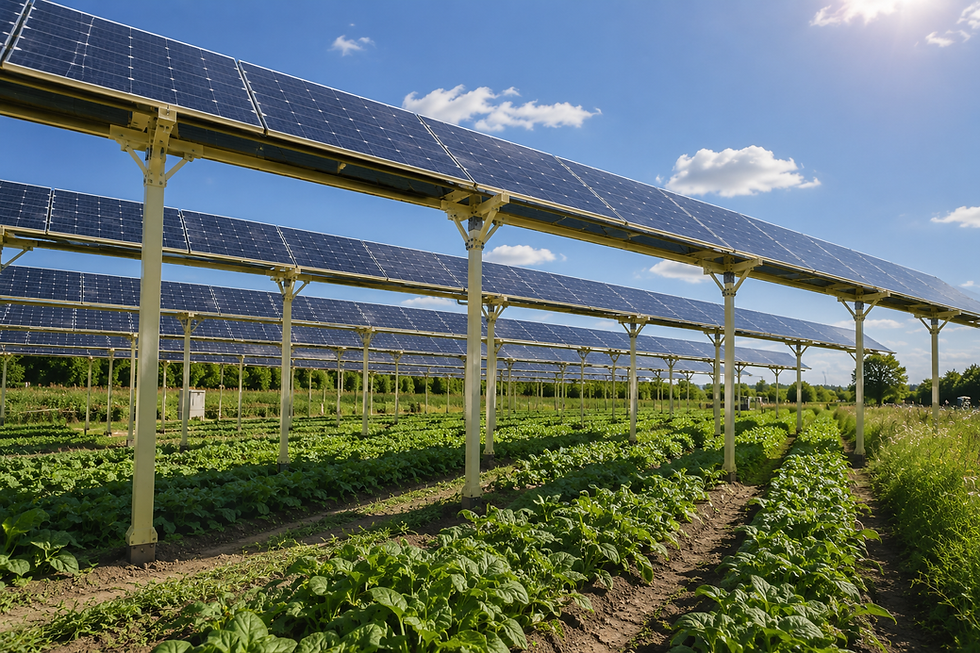
Against this backdrop, the UK simultaneously faces a requirement to build tens of thousands of hectares of new solar capacity to meet Clean Power 2030 targets. The conflict between these two imperatives — the need for more domestic food production and the need for more land for solar energy — is one of the most active and contested planning debates in the country. 59% of England's largest operational solar farms already sit on productive farmland, with nearly a third of that area classified as best and most versatile agricultural land (ISEP Global, 2026). The planning system is under growing pressure to resist further conversion of productive farmland to conventional solar use. Agrivoltaics is the answer that resolves both pressures simultaneously, and it does so on a foundation of infrastructure that, if specified correctly, never compromises the farming beneath it.
Why the Land Use Conflict Is the Central Food Security Question
The UK's declining food self-sufficiency is driven by several factors: population growth, the loss of agricultural land to housing, infrastructure, and rewilding, static crop yields over two decades of significant yield fluctuation, and the structural cost pressures that have made UK farming progressively less financially viable without support payments that are themselves being reformed (Alder, 2024). One analysis suggests UK food self-sufficiency could decline to as low as 45% if current trends continue, driven primarily by the combination of population growth requiring 10% more food production and a projected loss of up to 20% of cropable area over the next 15 to 20 years (Alder, 2024).
In that context, conventional ground-mount solar development on productive agricultural land is a direct contributor to the self-sufficiency decline. A solar farm on Grade 2 or Grade 3a agricultural land removes that land from food production for 25 to 30 years. In the categories where UK self-sufficiency is most vulnerable, fruit, vegetables, and salad crops, the land where agrivoltaic production is most agronomically feasible is also the land where conventional solar development generates the most legitimate food security concern.
The University of Sheffield's 2025 study found that 55.5% of UK land is suitable for agri-PV deployment, and that agrivoltaic technology could theoretically allow the UK to meet its solar energy targets without sacrificing any agricultural land to food production (The Planner, 2025). The most suitable regions, Cambridgeshire, Essex, Lincolnshire, and the wider East and South East of England, are precisely the regions where UK fresh vegetable and salad production is concentrated and where import substitution potential is greatest. The food security case for agrivoltaics in these regions is therefore the strongest available: it allows solar energy generation on the most productive arable land in the UK without removing a single hectare from domestic food production.
What Agrivoltaics Actually Produces — the Food Side of the Equation
The food security case for agrivoltaics is not simply that it avoids removing land from farming. It is that it can positively increase the productivity of the land it occupies, for the specific crop categories where UK import dependency is most severe.
Fresh vegetables and salad crops, the categories where UK self-sufficiency is at historic lows, are among the crops best suited to agrivoltaic production. Leafy crops such as lettuce, spinach, rocket, and mixed salads are shade-tolerant, benefit from the microclimate moderation that panel shade provides in hot summer conditions, and have shown yield increases of 20 to 40% under agrivoltaic arrays in recent field trials (Editorial Ge, 2026). The 30% reduction in soil water evaporation under panel shade reduces irrigation demand for these water-sensitive crops, cutting the energy and water costs that make intensive vegetable production increasingly expensive in a warming UK climate.
Soft fruits, strawberries, raspberries, blueberries, where UK import dependency is also substantial, benefit from panel shade reducing heat stress and from the physical protection that elevated arrays provide against the heavy rainfall and hail events that damage delicate fruit crops. A 2025 study found soil organic carbon levels increasing by 10 to 15% under agrivoltaic arrays within three years of installation, improving soil structure and water retention in ways that directly support the root development and soil health requirements of intensive vegetable and fruit production (Editorial Ge, 2026).
Sheep and livestock grazing beneath solar panels, the most established form of agrivoltaic farming in the UK, contributes to UK meat self-sufficiency while simultaneously providing vegetation management that eliminates mowing costs. The 15 commercial agrivoltaic projects currently operational in the UK are predominantly livestock-based, with the 30.1 MW Bracks project in Cambridgeshire the largest, incorporating sheep grazing alongside planned biodiversity enhancements (CMS Law, 2025). Each of these projects produces food and electricity from the same land, contributing to domestic food supply without reducing the agricultural land base that food security analysis consistently identifies as the UK's most critical strategic asset.

The Planning Advantage — Agrivoltaics as National Security Infrastructure
The Prime Minister stated in February 2024 that food security is a vital part of national security and that the UK must be agile and responsive in maintaining domestic food production at current levels. The NFU's response to the government's food security policy acknowledged the recognition that food security is critical to national security while emphasising the need for the right policy framework to boost confidence and resilience (NFU, 2025). Food security has moved from an agricultural policy concern to a national security framing that carries significant planning weight.
An agrivoltaic planning application that can demonstrate continued agricultural productivity alongside solar energy generation is not simply a solar farm application with an agricultural mitigation measure attached. It is an application that directly addresses the national security concern that conventional solar development on productive farmland generates, by demonstrating that the land will continue producing food across the full operational life of the solar installation. In the planning environment of 2026, where local planning authorities are increasingly sensitised to the food security implications of agricultural land conversion, that demonstration is a significant material benefit that shifts the balance of the planning judgment.
The Biodiversity Net Gain requirement, mandatory since February 2024, adds a further dimension. An agrivoltaic application that incorporates wildflower corridors for pollinators, managed grazing for soil health, and organic vegetable production beneath elevated arrays can demonstrate a 10% or greater biodiversity net gain alongside continued food production and solar energy generation. The combination, food security, energy security, and biodiversity net gain, from the same land, addresses three of the most significant planning policy drivers in the current UK environment simultaneously.
Why FRP Mounting Infrastructure Is Part of the Food Security Case
The food security argument for agrivoltaics rests on a single non-negotiable condition: the agricultural land beneath the solar array must remain in productive food-producing use for the full 30-year operational life of the installation. If the mounting infrastructure compromises that condition — through soil contamination from corroding galvanised steel frames, through maintenance access disrupting crop cycles at irregular intervals, or through the failure of infrastructure designed for a climate that no longer exists — the food security case for the agrivoltaic installation does not hold.
FRP mounting frames meet that condition entirely. No corrosion products enter the soil at any point across 30 years of operation. No maintenance access across the growing land is required across that period. No contamination accumulates in the root zones of the vegetable and fruit crops whose domestic production the installation is designed to support. The soil beneath an FRP agrivoltaic installation at year twenty-nine is capable of producing the same quality and volume of food as the soil at installation day, without any chemical intervention from the infrastructure above it (IntechOpen, 2022).
That soil integrity is the foundation of the food security case. The agrivoltaic system produces food because the soil beneath it remains productive. The soil remains productive because the infrastructure above it does not contaminate it. The infrastructure does not contaminate it because it is made from FRP, not galvanised steel. The chain is direct and the conclusion is unavoidable: FRP mounting infrastructure is not a secondary specification consideration on a food-security-justified agrivoltaic installation. It is the specification that makes the food security justification true across the full 30 years the planning consent is granted for.
UK food self-sufficiency is declining. Import dependency is at historic highs for the crop categories the UK climate can most readily support. The land use conflict between solar energy and food production is one of the most active planning debates in the country. Agrivoltaics resolves that conflict. FRP mounting infrastructure is what ensures that resolution is genuine and lasting, rather than nominal.
Reinforce Technology FRP Products for Food-Security Agrivoltaic Installations
Reinforce Technology supplies FRP pultruded structural profiles for agrivoltaic mounting frame applications across the UK, including installations on productive arable, horticultural, and livestock land where the agricultural output of the site is a planning requirement as well as a commercial objective. Available in polyester and vinyl ester resin systems with UV-stable formulations rated for the full 30-year operational life of the installation. No soil contamination, no corrosion products, no maintenance access required across 30 years of productive farming beneath the panels.
Contact us to discuss your agrivoltaic project and the correct FRP specification for your farm, crop type, and food security objectives.
Final confirmation of structural suitability for any specific agrivoltaic application remains the responsibility of the appointed project engineer. Reinforce Technology provides material guidance based on information supplied to us. We are happy to provide full technical data sheets and application-specific support to assist with that process.
References
Alder, M.D. (2024) UK Food Security: An Analysis. Global Warming Policy Foundation. Available at: https://thegwpf.org/content/uploads/2024/05/Alder-UK-Food-security.pdf [Accessed: June 2026]. [UK self-sufficiency could decline to 45% if current trends continue; projected 20% loss of cropable area over 15 to 20 years].
CMS Law (2025) Expert Guide on Agrivoltaics and Floating Photovoltaics UK. Available at: https://cms.law [Accessed: June 2026]. [15 commercial operational agrivoltaic projects in the UK as of April 2025; Bracks project 30.1 MW Cambridgeshire largest].
Editorial Ge (2026) Future of Agrivoltaics in Sustainable Farming: Harvesting Sun and Soil. Available at: https://editorialge.com/future-of-agrivoltaics-in-sustainable-farming/ [Accessed: June 2026]. [Leafy crop yield increases 20 to 40% under panels; soil organic carbon up 10 to 15% within three years].
IntechOpen (2022) 'Fibre-Reinforced Polymer (FRP) in Civil Engineering', in IntechOpen Engineering Series. Available at: https://www.intechopen.com/chapters/84203 [Accessed: June 2026]. [GFRP no corrosion mechanism; no chemical contamination at any point across operational life].
ISEP Global (2026) The Best and Most Versatile Farmland Should Be Protected Amid Rapid Expansion of UK Solar Power. Available at: https://www.isepglobal.org [Accessed: June 2026]. [59% of England's largest operational solar farms sit on productive farmland; nearly a third classified as best and most versatile agricultural land].
Level 3 Food Hygiene Certificate (2026) UK Food Self-Sufficiency Statistics: 2026 Facts, Data and Key Insights. Available at: https://level3foodhygienecertificate.org.uk/blog/food-self-sufficiency-statistics [Accessed: June 2026]. [UK Food Production to Supply Ratio 65% in 2024; only 35% of fruit and vegetables produced domestically; 33 countries account for 90% of imported food supply].
NFU (2025) NFU Issues Food Security Warning on Self-Sufficiency Day. Available at: https://www.nfuonline.com/updates-and-information/self-sufficiency-day/ [Accessed: June 2026]. [Fresh vegetable self-sufficiency 53%, lowest since 1988; 84% of fresh tomatoes imported; lettuce imports fell 36% in 2023 causing UK shortages].
The Planner (2025) Solar Technology Could Meet UK Power Needs Without Losing Farmland. Available at: https://www.theplanner.co.uk [Accessed: June 2026]. [University of Sheffield 2025: 55.5% of UK land suitable for agri-PV; Cambridgeshire, Essex, Lincolnshire, East and South East identified as most suitable].


Comments