
The UK Is Spending £725 Billion on Infrastructure. The Sectors Leading That Spend Are the Sectors FRP Was Built For.
The UK government has committed £725 billion to infrastructure over the next decade. The NISTA pipeline covers 734 projects worth £718 billion. The ICE's State of the Nation 2026 describes the energy and water sectors as the sites of blockbuster transformation programmes. The UK construction market has split into two speeds: infrastructure, energy, water, and utilities are sustaining and growing demand while private housing, retail, and commercial construction deteriorate. Reinforce Technology operates precisely in the sectors that are outperforming. Here is what that means for the next decade of FRP secondary infrastructure specification in the UK.
Published by Reinforce Technology | 10 September 2026
In June 2025, the UK government published its 10 Year Infrastructure Strategy, committing at least £725 billion to infrastructure over the decade to 2035, an increase of approximately 50% on the total spent on UK public infrastructure over the previous ten years (ICE, 2026). The strategy covers economic infrastructure, energy, transport, water, and for the first time social infrastructure including hospitals, schools, and prisons. Alongside it, the National Infrastructure and Service Transformation Authority published the UK Infrastructure Pipeline, covering 734 projects worth £718 billion in construction, under development, or in pre-project stages across both public and privately delivered programmes (NISTA, 2026).
The ICE's State of the Nation 2026 report, published in March 2026, placed this strategy in its operational context. Blockbuster transformation programmes are being lined up in the energy and water sectors. In pursuit of energy security and decarbonisation, 100GW of generating capacity will be needed, plus adequate energy storage. A rewiring of Britain will include reconfiguring the nation's transmission and distribution networks. Transformation in the water sector involves creating nine large reservoirs, the first for 35 years. This is not a planning document. It is a description of physical construction activity that is already underway across the UK in 2026 and will continue at pace through the decade to 2035.
Against this background, the UK construction market has divided into what analysts are calling a two-speed market. Infrastructure, energy including renewables and nuclear, water and industrial projects are sustaining demand, while private housing, retail and commercial construction continue to deteriorate. The construction PMI was below 50 for 15 consecutive months to March 2026, the longest contraction since 2008. Yet non-residential project starts rose 6% in Q1 2026, led by utilities and civil engineering schemes. The sectors driving positive construction output are precisely the sectors where FRP secondary infrastructure is most relevant and most correctly specified (Daily Build, 2026).
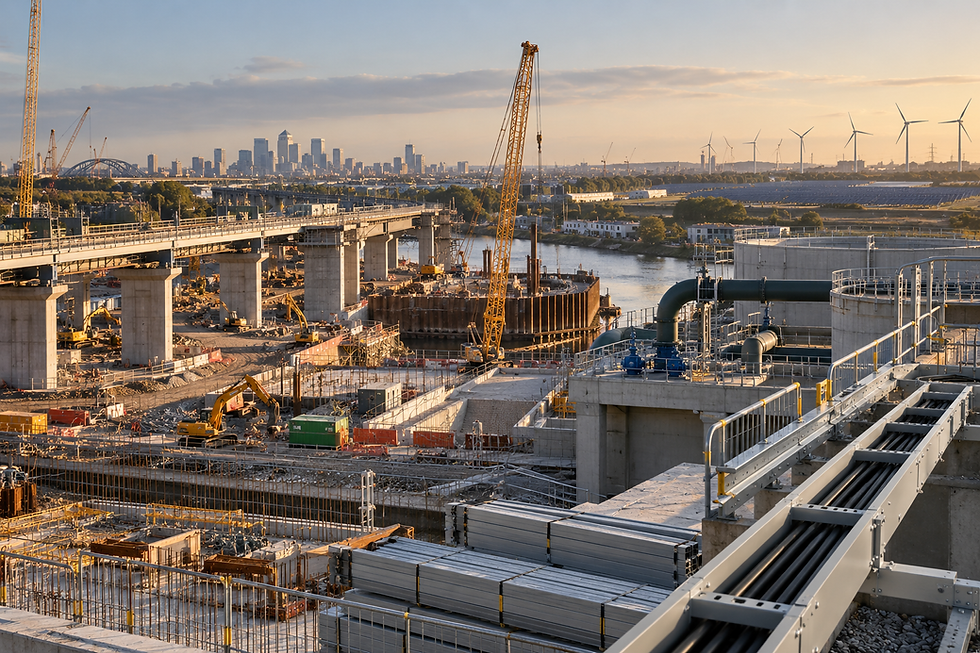
The Sectors Leading UK Construction — and Why FRP Belongs in All of Them
The two-speed market is not an abstract financial phenomenon. It has a physical expression in the ground: water treatment works being constructed across the country under AMP8's £104 billion investment cycle, solar farms being commissioned at a rate of 5 to 5.5 GWp per year, offshore wind foundations being installed in UK waters, grid transmission and distribution infrastructure being upgraded across the national network, SMR sites entering early works programmes, and AI data centre facilities being built at unprecedented power density. Each of these physical construction activities creates secondary infrastructure specification decisions, and in each case the secondary infrastructure environment — corrosive, electrically sensitive, magnetically sensitive, or thermally demanding — is one where FRP is the correct material specification and steel accumulates maintenance liabilities from the first years of operation.
The water and sewerage sector illustrates this most clearly. Blockbuster transformation programmes are being lined up in the energy and water sectors. Sewerage construction spending grew 74.8% in 2025 according to ONS data. Every new sewage treatment works constructed under AMP8 contains secondary grating, walkways, cable management, and structural profiles operating in H₂S, chlorine, and persistent humidity — the most chemically aggressive secondary infrastructure environment in UK civil construction. FRP in vinyl ester resin is immune to every chemical driver in that environment. Galvanised steel accumulates corrosion from the first years of operation and requires recoating maintenance across the facility's 50-year design life. The AMP8 construction surge is creating a concentrated window of secondary specification decisions where the correct material choice eliminates 50 years of maintenance and the incorrect one creates it.
The energy sector tells a similar story at larger scale. The 100GW of generating capacity that the ICE identifies as required encompasses solar farms, offshore wind, onshore wind, battery energy storage, and the SMR fleet that GBE-N is assembling. Every solar farm needs DC cable management that is non-conductive at 1,500V string voltage, corrosion-immune in outdoor agricultural environments, and maintenance-free across 30-year CfD horizons. Every offshore wind installation needs non-sparking, non-magnetic, saltwater-immune secondary structural materials on topsides and at installation vessel deck level. Every BESS installation needs non-sparking secondary structural materials in the Zone 1 and Zone 2 explosive atmosphere zones adjacent to battery modules. FRP provides the complete property set that each of these energy infrastructure environments requires, in every case, simultaneously.
The Rewiring of Britain and What It Creates for FRP Specification
The ICE's description of a rewiring of Britain — reconfiguring the nation's transmission and distribution networks — is one of the largest secondary infrastructure specification opportunities of the decade. National Grid's RIIO-T3 transmission investment programme, Ofgem's approved £28 billion network investment rising to a potential £90 billion over five years to 2031, and the NESO grid connection programme that issued 713 connection offers in June 2026 collectively represent an electricity network upgrade at a scale and pace that the UK has not seen since the original electrification of the national grid in the mid-twentieth century.
Every substation upgrade, every new overhead line tower, every underground cable route, and every grid connection works package in that programme contains secondary cable management and structural profiles. The electrical environments of high-voltage transmission and distribution infrastructure — where non-conductive cable management eliminates earthing and bonding requirements at 11kV, 33kV, 132kV, and 400kV system voltages — are environments where the non-conductive property of FRP is a specific and safety-relevant specification advantage over metallic cable management. And the outdoor atmospheric environments of transmission and distribution infrastructure sites, exposed to UV, temperature cycling, and in coastal locations marine atmospheric chloride, across 30 to 50-year asset lives, are environments where FRP's corrosion immunity eliminates the maintenance recoating cycles that galvanised steel accumulates in the same conditions.
Nine New Reservoirs and the Water Infrastructure Secondary Specification
The ICE's reference to nine new large reservoirs — the first for 35 years — is a striking illustration of the scale of the water sector transformation the £725 billion strategy is funding. New reservoirs require civil engineering works of significant scale: embankment construction, spillway structures, intake and outlet works, and the water treatment infrastructure that processes the stored water for supply. The secondary infrastructure of those facilities — grating, walkways, cable management, and structural framing — operates in the same water chemistry environments as existing water treatment works: chlorine dosing, pH adjustment, persistent humidity, and in upland reservoir locations the mildly acidic chemistry of catchment surface water.
Building nine new reservoirs is building nine new secondary infrastructure specification programmes, each with a 50-year design life and each in a water chemistry environment where galvanised steel secondary infrastructure accumulates maintenance liabilities that FRP secondary infrastructure eliminates. The specification decisions made for those new reservoirs, and for the water treatment infrastructure that accompanies them, will be made once and will determine the maintenance profiles of those assets across the next five decades. Getting those decisions right — specifying FRP in vinyl ester resin for the water chemistry environments of reservoir and water treatment secondary infrastructure — is significantly more effective and less costly than revising them after the facilities are commissioned and operational.
What Reinforce Technology Supplies Across the £725 Billion Programme
Reinforce Technology's product range covers the secondary infrastructure specification needs of every major sector in the £725 billion infrastructure programme. FRP cable trays for DC and AC cable management in solar farms, substations, EV charging hubs, and AI data centres. FRP grating and walkways for water treatment works, sewage treatment plants, cooling towers, and process facilities. FRP structural profiles for secondary framing in offshore and marine structures, coastal civil infrastructure, and the building secondary structures of the hospitals, schools, and prisons that form the social infrastructure component of the national strategy. FRP perimeter fencing for the solar farms, water treatment works, BESS installations, and hydrogen facilities that constitute the energy and utility infrastructure of the programme. FRP drainage for the chemical and process environments of water treatment and industrial infrastructure.
Each of these products addresses a specific limitation of galvanised steel secondary infrastructure in the environment where that steel would otherwise be specified. The secondary infrastructure specification decisions across the 734 projects in the NISTA pipeline will collectively determine whether UK infrastructure assets created under the £725 billion strategy operate maintenance-free across 30 to 50-year design lives or accumulate the maintenance liabilities that incorrect initial specification creates. Reinforce Technology is positioned to support those specification decisions across every sector of the programme, with the technical expertise, product range, and documented performance data that correct FRP secondary infrastructure specification requires.
The UK has committed £725 billion to infrastructure over the next decade. The construction market has split in two: energy, water, utilities, and renewables are leading while housing and commercial deteriorate. The sectors outperforming are precisely the sectors where FRP secondary infrastructure eliminates the corrosion, conductivity, and maintenance liabilities that galvanised steel creates across 30 to 50-year design lives. Reinforce Technology supplies FRP cable trays, grating, structural profiles, fencing, and drainage for the energy, water, and utilities infrastructure that is driving UK construction output in 2026 and will continue to do so across the decade to 2035.
Contact Reinforce Technology
Reinforce Technology supplies FRP secondary infrastructure products for energy, water, utilities, renewables, offshore, and civil infrastructure projects across the UK. If your project is in the NISTA pipeline, in the AMP8 water investment programme, in the Clean Power 2030 solar and wind build-out, or in the nuclear, hydrogen, or AI data centre sectors, we supply the FRP secondary specification that eliminates maintenance liabilities across your asset's design life. Contact us to discuss your project and the correct FRP specification for your application, environment, and operational horizon.

Final confirmation of suitability for any specific application remains the responsibility of the appointed project engineer. Reinforce Technology provides technical guidance and material recommendations based on information supplied to us, but specification sign-off should always sit with the qualified professional responsible for the design.
References
Daily Build (2026) UK Construction 2026: Navigating a Two-Speed Market Amid £725bn Infrastructure Push. Available at: https://dailybuild.co.uk/p/uk-construction-2026-navigating-a-two-speed-market-amid-725bn-infrastructure-push [Accessed: 10 September 2026]. [Infrastructure, energy, water and industrial projects sustaining demand; private housing and commercial deteriorating; PMI below 50 for 15 consecutive months to March 2026; non-residential project starts up 6% Q1 2026 led by utilities and civil engineering].
ICE (2026) State of the Nation: Infrastructure in 2026. Institution of Civil Engineers. Available at: https://knowledgehub.ice.org.uk/insight/state-nation-2026/ [Accessed: 10 September 2026]. [£725bn strategy a 50% increase on previous ten years; blockbuster transformation programmes in energy and water; 100GW generating capacity required; rewiring of Britain for transmission and distribution; nine new large reservoirs first for 35 years].
IntechOpen (2022) 'Fibre-Reinforced Polymer (FRP) in Civil Engineering', in IntechOpen Engineering Series. Available at: https://www.intechopen.com/chapters/84203 [Accessed: 10 September 2026]. [Non-conductive; corrosion-immune; non-sparking; non-magnetic; 70 to 75% lighter than steel; 25 to 50-year maintenance-free design life in corrosive and electrically sensitive environments].
Morson Group (2026) The Infrastructure Sector Report 2026. Available at: https://morson-group.com/news/the-infrastructure-sector-report-2026/ [Accessed: 10 September 2026]. [£725bn commitment; 780 major projects in national pipeline; energy transition and regulated utilities including electricity transmission, offshore wind, water and environmental programmes as leading investment drivers].
NISTA (2026) Updated Pipeline Helps the Country Build Better. Available at: https://projectdelivery.gov.uk/2026/03/10/updated-pipeline-helps-the-country-build-better/ [Accessed: 10 September 2026]. [734 projects worth £718 billion; new hospitals, schools, railways, reservoirs and clean energy plants; public and privately delivered infrastructure programmes in construction, under development or in pre-project stages].
ScienceDirect (2025) 'Sustainable composites for metal replacement: Environmental assessment and material selection of fiber-reinforced polymer across industries', ScienceDirect, doi: 10.1016/S2667-3789(25)00051-3. Available at: https://www.sciencedirect.com/science/article/pii/S2667378925000513 [Accessed: 10 September 2026].


Comments