
What Does Sustainability Actually Mean? Agrivoltaic Farming Is the Closest Answer UK Agriculture Has Right Now.
Sustainability is one of the most overused words in modern construction. It appears on procurement documents, planning submissions, and corporate reports so frequently that its meaning has blurred. But the idea behind it is precise and worth recovering: a sustainable system is one that sustains itself. It does not consume more than it produces. It does not generate waste that poisons the conditions it depends on. It does not borrow from the future to pay for the present. Agrivoltaic farming, at its best, is that system made real. And FRP is the infrastructure material that allows it to last.
Published by Reinforce Technology | June 2026
A healthy forest does not need external inputs to maintain itself. Sunlight is converted into biomass. Fallen trees become the substrate for the next generation. Leaf litter feeds the fungi that support the roots above. Water is retained in the soil and released slowly. Nothing accumulates as waste. Nothing depletes faster than it is replenished. The forest sustains itself across centuries without drawing on resources from outside its own boundaries. That is what sustainability means in its most fundamental and most demanding sense.
The UK's food and energy systems are, by this standard, far from sustainable. They are linear systems: fossil fuels extracted, burned, and converted to CO₂ that accumulates in the atmosphere. Food produced using inputs, transported, consumed, and generating waste that the soil does not readily recapture. Land devoted to one use, food or energy, rather than both. The resource flows are largely one-directional. The accumulations, of carbon, of waste, of depleted soil, are real and growing.
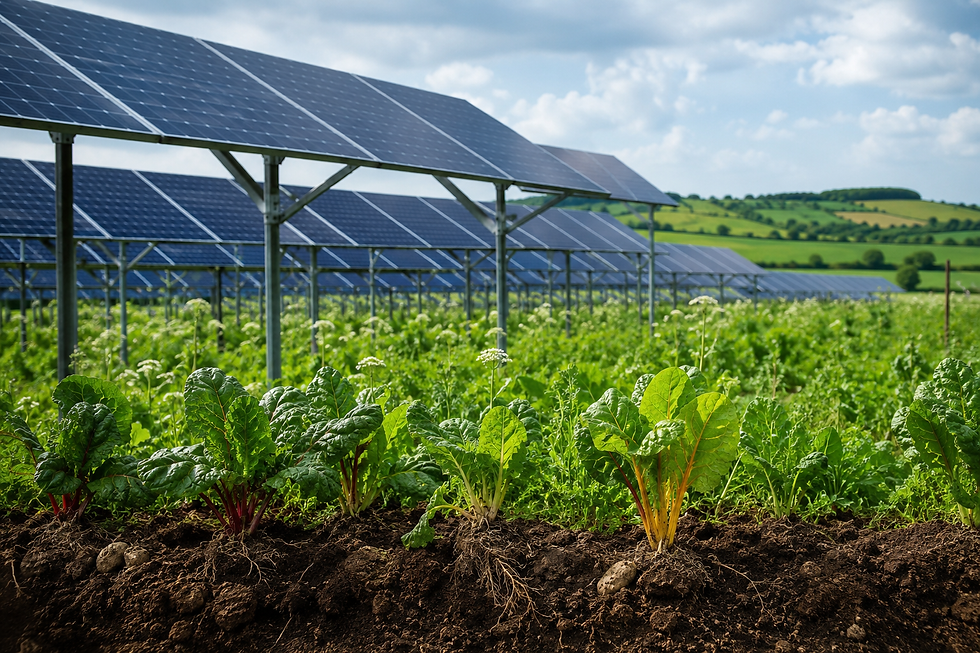
Agrivoltaic farming is one of the most practical and immediately deployable responses to that problem available in the UK right now. Not because it solves everything, it does not, but because it closes several of the most significant resource loops simultaneously. It produces food and energy from the same land. It uses the shade of energy-generating panels to reduce water evaporation, cutting the irrigation demand that strains water resources. It can improve soil carbon levels beneath the array over time. It keeps agricultural land in food production while simultaneously generating the clean electricity that reduces the UK's dependence on imported fossil fuels. It is, in the precise sense of the word, more sustainable than either farming alone or solar farming alone because it produces more and wastes less from the same input: land.

What Makes Agrivoltaics Genuinely Sustainable
The sustainability case for agrivoltaics is not primarily about the solar panels. It is about what happens to the land. A conventional solar farm removes agricultural land from food production for 25 to 30 years. That is the trade that has generated legitimate public opposition to ground-mounted solar development on productive farmland, and it is a trade that the UK cannot afford at the scale that the Clean Power 2030 target would require if conventional solar were the only model available. The University of Sheffield's 2025 analysis found that 55.5% of UK land is suitable for agri-PV deployment, enough to meet UK electricity demand more than four times over without any land use conflict, precisely because the land continues to produce food (The Planner, 2025).
The land use efficiency argument is straightforward. Studies report that combined agrivoltaic land use can reach 186% efficiency compared with using separate areas exclusively for farming and solar generation (GreenMatch, 2025). The same hectare produces crops and electricity simultaneously. The inputs, sunlight, land, and rainfall, serve both outputs at once. That is the resource loop closing in real time.
The water argument is less obvious but equally important. Panel shade reduces soil evapotranspiration by 14 to 30%, depending on the configuration, panel height, and crop type (Earth Day, 2026). In the UK, where 2025 was the warmest and sunniest year on record and where summer droughts are becoming a growing agricultural risk, water retained in the soil beneath agrivoltaic panels is water that does not need to be drawn from an aquifer, a river, or a mains supply. It is a resource that the system conserves rather than depletes.
The soil carbon argument takes longer to manifest but is documented. Research published in 2025 found soil organic carbon levels under agrivoltaic arrays increased by 10 to 15% within three years of installation (Editorial Ge, 2026). The shade moderates soil temperature extremes, reduces moisture loss, and supports the microbial communities that build soil organic matter. A soil that gains organic carbon over time is a soil that is becoming more fertile, more water-retentive, and more resilient to both drought and waterlogging. It is a soil that is sustaining itself rather than depleting.
Where the System Breaks Down Without the Right Infrastructure
A sustainable system, in the forest analogy, does not import waste from outside its own boundaries. It does not accumulate substances that poison the conditions it depends on. This is where the specification of agrivoltaic mounting infrastructure becomes a sustainability question in the most direct sense, not a procurement question dressed up in sustainability language.
Galvanised steel mounting frames corrode in active agricultural environments. The zinc coating that provides corrosion protection is a sacrificial layer that depletes, releasing zinc compounds into the soil at every ground contact point across the operational life of the installation. Zinc at elevated concentrations is toxic to the soil microbial communities that build the organic carbon the system is trying to accumulate. It disrupts the very biological processes that make the soil more fertile over time. The infrastructure that was specified to support a sustainable agrivoltaic system is, if made from galvanised steel, slowly poisoning the sustainability outcome it was built to deliver.
This is not a theoretical concern. It is the mechanism by which galvanised steel corrodes in moist, chemically active agricultural soils, and it proceeds at a rate that compounds with the intensity of the agricultural activity around it. Fertilisers, pesticides, and soil acids all accelerate the depletion of the zinc coating. The more productive the farming beneath the panels, the faster the contamination accumulates.
FRP mounting frames produce no corrosion products. There is no zinc to leach, no iron oxide to form, and no chemical byproduct of any kind to enter the soil beneath the frames at any point across a 30-year operational life. The soil beneath an FRP mounting frame at year twenty-nine is chemically identical to the soil at installation day in terms of infrastructure-derived contamination. That is the system maintaining its own conditions rather than degrading them. That is, in the precise sense used at the start of this article, sustainability (IntechOpen, 2022).
The Energy Loop and the Food Loop Closing Together
A sustainable system, at its most ambitious, closes its own resource loops. The forest does not export carbon to the atmosphere. It captures it. The agrivoltaic farm, at its most integrated, approaches something similar. The solar electricity generated on farm can power the farm's own energy demands: irrigation pumping, grain drying, cold storage, livestock ventilation. Energy that was previously imported from the grid at volatile wholesale prices is now generated on site at a fixed cost determined at installation. The energy loop, from sunlight to electricity to farm operations, closes on the same land.
The food loop operates alongside it. The crops grown beneath the panels feed the supply chains that the UK economy depends on. The reduced water demand through panel shade reduces the pressure on water resources that intensive agriculture creates. The improving soil carbon under the array builds the fertility that sustains food production across subsequent decades, without the synthetic fertiliser inputs that conventional farming requires to maintain yields on depleted soils.
Neither loop is perfectly closed. The panels themselves have an embodied carbon cost from manufacturing. The FRP frames have a manufacturing emissions profile that, while substantially lower than equivalent steel sections, is not zero. The crops require inputs. The system is not the forest, perfectly self-sustaining without external inputs. But it is substantially closer to that model than the linear systems it replaces, and the direction of travel is consistently toward greater closure of those loops as agrivoltaic systems become more integrated, more technically sophisticated, and more widely deployed.
FRP as a Sustainability Decision, Not a Procurement Decision
The choice between FRP and galvanised steel mounting frames on an agrivoltaic installation is typically presented as a procurement decision. It is, in truth, a sustainability decision. Galvanised steel frames accumulate a corrosion liability from the first growing season. They introduce chemical contamination into the soil system the agrivoltaic installation is designed to improve. They require maintenance access across active farmland at irregular intervals, each of which disturbs the soil structure and biological communities the system is trying to build. They do not sustain the system. They work against it, quietly, across 30 years of operation.
FRP frames do not corrode. They do not contaminate. They do not require maintenance access. They do not introduce any substance into the soil, water, or air of the agrivoltaic system at any point across their operational life. Their manufacturing emissions are approximately 60 to 70% lower per tonne than primary steel production on a cradle-to-gate basis (ScienceDirect, 2025). Their design life of 30 years or more matches the operational horizon of the agrivoltaic installation without requiring replacement within that period.
In the terms this article opened with: FRP mounting infrastructure sustains the system it is part of rather than depleting it. That is what sustainability requires from the materials we build with. And in the agrivoltaic context, where the whole purpose of the installation is to demonstrate that food production and energy generation can coexist and reinforce each other on the same land for 30 years, the specification of mounting infrastructure that does not undermine that purpose from the inside is not optional. It is the specification that makes the sustainability claim true rather than aspirational.
Reinforce Technology FRP Products for Agrivoltaic Installations
Reinforce Technology supplies FRP structural profiles and cable management systems for agrivoltaic solar farm applications across the UK. Our pultruded FRP profiles, independently tested by SGS and TÜV Rheinland, are available in polyester and vinyl ester resin systems with UV-stable formulations rated for the full 30-year operational life of the installation. No soil contamination, no corrosion products, no maintenance access required across 30 years of farming beneath the panels.
Contact us to discuss your agrivoltaic project and the correct FRP specification for your farm, crop rotation, and sustainability objectives.
Final confirmation of structural suitability for any specific agrivoltaic application remains the responsibility of the appointed project engineer. Reinforce Technology provides material guidance based on information supplied to us. We are happy to provide full technical data sheets and application-specific support to assist with that process.
References
Earth Day (2026) How Soil and Solar Can Pay Farmers Back. Available at: https://www.earthday.org/how-soil-and-solar-can-pay-farmers-back/ [Accessed: June 2026]. [Agrivoltaics reduce irrigation needs by 14 to 30%; shade reduces heat stress in livestock].
Editorial Ge (2026) Future of Agrivoltaics in Sustainable Farming: Harvesting Sun and Soil. Available at: https://editorialge.com/future-of-agrivoltaics-in-sustainable-farming/ [Accessed: June 2026]. [Soil organic carbon increases 10 to 15% within three years of agrivoltaic installation].
GreenMatch (2025) Agrovoltaics: Solar Energy for Sustainable Farming. Available at: https://www.greenmatch.co.uk/blog/agrovoltaics-solar-energy-for-sustainable-farming [Accessed: June 2026]. [Land use efficiency up to 186%; net farm income increase up to 142%].
IntechOpen (2022) 'Fibre-Reinforced Polymer (FRP) in Civil Engineering', in IntechOpen Engineering Series. Available at: https://www.intechopen.com/chapters/84203 [Accessed: June 2026]. [GFRP no corrosion mechanism; no chemical contamination at ground contact points].
ScienceDirect (2025) 'Sustainable composites for metal replacement: Environmental assessment and material selection of fiber-reinforced polymer across industries', ScienceDirect, doi: 10.1016/S2667-3789(25)00051-3. Available at: https://www.sciencedirect.com/science/article/pii/S2667378925000513 [Accessed: June 2026]. [Pultruded GFRP manufacturing emissions approximately 60 to 70% lower per tonne than primary steel production, cradle-to-gate].
The Planner (2025) Solar Technology Could Meet UK Power Needs Without Losing Farmland. Available at: https://www.theplanner.co.uk [Accessed: June 2026]. [University of Sheffield 2025: 55.5% of UK land suitable for agri-PV; could meet UK electricity demand four times over without land use conflict].


Comments