
A Solar Farm Has Three Secondary Infrastructure Categories. Specify All Three in FRP.
A ground-mount solar farm has three categories of secondary infrastructure: the mounting frames that carry the panels, the cable management that routes the DC output to the inverters, and the perimeter fencing that secures the site across its operational life. They are typically specified separately, procured separately, and installed by different subcontractors. But they share the same outdoor agricultural environment, the same 30-year design life, and the same corrosion, UV, and thermal cycling exposure. Specifying all three in FRP as a coordinated system delivers whole-life performance that a patchwork of separate material specifications cannot match.
Published by Reinforce Technology | 25 August 2026
The UK solar market is adding 5 to 5.5 GWp in 2026, with ground-mounted projects representing approximately 70% of new capacity. A 1 acre ground-mount solar farm costs £400,000 to £600,000 fully installed in 2026, covering panels, racking and foundations, inverters, cabling, grid connection, fencing and CCTV (Solar Panels for Farms, 2026). A 50 MWp utility-scale solar farm scales that cost across multiple hundreds of acres, with the secondary infrastructure — mounting structure, cable management, and perimeter fencing — representing a meaningful proportion of the total capital expenditure and an even more meaningful proportion of the whole-life cost if the material specification decisions create maintenance liabilities that accumulate across the 30-year CfD or PPA horizon.
The conventional approach to solar farm secondary infrastructure specification treats the three categories as separate procurement decisions. The mounting structure is specified and procured by the mechanical subcontractor. The cable management is specified and procured by the electrical subcontractor. The perimeter fencing is specified and procured by the civil works package. The result, on a site that will be maintained by a single asset owner across 30 years, is a patchwork of secondary infrastructure specifications with different maintenance requirements, different failure modes, and different replacement timelines.
The alternative approach specifies all three categories in FRP as a coordinated system from the outset. The mounting frames, cable tray runs, and perimeter fencing of the solar farm all share the same material platform: glass fibre reinforced polymer, corrosion-immune in the outdoor agricultural environment, non-conductive in the DC electrical environment, UV-stable in direct solar exposure, and maintenance-free across the 30-year design life of the installation. The coordinated FRP specification eliminates the maintenance patchwork and delivers the programme and cost savings of FRP installation across all three secondary infrastructure categories simultaneously.
FRP Mounting Frames: What the Solar Farm Environment Demands
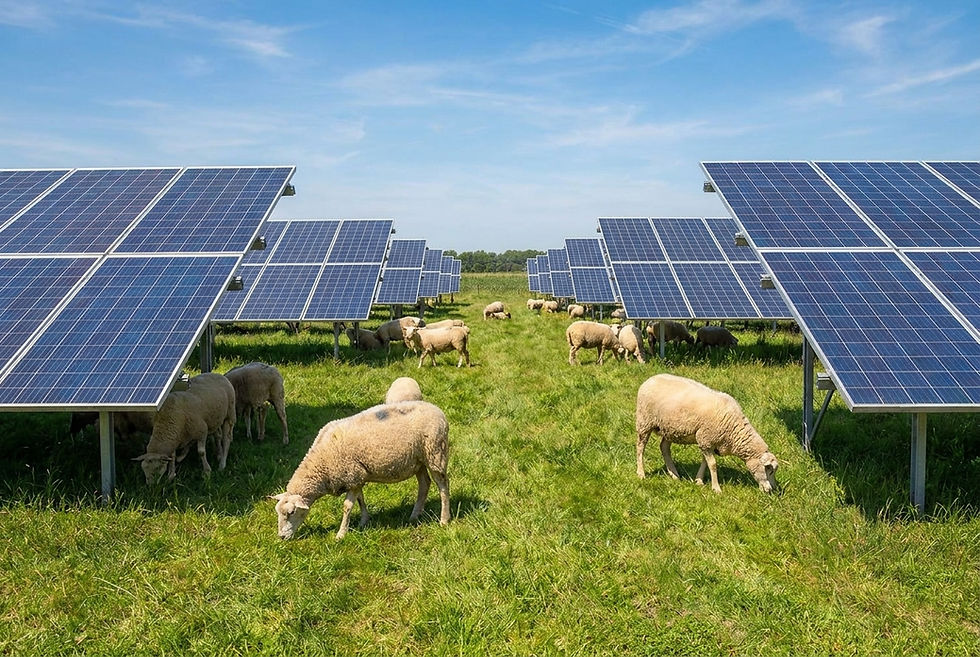
The mounting frames of a ground-mount solar farm carry the photovoltaic panels across an outdoor agricultural site for 30 years. They sit in direct solar exposure for every hour of generation, in ground contact or close proximity to agricultural soil, and in the outdoor atmospheric environment of the UK's increasingly variable summer weather. The structural demand is well-understood: they must resist the wind uplift and lateral loading of the panels across the full wind loading envelope of the site, accommodate thermal expansion and contraction across the UK's seasonal temperature range, and maintain panel orientation and alignment across 30 years without connection loosening or structural settlement.
Galvanised steel mounting frames in ground contact on an agricultural site begin to accumulate corrosion at the post base and soil contact points within the first years of installation. The zinc coating in direct soil contact depletes faster than in open atmospheric exposure because the persistent soil moisture and the mildly acidic chemistry of agricultural soils create a continuously wet, mildly corrosive electrochemical environment at the zinc surface. Corrosion progresses from the post base upward, generating visible rust at connection details and structural section loss in the post below ground over the 30-year operational life.
FRP pultruded structural profiles for solar mounting frames have no corrosion mechanism in direct soil contact, in agricultural soil chemistry, or in the outdoor atmospheric environment at any temperature or UV intensity. The mounting frame installed on day one has the same structural performance on day 10,950 as it did on day one, without any maintenance intervention. For agrivoltaic installations where the soil beneath the mounting frames must remain productive for certified organic food production, the absence of zinc contamination from FRP mounting frames is not just a maintenance advantage. It is a certification and revenue protection advantage that galvanised steel mounting frames cannot match (IntechOpen, 2022).
The non-conductive property of FRP mounting frames is also directly relevant in the solar farm electrical environment. At string voltages of 1,000V to 1,500V DC, a metallic mounting frame in contact with or close to a cable with damaged insulation creates a conducted fault current path to ground that FRP mounting frames do not provide. Non-conductive FRP mounting frames eliminate this conducted fault current risk at the structural level, complementing the non-conductive FRP cable trays that route the DC cables through the array.
FRP Cable Trays: Routing 1,500V DC Across 30 Years
The DC cable management of a ground-mount solar farm routes the string output from the panel rows to combiner boxes and from combiner boxes to central inverters. At 1,500V DC string voltage, the cable management operates at voltages where non-conductive cable tray eliminates the DC arc propagation risk that sustained DC arcs in metallic cable trays present, a fire initiation pathway with no equivalent in AC cable management at lower voltages.
DC arcs at 1,500V do not extinguish at natural zero-crossings in the way that AC arcs do at 50Hz. An arc initiated in a steel cable tray by a DC fault event sustains itself and propagates along the tray infrastructure until the protective devices in the circuit interrupt the fault current. Non-conductive FRP cable trays eliminate the conductive fault current path through the tray wall, containing any arc event at the fault location rather than allowing it to propagate along the secondary cable management infrastructure (Solar Love, 2026).
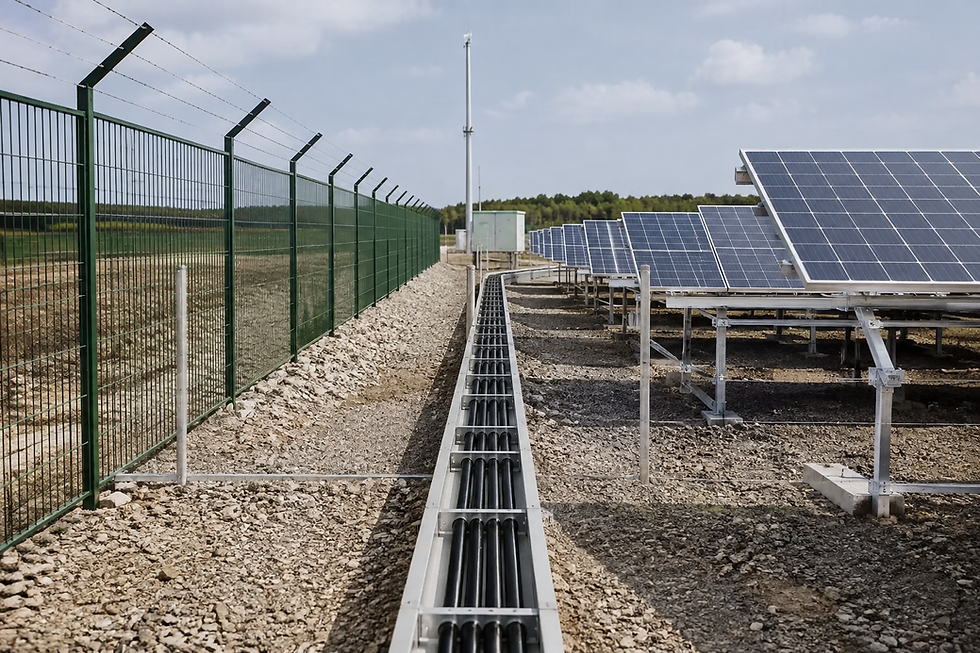
Beyond the DC arc risk, FRP cable trays on a solar farm provide the same corrosion-immune outdoor agricultural performance as the mounting frames: no coating to deplete in soil contact, no rust in the outdoor atmospheric environment, no maintenance recoating across 30 years. They install faster than steel with snap-fit connection systems that eliminate hot work from the installation programme, reducing the installation subcontractor's labour cost and programme duration across several kilometres of cable tray runs on a large solar farm. And they require no earthing and bonding in the 1,500V DC environment, eliminating the earthing programme that metallic cable trays generate across a large installation (Fibrograts, 2026).
FRP Perimeter Fencing: Security Without Scrap Value
The perimeter fencing of a ground-mount solar farm physically secures the site against unauthorised access, deters the organised metal theft operations that have made UK solar farms one of the highest-risk categories of infrastructure for cable theft, and defines the operational boundary of the installation across a 30-year consent period.
Steel perimeter fencing on a solar farm has scrap metal value. Organised crime groups targeting renewable energy infrastructure for cable theft do not stop at the cables inside the perimeter. Steel palisade panels, steel mesh sections, and steel posts all have a realised value through illegal metal dealers. DeterTech intelligence confirmed the UK entered a peak period of solar site theft by fully industrialised criminal networks in 2025, with 750 kilometres of cable stolen from UK solar farms in an eight-month period and fencing repair costs of £110 to £150 per metre (WCCTV, 2026).
FRP perimeter fencing has a scrap value of precisely zero. Glass fibre and polymer resin cannot be smelted, sold to a metal dealer, or monetised through any channel that organised metal theft uses. An FRP perimeter fence eliminates the secondary theft incentive that steel perimeter fencing provides, independently of any other security measure on the site. It also eliminates the earthing and bonding requirement that steel fencing in proximity to the site's DC electrical infrastructure would demand, and the corrosion maintenance cycle that steel agricultural perimeter fencing accumulates across 30 years of outdoor exposure.
The Coordinated FRP System: Why Specifying All Three Together Matters
The case for specifying mounting frames, cable trays, and perimeter fencing in FRP as a coordinated system goes beyond adding the individual advantages of each category together. The coordinated FRP specification creates three compounding benefits that the patchwork specification of different materials across the three categories does not deliver.
The first is whole-life cost coherence. When all three secondary infrastructure categories share the same 30-year maintenance-free design life, the asset owner has a single, consistent maintenance liability profile for the entire secondary specification: none. No recoating cycles for mounting frames. No earthing continuity verification for cable trays. No fencing repair budget for corroded steel panels. The whole-life cost of the FRP-specified solar farm is lower and more predictable than a mixed-material specification where each category has a different maintenance timeline and a different failure mode.
The second is installation programme coherence. When all three FRP secondary infrastructure categories are procured from a single supplier and installed by coordinated subcontract teams, the installation programme benefits from the shared lightweight handling advantages, shared snap-fit and bolted connection methodologies, and shared hot-work-free installation approach across all three categories. The crane requirements, the plant mobilisation, and the site safety management for FRP installation across all three categories are simpler and cheaper than equivalent steel installation across the same three, because the same lightweight, hot-work-free, standard-tool installation approach applies throughout.
The third is planning and asset management coherence. A planning application for a solar farm on productive agricultural land that presents a coordinated FRP secondary specification, covering mounting frames that produce no soil contamination, cable trays that require no maintenance access to the agricultural land beneath the array, and perimeter fencing with zero scrap value and 30-year maintenance-free performance, makes a stronger planning case than a patchwork material specification. The FRP package can be presented to the planning authority and the CfD counterparty as a single, coherent whole-life secondary specification with documented performance across 30 years in the agricultural outdoor environment of a UK ground-mount solar farm.
Solar Farm Secondary Specification: The FRP Package
For a utility-scale ground-mount solar farm project in the UK in 2026, the coordinated FRP secondary specification across mounting frames, cable trays, and perimeter fencing covers the following. Mounting frame profiles: pultruded FRP structural sections in polyester or vinyl ester resin, section sizes determined by structural engineering design for wind loading and panel weight at the specific site wind speed zone and soil conditions. Cable trays: FRP ladder trays with snap-fit accessory systems in polyester resin with UV-stable formulations, tray widths determined by cable bundle size and routing geometry, rated to IEC 61537 for the DC electrical environment. Perimeter fencing: FRP post and rail mesh panel fencing in polyester resin for standard agricultural atmospheric environments or vinyl ester for coastal sites, 358 anti-climb mesh aperture for security perimeter, post embedment depths confirmed against soil bearing capacity at post locations.
All three categories specified together, procured together where possible, and installed in a coordinated programme that takes advantage of the shared FRP installation methodology across the site.
A UK ground-mount solar farm is a 30-year agricultural outdoor installation with three categories of secondary infrastructure that all share the same environment, the same design life, and the same corrosion, UV, and thermal cycling exposure. Specifying mounting frames, cable trays, and perimeter fencing in FRP as a coordinated system delivers whole-life cost coherence, installation programme coherence, and planning coherence that a patchwork material specification cannot match. The UK solar market is adding 5.5 GWp in 2026. Every ground-mount project in that pipeline has three secondary specification decisions to make. Making all three in FRP, together, from the outset, is the approach that delivers 30 years of maintenance-free performance across the full secondary specification of the installation.
Reinforce Technology FRP for Solar Farm Secondary Infrastructure
Reinforce Technology supplies FRP pultruded structural profiles for solar mounting frames, FRP ladder cable trays with snap-fit accessories for DC cable management, and FRP post-and-rail mesh perimeter fencing for ground-mount solar farms across the UK. All products in UV-stable polyester or vinyl ester resin systems, non-conductive throughout, corrosion-immune in outdoor agricultural environments, and maintenance-free across 30-year solar farm design lives. Supply across all three secondary categories from a single source, with full technical documentation and load data for project QA submissions.

Contact us to discuss your solar farm project and the coordinated FRP secondary specification for your mounting structure, cable management, and perimeter fencing.
Final confirmation of suitability for any specific solar farm application, including structural design for wind loading, cable current-carrying capacity assessment, and post embedment design for specific soil conditions, remains the responsibility of the appointed project engineer. Reinforce Technology provides technical guidance and material recommendations based on information supplied to us, but specification sign-off should always sit with the qualified professional responsible for the design.
References
Fibrograts (2026) FRP Cable Tray Sizes and Specifications: Complete Guide. Available at: https://fibrograts.com/frp-cable-tray-sizes-and-specifications/ [Accessed: 25 August 2026]. [Snap-fit connection system; no hot work permits; standard hand tools; 30 to 50% faster installation than bolted steel].
IntechOpen (2022) 'Fibre-Reinforced Polymer (FRP) in Civil Engineering', in IntechOpen Engineering Series. Available at: https://www.intechopen.com/chapters/84203 [Accessed: 25 August 2026]. [Non-conductive; corrosion-immune in soil contact and outdoor agricultural environments; UV-stable; 30-year maintenance-free design life; no zinc contamination from FRP in soil contact].
NACE International (2016) International Measures of Prevention, Application and Economics of Corrosion Technology (IMPACT). Houston, TX: NACE International. Available at: http://impact.nace.org/economic-impact.aspx [Accessed: 25 August 2026].
ScienceDirect (2025) 'Sustainable composites for metal replacement: Environmental assessment and material selection of fiber-reinforced polymer across industries', ScienceDirect, doi: 10.1016/S2667-3789(25)00051-3. Available at: https://www.sciencedirect.com/science/article/pii/S2667378925000513 [Accessed: 25 August 2026].
Solar Love (2026) Earthing and Grounding Solar Systems UK (2026). Available at: https://solarlove.org/earthing-grounding-solar-systems/ [Accessed: 25 August 2026]. [Sustained DC arcs fire-ignition pathway; DC arc propagation in metallic cable management at 1,500V DC].
Solar Panels for Farms (2026) 1 Acre Solar Farm UK 2026. Available at: https://solarpanelsforfarms.uk/1-acre-solar-farm-uk/ [Accessed: 25 August 2026]. [£400,000 to £600,000 fully installed 1 acre ground-mount; covers panels, racking, inverters, cabling, grid connection, fencing and CCTV].
Solar Power Portal (2026) UK Solar Forecast to Grow 50% YoY Again in 2026. Available at: https://www.solarpowerportal.co.uk [Accessed: 25 August 2026]. [5 to 5.5 GWp forecast 2026; ground-mount 70% of new capacity].
WCCTV (2026) Cost of Solar Farm Theft in the UK. Available at: https://www.wcctv.co.uk [Accessed: 25 August 2026]. [750km cable stolen in eight-month period; fencing repairs £110 to £150 per metre; DeterTech peak period of industrialised solar crime].
Younis, A., Ebead, U. and Judd, S. (2018) 'Life cycle cost analysis of structural concrete using seawater, recycled concrete aggregate, and GFRP reinforcement', Construction and Building Materials, 175, pp. 135-144. doi: 10.1016/j.conbuildmat.2018.04.183.


Comments