
The UK Has 121,262 Public EV Chargers and Needs Hundreds of Thousands More. Here Is Why Nobody Is Talking About What They Are Built From — and Why They Should Be.
At the end of May 2026, the UK had 121,262 public EV chargers across 46,664 locations. Ultra-rapid chargers grew 41% in 2025 alone. The government's target requires hundreds of thousands more by 2030. Every charging hub — motorway, depot, urban, and rural — requires cable management, grating, structural profiles, and perimeter infrastructure that must perform outdoors, in electrically sensitive environments, for 20 to 25 years. Nobody is talking about what those hubs are built from. They should be.
Published by Reinforce Technology | June 2026
The UK's public EV charging network grew by just over 19% in 2025, with 14,097 new charge points added across the year (Zapmap, 2026). By the end of May 2026, 121,262 EV chargers were operational across 46,664 locations nationwide (Zapmap, 2026). Ultra-rapid chargers — the 150 kW and above devices being deployed at motorway service areas, charging hubs, and fleet depots — grew 41% in 2025 alone, reflecting the concentrated industry push to build the high-power infrastructure that enables long-distance EV travel (New Civil Engineer, 2026).
The government's EV infrastructure targets require this pace to be sustained and significantly accelerated. The ZEV mandate requires 80% of new car sales to be electric by 2030. The Local Electric Vehicle Infrastructure fund and the Rapid Charging Fund are directing capital into the high-power public network. Private investment from operators including BP Pulse, Gridserve, Pod Point, and Osprey is scaling at pace. The infrastructure being deployed now — the charging hubs at motorway service areas, the depot charging installations at logistics facilities, the on-street charging infrastructure in urban centres — will be the foundation of the UK's EV charging network for the next two decades.
Behind every charge point is a secondary infrastructure system that most coverage of the EV charging boom completely ignores. The cable trays routing high-voltage AC and DC cables from the grid connection to the charge point enclosures. The grating and walkways providing safe technician access to equipment in outdoor, weather-exposed charging hub environments. The structural profiles supporting cable management overhead and at ground level across large depot and hub installations. The perimeter fencing securing charging sites against vehicle incursion and vandalism. This secondary infrastructure operates outdoors, in direct proximity to high-voltage electrical systems, for the full 20 to 25-year operational life of the charging installation. What it is made from determines whether it performs across that life or accumulates maintenance liabilities that the operators of a margin-sensitive charging network cannot afford.
FRP (Fibre Reinforced Polymer) is the specification that addresses every demand the EV charging environment places on secondary infrastructure simultaneously — non-conductivity, corrosion resistance, lightweight installation, and maintenance-free design life. This is the blog the EV charging industry has not yet had.
Why EV Charging Infrastructure Creates Specific Secondary Material Demands
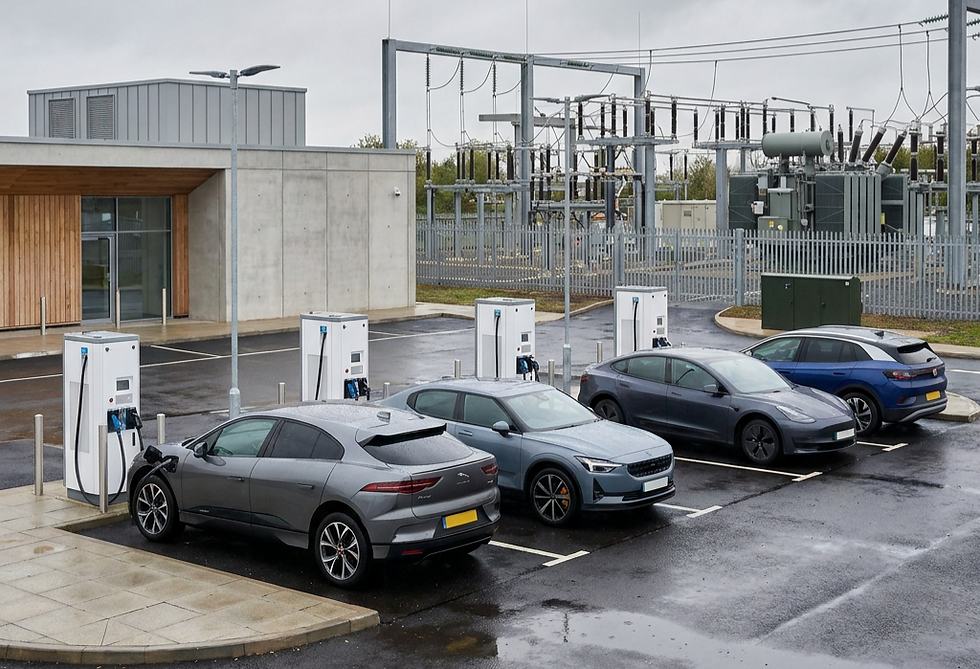
An EV charging hub is not a simple electrical installation. A motorway rapid charging hub — the standard format being deployed at pace across UK service areas — comprises high-voltage AC supply from the grid, DC fast chargers drawing 150 kW to 350 kW each, transformer and switchgear infrastructure, cable management running from the grid connection through the site to each charge point, and the civil and structural infrastructure that houses, protects, and provides access to all of it. The secondary infrastructure of that hub operates permanently outdoors, in direct proximity to high-voltage systems, and is expected to perform without significant maintenance intervention across 20 to 25 years of continuous operation.
The specific material demands of this environment combine three challenges simultaneously. The electrical environment — high-voltage AC distribution and DC charging systems in close proximity — means that any conductive secondary infrastructure in the wrong location carries a specific and avoidable electrical risk. Steel cable trays in proximity to high-voltage AC and DC systems must be earthed and bonded throughout, adding specialist installation labour, materials, and ongoing compliance verification. FRP cable trays are non-conductive and require no earthing or bonding — eliminating both the installation overhead and the ongoing compliance burden.
The outdoor environmental exposure — rain, UV, frost, de-icing chemicals on motorway sites, and in coastal locations salt air — creates a corrosion environment that attacks galvanised steel coatings at fixing points, cut edges, and connection interfaces from day one of installation. A charging hub specified in galvanised steel secondary infrastructure in a motorway or coastal environment begins accumulating a maintenance liability before the installation is complete. FRP in the same environment provides corrosion-immune performance across the full 20 to 25-year operational life of the hub with no recoating, no structural replacement, and no maintenance-driven access to live electrical zones.
The operational model of EV charging infrastructure — thin commercial margins, remote monitoring-led operations, and minimal on-site staff presence — is fundamentally incompatible with the kind of maintenance programme that corroding secondary infrastructure eventually demands. The charging operators building the UK's network are not resourced to manage recoating programmes across hundreds of hub locations. They need infrastructure that does not generate those events. FRP is the specification that provides it.
The Four EV Charging Environments Where FRP Is the Correct Specification
1. Motorway and En-Route Charging Hubs
Motorway charging hubs are the highest-profile and highest-power element of the UK's public charging network. Sites at motorway service areas draw ultra-rapid chargers rated at 150 kW to 350 kW, transformer and switchgear infrastructure, and extensive cable management connecting the high-voltage grid supply to individual charge point bays across large open-air sites. These sites are exposed to the full range of motorway environmental conditions — road salt spray from vehicle traffic, persistent wet weather exposure, and in many locations proximity to coastal conditions on the M5, M4, and A1 corridors.
FRP cable trays routing the high-voltage DC and AC supply cables across motorway hub sites provide non-conductive cable management that eliminates earthing and bonding requirements, is resistant to road salt and de-icing chemical exposure, and provides maintenance-free performance across the 20-year operational life of the hub. FRP perimeter fencing around motorway charging sites provides corrosion-resistant, non-conductive boundary infrastructure — no scrap metal value to attract vandalism or theft, and radar transparent for the CCTV and security systems that motorway hub operators deploy.
2. Fleet and Depot Charging Installations
The electrification of the UK's commercial vehicle fleet — vans, trucks, and buses — is creating a parallel charging infrastructure boom in depot environments. Logistics operators, bus operators, and fleet managers are installing high-power AC and DC charging infrastructure at operating depots across the country. Depot environments combine the electrical demands of high-power charging with the operational contamination of vehicle maintenance — diesel and oil residues on older mixed-fleet depots, cleaning chemicals, and the wash-down water that creates persistent wet conditions on grating and walkway surfaces.
FRP cable management in fleet depot environments provides non-conductive, chemically resistant cable routing that requires no earthing and bonding in the high-voltage charging environment and no recoating maintenance in the chemically contaminated depot atmosphere. FRP moulded grating on depot access platforms and walkways provides anti-slip performance that does not degrade in the oil and chemical contamination that depot environments generate, and non-conductivity that is directly relevant in the traction current environments of bus and truck depots where high-voltage systems are present at floor level.
3. Urban On-Street and Car Park Charging
Urban on-street charging — the lamp post chargers, kerb-side units, and car park columns that serve residents without home charging access — is the fastest-growing category by location count if not by power level. Urban environments create specific secondary infrastructure challenges: road salt in winter, vehicle pollution from traffic, vandalism exposure, and the aesthetic requirements of local authority planning authorities who assess charging infrastructure as urban furniture as much as electrical equipment.
FRP structural profiles for the mounting frames and cable management housings of urban charging infrastructure are non-conductive, corrosion-resistant, lightweight, and capable of being manufactured in the colour and finish specifications that local authority planning requirements demand. They do not corrode in the urban salt and pollution environment that degrades galvanised steel mounting infrastructure within a few years. And they require no maintenance recoating intervention on installed urban infrastructure where access involves traffic management, lane closures, and local authority coordination that makes each maintenance event disproportionately expensive relative to the work being done.
4. Destination Charging at Retail, Hospitality, and Leisure Sites
Destination charging — the charge points at supermarkets, hotels, leisure centres, and retail parks that allow drivers to charge while using the facility — is the largest single category in the UK network by volume. These installations are typically lower power (7 kW to 50 kW) but are installed in outdoor car park environments where they operate continuously, exposed to weather, with minimal on-site maintenance resource.
Cable management for destination charging at retail sites must route supply cables from the building's electrical intake to the charge point bays across outdoor car park environments — often through cable management that is exposed to weather, vehicle overhang, and the cleaning chemicals used on car park surfaces. FRP cable trays in these environments provide corrosion-immune, non-conductive cable routing that requires no maintenance intervention across the operational life of the destination charging installation. For a supermarket or hotel operator whose core business is not managing electrical infrastructure, the elimination of maintenance events from the secondary infrastructure of their charging installation is a directly valuable operational outcome.

The Commercial Case: Why Charging Operators Cannot Afford Steel Secondary Infrastructure
The commercial model of public EV charging is under sustained pressure. Charge point operators are investing heavily in infrastructure whose return depends on utilisation rates that are still building as EV adoption scales. The government's review into the cost of public charging, announced for the first half of 2026, reflects an industry where the margin between investment recovery and loss is thin and where any unplanned maintenance cost has an outsized impact on project economics (Zapmap, 2026).
A galvanised steel cable management installation at a motorway charging hub that requires inspection, recoating, and partial replacement at year eight — in a live high-voltage environment where access requires traffic management, specialist electrical isolation, and permit-to-work procedures — is not a background maintenance event. It is an unplanned capital expenditure in an asset whose financial model was built on a 20-year maintenance-free assumption. It is the kind of cost that turns a marginally viable charging hub into an underperforming asset and that, multiplied across a portfolio of hundreds of hub locations, materially changes the commercial outlook for a charging network operator.
FRP secondary infrastructure carries a higher upfront material cost than galvanised steel — typically 1.5x to 2x. Against the total capital cost of a motorway ultra-rapid charging hub, including the transformers, switchgear, charge point units, civils, and grid connection, the FRP material premium across the cable management and secondary infrastructure package is a small fraction of the total. The operational cost of a single maintenance event in a live charging environment is not. For charging operators managing thin margins across a large estate of hub locations, the specification decision that eliminates that maintenance event category is not a premium. It is a risk management decision with a directly quantifiable financial justification.
What FRP Delivers for EV Charging Infrastructure — Summary
Non-conductive cable management. FRP cable trays in high-voltage AC and DC charging environments require no earthing or bonding, cannot become accidental current paths, and eliminate the specialist electrical installation overhead that steel cable management demands in these environments.
Corrosion immunity in outdoor and salt-exposed environments. FRP secondary infrastructure at motorway, coastal, and urban charging sites performs without corrosion-related degradation across a 20 to 25-year design life. No recoating, no structural replacement, no maintenance access to live electrical zones.
Lightweight installation. FRP cable trays and structural profiles are 75 to 80% lighter than steel equivalents, enabling faster installation across large hub sites and reducing the structural specification required for cable management supports .
Non-sparking in ATEX-adjacent environments. Some charging hub locations — particularly those adjacent to fuel forecourts or in enclosed parking structures — create environments where the non-sparking properties of FRP provide a safety advantage over metal secondary infrastructure under impact or mechanical friction conditions.
Maintenance-free design life. The 20 to 25-year operational horizon of EV charging
infrastructure, and the thin-margin, remote-monitored operating model of the charging network operators deploying it, makes maintenance-free secondary infrastructure not a specification preference but an operational necessity.
Reinforce Technology FRP Products for EV Charging Infrastructure
Reinforce Technology supplies FRP cable trays, structural profiles, grating, and perimeter fencing for EV charging infrastructure applications across the UK. Our range covers the full secondary infrastructure package for motorway charging hubs, fleet depot installations, urban charging sites, and destination charging — in polyester and vinyl ester resin systems matched to the specific environmental exposure of each installation.
We work with charging infrastructure developers, M&E contractors, EPC contractors, and fleet operators across the UK's expanding EV charging network. Contact us to discuss your project and the correct FRP specification for your specific charging environment and installation type.
Final confirmation of suitability for any specific EV charging application — including resin system selection for the specific chemical and environmental exposure of the installation — remains the responsibility of the appointed project engineer. Reinforce Technology provides technical guidance and material recommendations based on information supplied to us, but specification sign-off should always sit with the qualified professional responsible for the design.
References
Expertsure (2026) UK EV Charging Statistics 2026: 25 Key Facts and Trends. Available at: https://www.expertsure.com/uk/ev-chargers/uk-ev-charging-statistics/ [Accessed: June 2026]. [118,321 public charge points installed by February 2026; 22% rapid or ultra-rapid; 13% growth in 2025].
GOV.UK (2026) Electric Vehicle Charging Infrastructure Statistics: 1 April 2026. Available at: https://www.gov.uk/government/collections/electric-vehicle-charging-infrastructure-statistics [Accessed: June 2026].
NACE International (2016) International Measures of Prevention, Application and Economics of Corrosion Technology (IMPACT). Houston, TX: NACE International. Available at: http://impact.nace.org/economic-impact.aspx [Accessed: June 2026].
New Civil Engineer (2026) 41% Year-on-Year Expansion of Ultra-Rapid Charging Network Recorded in 2025. Available at: https://www.newcivilengineer.com [Accessed: June 2026]. [9,893 ultra-rapid chargers operational at end 2025; 41% year-on-year growth].
Zapmap (2026) EV Charging Statistics — How Many Charging Points in the UK. Available at: https://www.zapmap.com/ev-stats/how-many-charging-points [Accessed: June 2026]. [121,262 EV chargers at 46,664 locations as of end May 2026; 14,097 new charge points added in 2025; 19.1% year-on-year growth].
Zapmap (2026) UK EV Charging Statistics 2025 Report. Available at: https://www.zapmap.com/ev-charging-statistics-2025-report [Accessed: June 2026].


Comments