
The UK Has 1,034 EV Charging Hubs. Every One Is a High-Voltage DC Outdoor Installation With a 20-Year Design Life. Here Is Why FRP Is the Specification.
There were 119,080 public EV chargers in the UK as of 1 April 2026, with 1,034 rapid charging hubs operational at the end of June 2026. Ultra-rapid chargers rated at 150kW and above grew 41% in 2025. A new EV charging hub is a high-voltage DC installation in an outdoor environment, designed for a 20-year operational life, with cable management and secondary structural infrastructure that must perform across that full horizon without maintenance. The specification decision for that cable management is not complicated. It is FRP.
Published by Reinforce Technology | 22 July 2026
Government statistics confirmed 119,080 public EV chargers in the UK as of 1 April 2026, including 27,372 rated rapid or above at 50kW and above (GOV.UK, 2026). Zapmap data confirms 1,034 rapid charging hubs operational at the end of June 2026, up from 723 at the end of 2024, representing 43% growth in the hub count in 18 months (Zapmap, 2026). Ultra-rapid chargers rated at 150kW and above grew 41% year on year in 2025 to approximately 9,893 units, driven by a concentrated industry push to reduce on-route dwell time and a strategic shift from individual chargers to clustered high-power hubs (New Civil Engineer, 2026). Extra MSA announced in November 2025 partnerships with multiple charging operators to deploy new EV Super Hubs featuring 400kW-capable chargers across seven motorway service area locations (IMARC, 2026).
The UK's EV charging network is not simply growing in size. It is growing in power density, hub scale, and the voltage and current levels at which public charging infrastructure operates. A 150kW ultra-rapid DC charger operates at voltages up to 1,000V DC. A 400kW charger hub operates at the upper end of the EV charging voltage range, with DC cable management carrying currents that make the earthing, bonding, and electromagnetic management of secondary cable infrastructure a specific and consequential specification requirement. FRP cable management eliminates those requirements entirely, through a material property — non-conductivity — that is intrinsic to the glass fibre reinforced polymer structure and cannot be compromised by installation quality, aging, or the degradation of a surface coating.
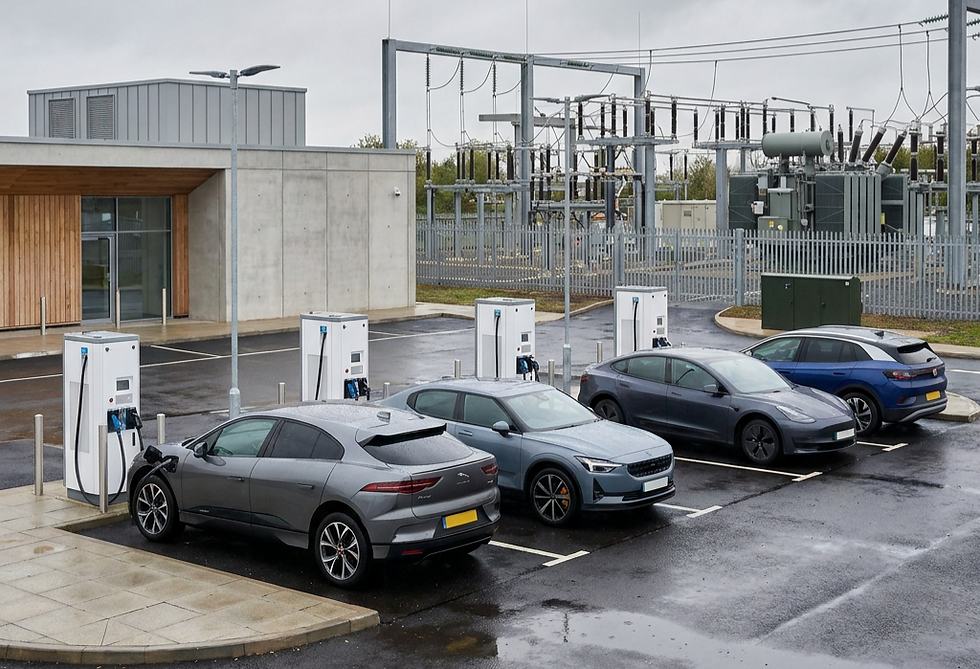
Every rapid charging hub in the UK's expanding network is also an outdoor infrastructure installation. The 1,034 hubs operational at the end of June 2026 are sited at motorway service areas, retail parks, supermarket car parks, and strategic en-route locations across the UK's road network. They sit in outdoor environments exposed to UV, rain, road salt, and the temperature cycling of UK weather across a 20-year asset life. The cable management and secondary structural infrastructure of those hubs must perform in this outdoor environment for the full 20 years without the option of a maintenance-driven replacement programme that would require hub shutdown and customer service disruption.

Why EV Charging Hubs Create a Specific Secondary Infrastructure Demand
EV charging hubs are unlike most other outdoor electrical infrastructure in two specific ways that directly determine the correct secondary cable management specification. The first is the voltage and current profile of high-power DC charging. The second is the combination of outdoor exposure with a 20-year asset life and a no-shutdown operational model.
DC fast charging operates at voltages up to 1,000V DC for the highest-powered CCS chargers currently deployed. This is substantially higher than the AC supply voltages of standard electrical installations, and DC fault current has characteristics that make it more hazardous than equivalent AC fault current in metallic cable management environments. AC fault current at mains frequency has a natural zero-crossing 100 times per second in a 50Hz system, at which point an arc in a metallic cable tray can extinguish. DC fault current has no zero-crossing. An arc initiated in a metallic cable tray by a DC fault current will sustain itself and propagate along the tray unless the fault current is interrupted by protective devices. Non-conductive FRP cable management eliminates the conducted fault current path through the cable management system entirely, removing the arc propagation risk at source rather than relying on protective device operation to interrupt it (IntechOpen, 2022).
The earthing and bonding programme that metallic cable management requires in a high-voltage DC environment adds material cost, installation labour, and ongoing compliance verification to each hub installation. Every metallic cable tray section in a DC charging hub must be bonded to the hub's earthing system, with the bonding continuity verified at commissioning and periodically thereafter. Across a network of 1,034 hubs, each requiring periodic earthing continuity verification as part of the periodic inspection and testing programme, the aggregate compliance cost of metallic cable management is a significant and entirely avoidable recurring operational expenditure. FRP cable management requires no earthing, no bonding, and no continuity verification.
The Outdoor Exposure Challenge for EV Hub Secondary Infrastructure
EV charging hubs at motorway service areas, retail parks, and en-route locations are exposed to the full range of UK outdoor environmental conditions across their 20-year operational lives. Road salt creates a chloride-rich environment at ground level and in the spray zone of vehicles using the hub. In coastal locations, marine atmospheric chloride adds to the road salt exposure. UV radiation degrades polymer coatings on secondary structural elements. And the UK's temperature range, from winter lows to summer highs now regularly exceeding 35°C following 2026's record heatwaves, creates thermal cycling across metal secondary components that generates fatigue at connection interfaces over 20 years.
Galvanised steel cable management in the road salt and outdoor UV environment of a UK EV charging hub accumulates corrosion at cut edges, fixing holes, and connection interfaces where coating continuity is disrupted. This corrosion is cosmetically visible to hub users long before it is structurally significant, creating a perception of poor maintenance in a customer-facing installation. It then becomes structurally relevant as coating failure advances to base metal corrosion and section loss begins.
FRP cable management in the same outdoor road environment produces no visible corrosion at any point across 20 years. It does not discolour from rust. It does not shed corrosion products onto the hub surface or onto vehicles using the hub. It maintains the clean, consistent appearance of a new installation across the full operational life, in the UV-stable resin formulations appropriate for outdoor exposure — with no maintenance intervention required (IntechOpen, 2022).
Where FRP Is Specified in EV Charging Hub Infrastructure
1. DC Cable Management from Grid Connection to Charger Units
The primary DC cable management of an EV charging hub routes the high-voltage DC output of the hub's power electronics from the distribution board to individual charger units across the hub footprint. At a 10-bay ultra-rapid hub where each bay delivers 150kW, the total DC cable management system carries up to 1.5MW of continuous DC power at voltages up to 1,000V. The cable management routing this power must be non-conductive to eliminate arc propagation risk, robust enough to protect cables from vehicle impact in a car park environment, and weatherproof across 20 years of outdoor exposure.
FRP cable trays for DC cable management in EV charging hubs provide non-conductive cable routing that eliminates the arc propagation risk of metallic alternatives in high-voltage DC environments, does not require earthing or bonding, is resistant to road salt and UV exposure, and carries the mechanical impact resistance required to protect high-value DC cables in a vehicle-manoeuvring environment (IntechOpen, 2022).
2. Structural Profiles for Hub Canopy and Equipment Support
Many EV charging hubs include a canopy structure over the charging bays, providing weather protection for drivers during charging sessions and a mounting surface for the hub's lighting, signage, and CCTV systems. The secondary structural framing of hub canopies operates in the same outdoor road environment as the cable management, with the additional requirement of visual quality in a customer-facing installation that hub operators use to differentiate their offering.
FRP pultruded structural profiles for hub canopy secondary framing provide corrosion-immune structural sections that maintain a consistent clean appearance across 20 years of outdoor exposure without the rust staining that galvanised steel secondary framing develops as coating condition deteriorates. The non-conductive property of FRP secondary structural profiles is also relevant where hub lighting and communications systems are in proximity to the structural framing, creating an interface between structural and electrical systems that non-conductive framing manages without the earthing and bonding complications of metallic alternatives.
3. Ground-Level Cable Containment and Drainage
Ground-level infrastructure at EV charging hubs, including cable containment routing DC cables between charger units and the hub distribution board, and drainage channels managing surface water from the hub car park, operates in the most concentrated road salt environment of any part of the installation. Ground-level galvanised steel cable containment in a road salt environment shows visible corrosion within two to three years of installation, requiring either replacement or acceptance of a cosmetically degraded installation in a new customer-facing asset.
FRP ground-level cable containment and drainage in EV charging hub environments is immune to road salt corrosion across the installation's 20-year life. FRP drainage channels in vinyl ester resin resist the contaminated surface water of car park drainage environments, including residual road salt concentrations and vehicle fluid contamination, without the lining maintenance that steel drainage channels require in the same conditions.
The Lifecycle Cost and Brand Presentation Case
EV charging hub operators invest substantially in the physical presentation of their hubs. National brands including Gridserve, Pod Point, Osprey, and the motorway service area operators who host third-party charging infrastructure compete on the quality and reliability of the customer experience their hubs deliver. A hub whose cable management and secondary structural infrastructure is visibly corroding within five years of installation is not delivering the brand experience that hub operators invest in the canopy, signage, and payment systems to create.
FRP cable management and secondary structural infrastructure in EV charging hubs does not corrode, does not rust, and does not create the visual deterioration that galvanised steel accumulates in outdoor vehicle environments across its operational life. The higher purchase price of FRP secondary infrastructure compared with galvanised steel is offset not only by the elimination of recoating and replacement costs across 20 years, but by the preservation of the hub's visual quality throughout its operational life — a commercial benefit that has a direct value for hub operators whose brand and customer return rate depend on the presentation quality of their installations.
A peer-reviewed lifecycle cost analysis found approximately 50% lifecycle cost savings for GFRP versus steel over long study periods (Younis, Ebead and Judd, 2018). At the current rate of EV charging hub deployment, with 1,034 hubs operational and the network growing rapidly toward the government's 300,000 charger target by 2030, the aggregate secondary infrastructure specification decisions being made across the UK's EV charging network are creating a maintenance liability that will compound across 20 years for every hub specified with galvanised steel secondary infrastructure, or be eliminated entirely for every hub specified with FRP.
The UK's EV charging network has 119,080 public chargers, 1,034 rapid hubs, and 41% annual growth in ultra-rapid units. Every new hub is a high-voltage DC installation in an outdoor road salt environment with a 20-year design life and no shutdown option for maintenance. FRP cable management and secondary structural profiles are non-conductive in the DC environment, corrosion-immune in outdoor road salt conditions, visually clean across 20 years, and maintenance-free across the full operational life of the infrastructure that is electrifying the UK's road transport system.
Reinforce Technology FRP Products for EV Charging Infrastructure
Reinforce Technology supplies FRP cable trays, structural profiles, and drainage channels for EV charging hub secondary infrastructure across the UK. Available in polyester and vinyl ester resin systems with UV-stable formulations for outdoor road environments. Non-conductive throughout, eliminating earthing and bonding requirements in high-voltage DC charging environments, corrosion-immune in road salt and outdoor atmospheric exposure, and maintenance-free across 20-year hub operational lives.
Contact us to discuss your EV charging hub project and the correct FRP specification for your site environment, power level, and operational horizon.
Final confirmation of suitability for any specific EV charging application, including cable management fire performance requirements and structural loading assessment, remains the responsibility of the appointed project engineer. Reinforce Technology provides technical guidance and material recommendations based on information supplied to us, but specification sign-off should always sit with the qualified professional responsible for the design.
References
GOV.UK (2026) Public Electric Vehicle Charging Infrastructure Statistics: 1 April 2026. Available at: https://www.gov.uk/government/statistics/electric-vehicle-charging-infrastructure-statistics-1-april-2026 [Accessed: 22 July 2026]. [119,080 public EV chargers as of 1 April 2026; 27,372 rated rapid or above at 50kW+].
IMARC (2026) UK Electric Vehicle Charging Market Size, Share and Growth 2026. Available at: https://www.imarcgroup.com/uk-electric-vehicle-charging-market [Accessed: 22 July 2026]. [Extra MSA 400kW capable Super Hubs at seven motorway service locations; Beaconsfield Services first site December 2025].
IntechOpen (2022) 'Fibre-Reinforced Polymer (FRP) in Civil Engineering', in IntechOpen Engineering Series. Available at: https://www.intechopen.com/chapters/84203 [Accessed: 22 July 2026]. [Non-conductive properties; volume resistivity 10¹² to 10¹⁶ Ω·m; no earthing or bonding required; corrosion-immune in outdoor environments; DC arc propagation eliminated by non-conductive cable management].
NACE International (2016) International Measures of Prevention, Application and Economics of Corrosion Technology (IMPACT). Houston, TX: NACE International. Available at: http://impact.nace.org/economic-impact.aspx [Accessed: 22 July 2026].
New Civil Engineer (2026) 41% Year-on-Year Expansion of Ultra-Rapid Charging Network Recorded in 2025. Available at: https://www.newcivilengineer.com [Accessed: 22 July 2026]. [87,796 chargepoints at end 2025; 9,893 ultra-rapid 150kW+ units, up 41% year on year; 20% overall growth].
ScienceDirect (2025) 'Sustainable composites for metal replacement: Environmental assessment and material selection of fiber-reinforced polymer across industries', ScienceDirect, doi: 10.1016/S2667-3789(25)00051-3. Available at: https://www.sciencedirect.com/science/article/pii/S2667378925000513 [Accessed: 22 July 2026].
Younis, A., Ebead, U. and Judd, S. (2018) 'Life cycle cost analysis of structural concrete using seawater, recycled concrete aggregate, and GFRP reinforcement', Construction and Building Materials, 175, pp. 135-144. doi: 10.1016/j.conbuildmat.2018.04.183.
Zapmap (2026) How Many EV Charging Points Are There in the UK? Available at: https://www.zapmap.com/ev-stats/how-many-charging-points [Accessed: 22 July 2026]. [1,034 rapid charging hubs at end June 2026; 926 at end 2025; 723 at end 2024; 28% year on year hub growth 2024 to 2025].


Comments