
The UK Is Adding 5.5 GWp of Solar in 2026. Every Ground-Mount Project Needs FRP Cable Tray.
The UK solar market is forecast to add 5 to 5.5 GWp in 2026 — 50% year on year growth for the second consecutive year. Ground-mounted solar now represents 70% of new capacity. The average new ground-mount project is 35MWp, operating at string voltages of 1,000V to 1,500V DC, across a 30-year design life in outdoor agricultural environments. Every project in that pipeline has a DC cable management specification decision. That decision determines whether the installation runs for 30 years without secondary infrastructure intervention — or not. Here is the case for FRP.
Published by Reinforce Technology | 1 August 2026
UK solar capacity reached approximately 22.3 GW by spring 2026, up from 21.6 GW at the end of 2025, across more than two million installations (Solar Weekly, 2026). The Cleve Hill solar farm, which came online in July 2025 at 373MW, is the largest operational solar site in the UK and one of 15 CfD-backed projects commissioned in 2025 (PV Magazine, 2025). The UK's Clean Power 2030 Action Plan targets 45 to 47 GW of solar capacity by 2030, requiring roughly a doubling of installed capacity in under five years. The forecast for 2026 is 5 to 5.5 GWp of new capacity, 50% year on year growth for the second consecutive year, with ground-mounted projects representing approximately 70% of the total (Solar Power Portal, 2026).
At the project level, the structural shift is significant. The average new ground-mount solar project completing in 2025 was 35MWp. Twenty projects were greater than 50MWp, processed through Local Planning Authority consent or the NSIP regime. The 713 projects that received NESO grid connection offers on 10 June 2026 represent the forward pipeline of this deployment programme, with the fastest-moving among them entering construction now. Each project in that pipeline has a DC cable management specification decision to make — and the decision is the same in every case: what routes the high-voltage DC power from the solar panels to the inverters, across an outdoor agricultural site, for 30 years, with no acceptable maintenance downtime.
The cable management specification on a ground-mount solar farm is not a minor secondary detail. It is the infrastructure that carries the revenue-generating output of every solar panel on the site to the grid connection, for the full 30-year life of the asset's CfD or PPA contract. Getting it wrong — specifying a galvanised steel cable tray that corrodes in the outdoor agricultural environment, requires earthing and bonding that adds installation complexity, and accumulates maintenance liabilities across three decades — is a specification error that compounds across every year of the installation's operational life. Getting it right, with FRP, means the cable management performs on day one of operation and on day 10,950 without intervention.
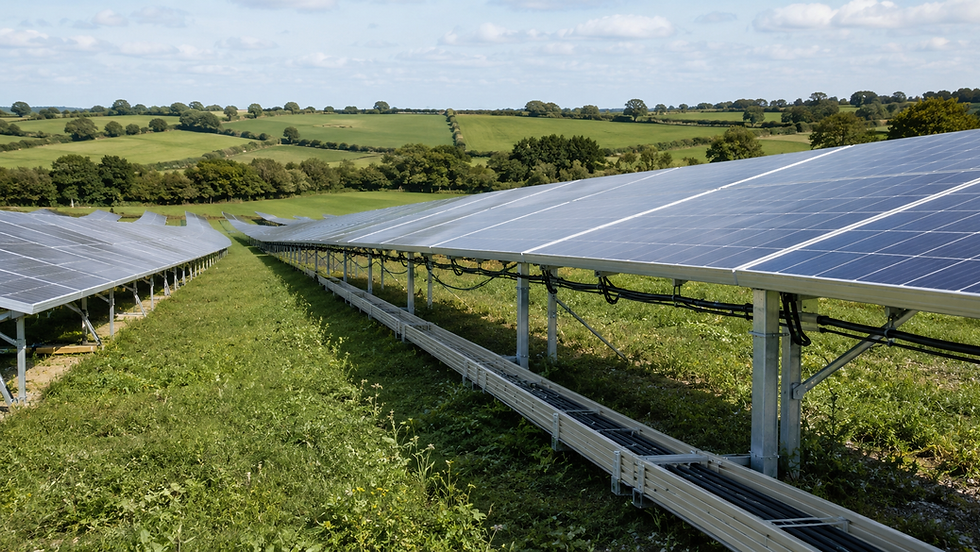
The DC Environment: Why Non-Conductivity Matters at 1,500V
Modern utility-scale solar arrays operate at string voltages of 1,000V to 1,500V DC, driven by the balance-of-system cost savings that higher string voltages enable through reduced cable cross-sections and longer string lengths. At 1,500V DC, the cable management routing string cables from panel rows to combiner boxes, and DC cables from combiner boxes to central inverters, operates at voltages that make the electrical properties of the cable tray material a specific and safety-relevant specification parameter.
DC arc fault behaviour is the critical distinction. A DC arc fault — initiated by cable insulation damage, connector failure, or a dielectric breakdown event — does not extinguish at a natural zero-crossing in the way that an AC arc does. AC current at 50Hz crosses zero 100 times per second, providing regular opportunities for an arc to extinguish. DC current at 1,500V maintains a sustained arc once initiated, with the arc plasma temperature exceeding 5,000°C and the arc capable of propagating along a conductive cable tray until the protective device interrupts the fault current. In a steel cable tray, a sustained DC arc can cause fire ignition, cable insulation destruction across the entire tray run, and catastrophic damage to the solar farm's DC electrical infrastructure (Solar Love, 2026).
FRP cable trays are non-conductive throughout their full cross-section, with volume resistivity of 10¹² to 10¹⁶ Ω·m. There is no conducted fault current path through an FRP cable tray. A DC arc fault in a cable within an FRP cable tray is constrained to the fault location rather than propagating along the tray infrastructure. The arc plasma cannot establish a conductive path through the FRP tray wall. Non-conductive FRP cable management eliminates DC arc propagation risk at source, through a material property that cannot be compromised by installation quality or aging (IntechOpen, 2022).
The earthing and bonding programme that metallic cable management requires in a 1,500V DC solar environment adds material cost, installation labour, and ongoing compliance burden to every project that specifies steel or aluminium cable trays. In a 50MWp solar farm with potentially kilometres of cable tray runs, the aggregate cost of the bonding programme is a significant and entirely avoidable capital expenditure item. FRP cable management requires no earthing, no bonding, and no continuity verification at any voltage encountered in a ground-mount solar installation.
The Outdoor Agricultural Environment: 30 Years of Exposure
Ground-mount solar farms in the UK occupy agricultural land exposed to the full range of UK weather conditions across a 30-year operational design life. The corrosion drivers are specific: persistent ground moisture from rainfall and the water table of low-lying agricultural sites creates a consistently humid environment at ground level. Agricultural soils contain sulphur compounds from natural decomposition that create mildly acidic soil chemistry attacking zinc coatings in direct soil contact. In coastal locations — which account for a significant proportion of the UK's best solar irradiance sites in the South West and South East — marine atmospheric chloride adds an aggressive electrochemical corrosion driver.
Galvanised steel cable management on a ground-mount solar farm is exposed to this combination of ground moisture, soil chemistry, and coastal atmospheric chloride across 30 years. The zinc coating depletes faster than in most other outdoor industrial applications because persistent moisture and soil contact eliminates the drying cycles that limit corrosion rate in freely draining elevated installations. Over a 30-year solar farm design life, galvanised steel cable trays will typically require at least one recoating intervention — each requiring access to cable tray runs substantially buried under cable fill and secondary infrastructure across the site.
FRP cable trays have no corrosion mechanism in any of the exposure conditions of the outdoor agricultural environment. Ground moisture, soil contact, agricultural soil chemistry, and coastal atmospheric chloride all create zero degradation in FRP cable tray material across 30 years. The design life of FRP cable management in agricultural outdoor environments is 30 years without maintenance, matching the operational design life of the solar farm it serves (IntechOpen, 2022).
The Snap-Fit Installation Advantage
Ground-mount solar farm installation programmes operate under significant schedule pressure. Project finance is drawn against a construction programme with a grid connection date that determines when revenue begins. Installation speed is not a convenience for solar farm cable management — it is a financial requirement.
Reinforce Technology's FRP cable tray systems use a snap-fit connection system that eliminates hot work from the cable tray installation programme entirely. No welding, no grinding, no cutting torch, and no hot work permits required. Snap-fit tray sections connect without tools in a fraction of the time that bolted metallic tray systems require, including all directional changes via snap-fit bends, tees, and crosses. The lighter weight of FRP cable tray sections — approximately 75% lighter than steel equivalents — means that two-person teams can handle, position, and connect tray sections without mechanical lifting assistance, reducing the crane and lifting equipment requirements of the installation programme (IntechOpen, 2022).
Cable Ventilation: The DC String Current-Carrying Consideration
DC cables in a solar farm cable tray carry the full current of every string simultaneously during peak generation periods — the hottest and brightest conditions of the day, when ambient temperature is highest and cable current-carrying capacity derating is most significant. The thermal management of DC cables in solar farm cable trays is therefore more critical than in many other cable management applications.
FRP ladder trays, with their open rung construction, provide maximum ventilation for DC cables across the tray width and depth. Each cable in an FRP ladder tray is exposed to free air circulation through the open rung gaps, allowing heat generated by resistive losses to dissipate freely rather than accumulating within an enclosed tray. This ventilation advantage directly reduces the cable derating factor required for the installation and can allow a smaller conductor cross-section to be specified, with a direct material cost saving on the cable specification that partially offsets the FRP tray purchase price premium over steel.
The 30-Year Financial Model and the Cable Management Decision
A 50MWp solar farm with a 15-year CfD at £75/MWh, operating at an 11% capacity factor, generates approximately 48,000 MWh annually and approximately £3.6 million of CfD revenue per year. Over 30 years, the total revenue generation potential of the asset is well in excess of £100 million. The cable management budget for that project is a small fraction of total capital expenditure. The difference in purchase price between FRP and galvanised steel cable management on a 50MWp project is a modest capital sum relative to the project's total capital cost and its 30-year revenue potential.
The maintenance cost of recoating galvanised steel cable management at year 10 and year 20 — including access arrangements, surface preparation, materials, application, and disruption to cable management routes — is a recurring operational cost that the FRP specification eliminates entirely. A peer-reviewed lifecycle cost analysis found approximately 50% lifecycle cost savings for GFRP versus steel over long study periods (Younis, Ebead and Judd, 2018). In the context of a 30-year solar farm, the lifecycle cost saving from correct cable management specification at the construction stage is a straightforward financial calculation.
The UK solar market is adding 5.5 GWp in 2026. Ground-mount projects are 70% of new capacity. Every project operates at 1,000V to 1,500V DC in an outdoor agricultural environment for 30 years. FRP cable trays are non-conductive at 1,500V DC, eliminating arc propagation risk and earthing programme cost. They are corrosion-immune in outdoor agricultural environments across 30-year design lives. They install faster with snap-fit connection and no hot work permits. And they provide the cable ventilation that DC string cable current-carrying capacity requires. The cable management specification for a UK ground-mount solar farm is FRP.
Reinforce Technology FRP Cable Trays for Solar Farm Applications
Reinforce Technology supplies FRP ladder trays, perforated trays, and channel trays for ground-mount and rooftop solar farm DC cable management across the UK. Available in polyester and vinyl ester resin systems with UV-stable formulations for outdoor solar farm environments. Snap-fit accessory systems eliminating hot work from the installation programme. Non-conductive throughout, with full load/span data and technical documentation for project QA submissions.

Contact us to discuss your solar farm project and the correct FRP cable tray specification for your site, DC voltage, cable load, and support span configuration.
Final confirmation of suitability for any specific solar farm application, including cable current-carrying capacity derating calculations and structural loading assessment, remains the responsibility of the appointed project engineer. Reinforce Technology provides technical guidance and material recommendations based on information supplied to us, but specification sign-off should always sit with the qualified professional responsible for the design.
References
IntechOpen (2022) 'Fibre-Reinforced Polymer (FRP) in Civil Engineering', in IntechOpen Engineering Series. Available at: https://www.intechopen.com/chapters/84203 [Accessed: 1 August 2026]. [Non-conductive properties; volume resistivity 10¹² to 10¹⁶ Ω·m; 75% lighter than steel; corrosion-immune in outdoor agricultural environments; 30-year design life].
NACE International (2016) International Measures of Prevention, Application and Economics of Corrosion Technology (IMPACT). Houston, TX: NACE International. Available at: http://impact.nace.org/economic-impact.aspx [Accessed: 1 August 2026].
PV Magazine (2025) UK Solar Capacity Hits 20 GW. Available at: https://www.pv-magazine.com/2025/11/05/uk-solar-capacity-hits-20-gw/ [Accessed: 1 August 2026]. [Cleve Hill 373MW online July 2025; 15 CfD-backed projects commissioned 2025].
ScienceDirect (2025) 'Sustainable composites for metal replacement: Environmental assessment and material selection of fiber-reinforced polymer across industries', ScienceDirect, doi: 10.1016/S2667-3789(25)00051-3. Available at: https://www.sciencedirect.com/science/article/pii/S2667378925000513 [Accessed: 1 August 2026]. [Pultruded GFRP manufacturing emissions approximately 60 to 70% lower per tonne than primary steel, cradle-to-gate, EuCIA data].
Solar Love (2026) Earthing and Grounding Solar Systems UK (2026). Available at: https://solarlove.org/earthing-grounding-solar-systems/ [Accessed: 1 August 2026]. [Sustained DC arcs one of few realistic fire-ignition pathways; DC arc propagation in metallic cable management].
Solar Power Portal (2026) UK Solar Forecast to Grow 50% YoY Again in 2026. Available at: https://www.solarpowerportal.co.uk/solar-projects/uk-solar-forecast-to-grow-50-yoy-again-in-2026 [Accessed: 1 August 2026]. [5 to 5.5 GWp forecast 2026; 50% YoY growth second consecutive year; average 2025 project 35MWp; 20 projects above 50MWp; ground-mount 70% of new capacity].
Solar Weekly (2026) UK Solar Industry 2026: Record Installations, Market Data. Available at: https://solarweekly.co.uk/uk-solar-industry-2026/ [Accessed: 1 August 2026]. [22.3GW installed spring 2026; 257,397 MCS-certified installations in 2025, up 32%].
Younis, A., Ebead, U. and Judd, S. (2018) 'Life cycle cost analysis of structural concrete using seawater, recycled concrete aggregate, and GFRP reinforcement', Construction and Building Materials, 175, pp. 135-144. doi: 10.1016/j.conbuildmat.2018.04.183.


Comments