
Agrivoltaics, Crop Rotation, and FRP: Why the UK's Dual-Use Solar Revolution Needs the Right Mounting Infrastructure
The UK government has set a target of reaching 45 to 57 gigawatts of installed solar capacity by 2030. Meeting that target requires significant quantities of land — and that has triggered a sharp public debate. Agrivoltaics is the answer. Here is the science, the planning policy, the structural requirements, and why FRP is the infrastructure material that makes it work.
Published by Reinforce Technology | May 2026
The Land Use Dilemma
The UK government has set a target of reaching 45 to 57 gigawatts of installed solar capacity by 2030, roughly two and a half times the 18.1 GW recorded in March 2025 (House of Commons Library, 2025). Meeting that target requires significant quantities of land, and that requirement has triggered a sharp public debate. Critics point out that 59% of England's largest operational solar farms sit on productive farmland, with nearly a third of that area classified as best and most versatile agricultural land (ISEP Global, 2026).
The proposed solution to this conflict is agrivoltaics, sometimes written as agri-PV or agrovoltaics. Rather than treating solar energy generation and food production as mutually exclusive, agrivoltaics integrates elevated or spaced solar panel arrays into working agricultural land, allowing crops to be grown beneath or between the panels simultaneously. This article examines the science behind agrivoltaics, the UK policy environment shaping its adoption, the structural and infrastructure requirements for deployment, and the role that FRP (Fibre Reinforced Polymer) systems play in making these projects viable.


What Agrivoltaics Is — and What the Evidence Shows
Agrivoltaics refers to the dual use of land for solar energy generation and agriculture. Solar panels are mounted on elevated frames or widely spaced racking systems, high enough above ground to permit crop cultivation, livestock movement, or machinery access beneath them. The configuration varies by project type: some systems use horizontal elevated arrays directly above crop rows, while others use vertical bifacial panels positioned between planted strips.
The concept originated in Germany in the 1980s and has since expanded across Europe, China, the United States, and Japan, with an estimated 1,000 or more agrivoltaic systems now in operation globally (GreenMatch, 2025). Research carried out across these markets has produced consistent evidence that dual land use can be genuinely productive, with studies reporting that combined land use efficiency can reach up to 186% compared to using separate areas exclusively for farming and solar generation (GreenMatch, 2025).
The microclimate effects of panels can be beneficial in the right conditions. Shade from panels reduces moisture evaporation from soil, moderates temperature extremes, and provides protection from heavy rainfall and strong winds (Atlantic Renewables, 2025). Crop-specific results vary significantly. Research cited in the UK context suggests that shade-tolerant varieties such as lettuce, spinach, and soft fruits show particular promise, while cereals and grains that depend on direct sunlight tend to show more modest performance under elevated panel systems (Atlantic Renewables, 2025). Globally, studies have recorded lettuce yield increases of 38% and tomato yield increases of 11% under agrivoltaic conditions, with cotton production rising 33% in certain setups (GreenMatch, 2025).
The UK Situation: Significant Potential, Limited Deployment So Far
Despite the scale of international activity, the UK market is still in its early stages. As of April 2025, there are 15 commercial operational agrivoltaics projects in the UK, most generating between 1 MW and 5 MW and primarily involving livestock grazing rather than arable crop production (CMS Law, 2025). The largest is the Bracks Agrivoltaics Project in Cambridgeshire, developed by BayWa r.e., which has a generating capacity of 30.1 MW and has incorporated sheep grazing since 2024 alongside plans for biodiversity enhancements (CMS Law, 2025).
A University of Sheffield study published in February 2025 concluded that agrivoltaic technology could enable the UK to meet its solar energy targets without sacrificing agricultural land, identifying Cambridgeshire, Essex, Lincolnshire, and the wider East and South East of England as the most suitable regions for deployment due to flat terrain, strong grid connectivity, and high solar radiation levels (The Planner, 2025). The same study found that approximately 55.5% of UK land is suitable for agri-PV deployment, suggesting the technology could theoretically support UK electricity demand more than four times over while avoiding land use conflicts (The Planner, 2025).
Important caveats remain. The Sheffield research acknowledged that UK-specific trials are limited, with performance data for staple crops such as wheat still uncertain in this context (Watts Up With That, 2025). Further research is needed to quantify how British growing conditions interact with different panel configurations and crop varieties before large-scale arable agrivoltaic programmes can be confidently rolled out. The UK market is nonetheless projected to grow at a compound annual growth rate of 11.96%, driven by the intersection of renewable energy targets and sustainable farming pressures (GreenMatch, 2025).
Planning Policy: A Shifting Landscape
The planning framework for solar farms in the UK changed significantly in late 2025. From 31 December 2025, the threshold for solar projects classified as Nationally Significant Infrastructure Projects (NSIPs) increased to 100 MW, up from 50 MW (Solar Grid Check, 2026). Projects between 50 MW and 100 MW now proceed through the local planning authority route rather than requiring a Development Consent Order from the Secretary of State, removing one of the most significant bottlenecks that had previously constrained utility-scale deployment.
The government's Clean Power 2030 Action Plan has restated that solar and farming can coexist, and the UK Solar Roadmap published in 2025 explicitly acknowledges agrivoltaics as a rapidly developing field (GOV.UK, 2025). However, there is as yet no dedicated legislative or regulatory framework for agrivoltaics in the UK. Projects are assessed case by case, and developers must navigate the same planning channels as conventional solar farms, with agrivoltaic design treated as a material benefit rather than a distinct planning category (CMS Law, 2025).
This creates both opportunity and risk. Projects that can credibly demonstrate continued agricultural productivity alongside energy generation are better positioned to achieve planning consent, particularly on land classified as agricultural grades 1 to 3a. As planning authorities become more familiar with agrivoltaics, the evidential burden on applicants is likely to increase, making robust technical specification all the more important.

Structural Requirements: Why Agrivoltaics Demands a Different Approach
Conventional ground-mounted solar racking is designed primarily for density and cost efficiency. Frames are typically positioned low to the ground to minimise wind loading, with no requirement for clearance beneath the array. Agrivoltaic systems are fundamentally different. To allow crop cultivation, livestock movement, or farm machinery access beneath the panels, elevated frames must achieve sufficient ground clearance while maintaining structural integrity under combined wind and snow loading.
This creates a set of structural requirements that standard steel solar racking is not always well equipped to meet, particularly in agricultural environments where the combination of moisture, soil contact, fertilisers, agrochemicals, and long service periods exposes structural components to sustained corrosion pressure. The key structural requirements for agrivoltaic mounting systems include the following.
Ground clearance. Systems designed for arable crop production under the panels typically require clearance of at least two metres, with some designs extending to three metres or above to accommodate tractor access. Elevated pultruded profiles, I-beams, and box sections form the primary load-bearing structure at these heights.
Column spacing. To avoid shading strips that would prevent machinery operation, column intervals must be wide enough to accommodate standard agricultural equipment, requiring spans significantly wider than those used in conventional solar installations.
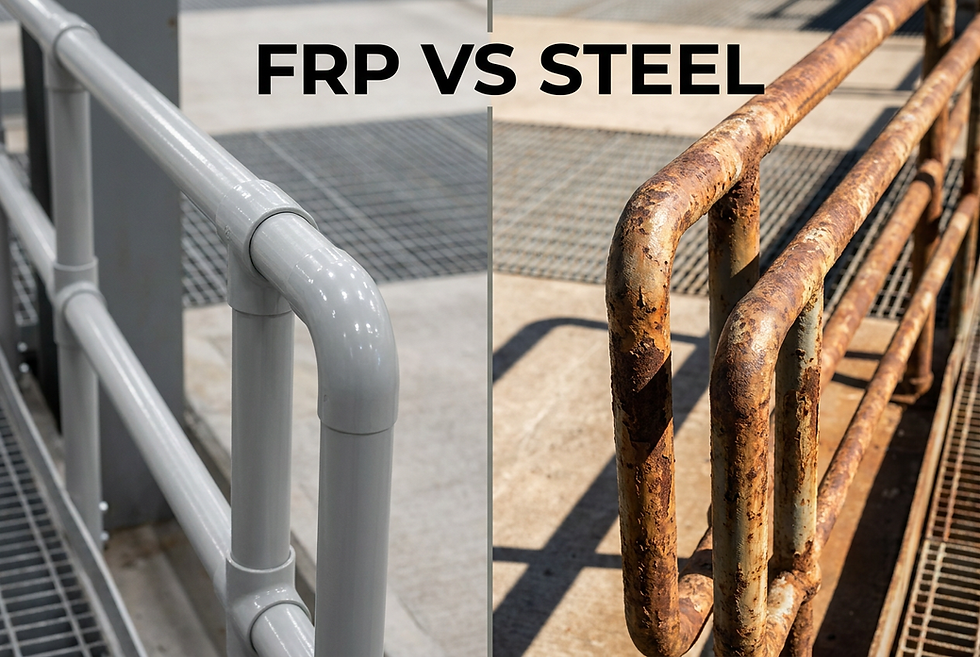
Corrosion resistance. Agricultural environments are hostile to untreated steel. Fertilisers, slurry, soil acids, and persistent moisture accelerate corrosion. Galvanised steel requires ongoing maintenance inspection, and paint systems degrade under UV exposure over the 25 to 40-year design life typical of commercial solar assets.
Weight. On softer agricultural soils, heavy steel structures require deep and expensive foundations. Lighter framing materials reduce the foundation specification and limit soil compaction around crop root zones — a genuine agronomic benefit in systems designed for food production.
Electromagnetic neutrality. In environments where electrical interference can affect agricultural monitoring equipment or precision farming sensors, non-conductive framing materials eliminate a potential source of disruption — increasingly relevant as precision agriculture adopts GPS, IoT sensors, and autonomous machinery on sites that also carry DC solar arrays.
The Case for FRP in Agrivoltaic Infrastructure
Fibre Reinforced Polymer (FRP) addresses the structural requirements of agrivoltaic systems across each of these dimensions. It is corrosion-resistant by composition, requiring no surface treatment or ongoing maintenance to resist moisture, agricultural chemicals, or UV degradation. It is lightweight compared to steel — typically around one quarter of the weight for equivalent structural profiles — reducing both handling costs and foundation demands on soft agricultural soils. It is non-conductive and non-magnetic, eliminating electromagnetic interference concerns for precision farming equipment operating in proximity to the array. And it can be manufactured to precise dimensional tolerances through the pultrusion process, producing consistent structural sections at scale.
Pultruded FRP I-beams, box sections, channels, and angles are directly applicable to the primary and secondary framing of elevated agrivoltaic structures. Their strength-to-weight ratio supports the longer spans required for machinery clearance, while their corrosion immunity removes the maintenance liability that corroded steel racking would introduce over a multi-decade project life.
At Reinforce Technology Group, our pultruded FRP profiles are independently tested by both SGS and TÜV Rheinland, providing clients and project engineers with verified performance data for structural specification and project approval submissions. Our solar mounting frames have already been deployed across utility-scale solar projects in the UK and internationally, and our technical team is experienced in supporting the engineering sign-off process for non-standard structural configurations.
FRP cable management systems, including our cable tray range, are equally relevant to the agrivoltaic environment. Cable runs in agricultural settings must contend with the same corrosion pressures as structural components, and FRP cable tray eliminates the maintenance burden associated with steel trays in exposed outdoor locations. Our cable tray is available in a standard grade suitable for most agrivoltaic applications, with fire retardant grades available on request at quotation stage for projects where that specification is required.
Crop Rotation Under Solar: What Developers and Landowners Need to Know
Agrivoltaic systems impose physical constraints on crop rotation planning that developers and landowners need to address at the design stage rather than after installation.
The primary variable is shading. Panel layout, tilt angle, and row spacing determine how light is distributed across the cropped area beneath the array. A well-designed agrivoltaic system can be modelled to understand seasonal variation in shading patterns, which in turn informs which crops are viable in which positions within the array footprint. Shade-tolerant crops such as leafy vegetables, soft fruits, and certain legumes are generally better suited to positions directly beneath panels, while inter-row strips receiving more direct light can support a wider range of varieties.
Crop rotation in agrivoltaic systems should therefore be designed around the light zoning of the array rather than treating the entire field as uniform. A rotation that cycles shade-tolerant and more light-demanding crops across positions within the array, matched to the actual irradiance pattern, can maintain productive yields while avoiding the yield suppression that comes from mismatched crop selection.
Water management is a secondary consideration. Panels intercept rainfall, creating drier zones directly beneath them and wetter zones at the panel drip line. Irrigation planning in agrivoltaic systems needs to account for this redistribution, and row orientations should be designed to manage runoff effectively rather than concentrating water in ways that could cause erosion or waterlogging.
Soil compaction is a further design consideration, particularly where machinery access is required. Column foundation positions must be integrated into field layouts in a way that does not compromise trafficable lanes, and access widths between structural columns must be consistent with the machinery intended for use on the site.

Looking Ahead: What the UK Market Needs Now
The UK agrivoltaics market is in an early but accelerating phase. Government policy is moving in a direction that is broadly supportive of dual land use, the planning threshold increase introduced in December 2025 has reduced bureaucratic friction for mid-scale projects, and the academic evidence base for agrivoltaics in British conditions is growing.
What the market now needs is a pipeline of well-specified projects that demonstrate to planning authorities, landowners, and lenders that agrivoltaics can deliver on both its energy generation and agricultural productivity objectives. That requires getting the infrastructure specification right from the outset — including the structural systems, cable management, and site engineering that underpin the long-term performance of the installation.
FRP has an important role to play in that infrastructure. Its properties align closely with the demands of the agrivoltaic environment, and the technology is proven in solar applications at scale. As the UK agrivoltaics sector develops, FRP structural profiles and cable management systems are becoming standard components in the specification of elevated agri-PV installations.
Reinforce Technology Group works with developers, engineers, and landowners on FRP solutions for solar infrastructure across the UK. To discuss your project requirements, contact our team directly.
Final confirmation of structural suitability for any specific agrivoltaic application — including frame loading under agricultural machinery clearance requirements and post foundation design for the specific ground conditions of the site — remains the responsibility of the appointed project engineer. Reinforce Technology provides material guidance based on information supplied to us, but structural design sign-off should always sit with the qualified professional responsible for the engineering. We are happy to provide full technical data sheets and application-specific support to assist with that process.
References
Atlantic Renewables (2025) How Agrivoltaics is Revolutionising UK Farming: The Solar-Powered Agricultural Renaissance. Available at: https://www.atlanticrenewables.co.uk [Accessed: May 2026].
CMS Law (2025) Expert Guide on Agrivoltaics and Floating Photovoltaics UK. Available at: https://cms.law [Accessed: May 2026].
GOV.UK (2025) Solar Roadmap: United Kingdom Powered by Solar. Department for Energy Security and Net Zero. Available at: https://www.gov.uk/government/publications/solar-roadmap [Accessed: May 2026].
GreenMatch (2025) Agrovoltaics: Solar Energy for Sustainable Farming. Available at: https://www.greenmatch.co.uk/blog/agrovoltaics-solar-energy-for-sustainable-farming [Accessed: May 2026]. [Land use efficiency up to 186%; net farm income increase up to 142%; water usage reduction ~30%; global market growth £2.7bn to £7.1bn by 2033].
House of Commons Library (2025) Planning for Solar Farms. CBP-7434. Available at: https://commonslibrary.parliament.uk [Accessed: May 2026].
IntechOpen (2022) 'Fibre-Reinforced Polymer (FRP) in Civil Engineering', in IntechOpen Engineering Series. Available at: https://www.intechopen.com/chapters/84203 [Accessed: May 2026].
ISEP Global (2026) The Best and Most Versatile Farmland Should Be Protected Amid Rapid Expansion of UK Solar Power. Available at: https://www.isepglobal.org [Accessed: May 2026]. [59% of England's largest operational solar farms sit on productive farmland].
Met Office (2026) 2025 is Double-Record Breaker: UK's Warmest and Sunniest Year on Record. Available at: https://www.metoffice.gov.uk [Accessed: May 2026].
NSIP Documents, Planning Inspectorate (n.d.) Use of Agricultural Land in England by Ground-Mounted Solar Photovoltaic Installations. Available at: https://nsip-documents.planninginspectorate.gov.uk [Accessed: May 2026].
ScienceDirect (2024) 'The technical and economic potential for crop-based agrivoltaics in the United Kingdom', Solar Energy. Available at: https://www.sciencedirect.com/science/article/pii/S0038092X24004390 [Accessed: May 2026].
Solar Grid Check (2026) Solar Farm Planning Permission UK: When You Need It and How to Apply. Available at: https://solargridcheck.co.uk [Accessed: May 2026]. [NSIP threshold increased to 100 MW from 31 December 2025].
The Planner (2025) Solar Technology Could Meet UK Power Needs Without Losing Farmland. Available at: https://www.theplanner.co.uk [Accessed: May 2026]. [University of Sheffield study: 55.5% of UK land suitable for agri-PV; Cambridgeshire, Essex, Lincolnshire identified as most suitable regions].
University of Sheffield (2025) Research Shows UK Solar Targets Can Be Achieved Without Sacrificing Farmland. Reported in Energy Global, 28 February 2025. Available at: https://www.energyglobal.com [Accessed: May 2026].
Watts Up With That (2025) Why is Labour Paving Over Britain's Arable Heartlands Without Consulting Local People? Available at: https://wattsupwiththat.com [Accessed: May 2026]. [UK-specific cereal agrivoltaic performance data still limited].


Comments