
An Agrivoltaic Farm Can Generate Three Income Streams Simultaneously. The Third One Is Carbon Credits. Here Is How.
UK farm carbon credits average £27 per tonne. The voluntary carbon market is growing at 28% annually and is projected to reach £10 billion in annual private climate finance by 2035. An agrivoltaic farm can generate verified carbon credits from soil carbon sequestration, biodiversity net gain units from wildflower habitat beneath the panels, and clean energy certificates from solar generation simultaneously. Three income streams from one piece of land. FRP mounting infrastructure is what keeps the soil that generates those credits clean, uncontaminated, and verifiable.
Published by Reinforce Technology | July 2026
Most discussions of agrivoltaic economics focus on two income streams: the electricity revenue from solar generation and the agricultural income from continued food production on the same land. Both are real, substantial, and well-documented. But there is a third income stream that is beginning to emerge from agrivoltaic installations in the UK and globally, one that compounds the financial case for dual-use solar farming in ways that were not available even three years ago: voluntary carbon credits.
The UK voluntary carbon market reached approximately £170 million in 2024 and is projected to grow at 28.4% annually to reach over £2 billion by 2033 (IMARC, 2026). The voluntary carbon market globally is valued at approximately £2 billion in 2026 and is forecast to reach £15 billion by 2035 at a compound annual growth rate of over 20% (Regreener, 2026). Corporate demand for nature-based removal credits is growing as more companies establish science-based targets requiring compensation for residual emissions that cannot be eliminated operationally. UK farm carbon credits currently average approximately £27 per tonne of CO₂ equivalent sequestered, with high-integrity verified credits trading at premiums substantially above that average (Agrotech Daily, 2025). The UK government's 2025 roadmap for voluntary carbon markets aims to channel £10 billion annually in private climate finance by 2035, creating sustained demand that should support stable or growing credit prices across the period when agrivoltaic installations coming into operation today will be generating their carbon sequestration data (Agrotech Daily, 2025).
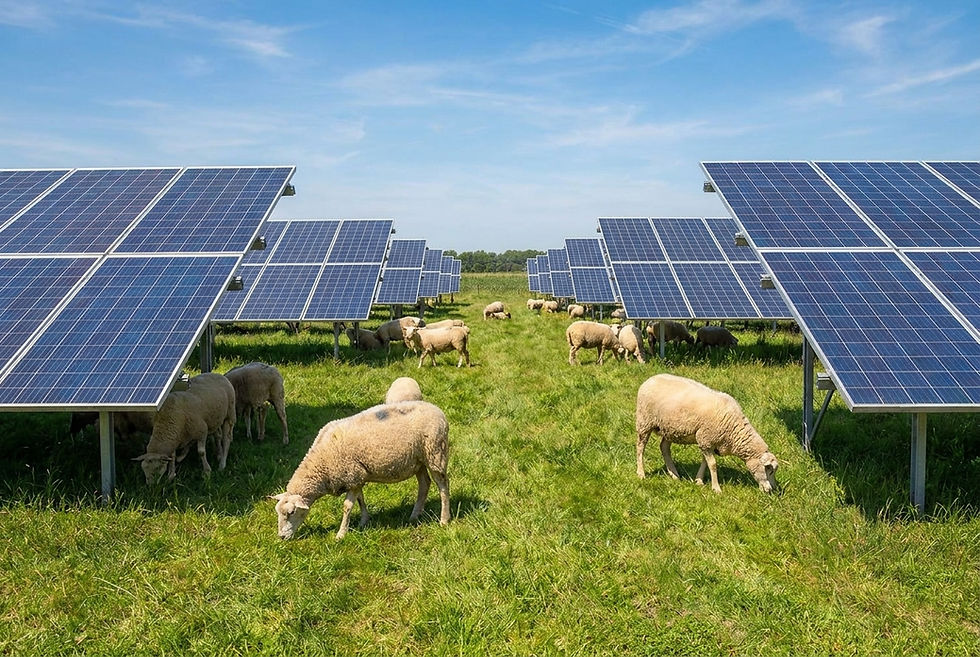
An agrivoltaic farm is unusually well-positioned to participate in voluntary carbon markets, for reasons rooted in the specific way that agrivoltaic systems interact with soil carbon, biodiversity, and clean energy generation simultaneously. Understanding those three carbon credit generation pathways, and what infrastructure specification requirements underpin each of them, is the subject of this blog.

Carbon Credit Pathway 1: Soil Carbon Sequestration
Soil carbon sequestration is the process by which carbon dioxide from the atmosphere is drawn down through plant photosynthesis and incorporated into soil organic matter. Agricultural soils are among the most significant potential carbon sinks available, and the voluntary carbon market has developed verified methodologies for measuring, monitoring, and crediting the additional soil carbon that regenerative agricultural practices generate relative to a baseline.
Agrivoltaic systems actively support soil carbon accumulation beneath the panel array through several mechanisms. Panel shade reduces soil temperature extremes, retaining soil moisture and supporting the microbial communities that build soil organic matter. Research published in 2025 found soil organic carbon levels increasing by 10 to 15% under agrivoltaic arrays within three years of installation (Editorial Ge, 2026). Reduced grazing pressure in managed areas beneath panels allows vegetation to establish and accumulate biomass. Wildflower and pollinator habitats planted beneath and between panel rows add above-ground carbon in perennial root systems and below-ground carbon in the soil organic matter that deep-rooted wildflower species generate.
The voluntary carbon market methodology most relevant to agricultural soil carbon in the UK is Verra's VM0042, which covers improved agricultural land management practices. In September 2025, Agreena's AgreenaCarbon Project became the first large-scale arable agriculture initiative to achieve Verra verification under VM0042 v2.0, issuing 2.3 million verified carbon units across operations spanning multiple European countries (Agrotech Daily, 2025). The British Standards Institution is developing assurance standards for international verification methodologies operating in the UK market, increasing buyer confidence in agricultural carbon credits (Agrotech Daily, 2025). The infrastructure for large-scale agricultural soil carbon credit generation is being established now, and agrivoltaic farms are well-positioned to participate in it.
The critical requirement for soil carbon credit generation is soil integrity. The soil must be genuinely sequestering additional carbon relative to a verified baseline, and that sequestration must be measurable, monitorable, and attributable to the land management practices of the agrivoltaic system rather than to any other input. Any source of contamination that affects soil biology, including metallic contamination from corroding mounting infrastructure, creates a confounding variable in the soil carbon measurement that undermines the verifiability of the credits generated. FRP mounting frames that produce no corrosion products across 30 years of operation support clean, uncontaminated soil chemistry that strengthens rather than complicates the soil carbon verification process (IntechOpen, 2022).
Carbon Credit Pathway 2: Biodiversity Net Gain Units
Biodiversity Net Gain has been a mandatory requirement for new development in England since February 2024 under the Environment Act 2021. Developers must deliver a 10% net gain in biodiversity value, and where they cannot achieve that gain on the development site itself, they can purchase biodiversity units from off-site habitat creation or enhancement projects. This has created a market for biodiversity units that is structurally complementary to the voluntary carbon market and that agrivoltaic installations are particularly well-positioned to supply.
An agrivoltaic site that incorporates wildflower corridors, managed grassland, hedgerow creation, or wetland habitat beneath and around the panel array can generate biodiversity units under the Biodiversity Net Gain metric framework. The shading and microclimate effects of solar panels actively support some of the habitat types that score highest in the biodiversity metric: wildflower meadow, which benefits from reduced soil temperature extremes and retained moisture under partial shade, and low-intensity managed grassland, which can achieve higher biodiversity scores than the intensive agricultural baseline that many agrivoltaic sites are assessed against.
Biodiversity units and voluntary carbon credits can be generated simultaneously from the same agrivoltaic site, provided the habitat management practices that generate biodiversity units are consistent with the land use that generates soil carbon sequestration. Wildflower habitat that increases soil organic carbon content and supports pollinators generates both biodiversity units and potential soil carbon credits from the same management action. The UK government's November 2024 Principles for Voluntary Carbon and Nature Market Integrity acknowledged this complementarity and explicitly endorsed the integration of biodiversity and carbon credit generation where appropriate (IMARC, 2026).
As with soil carbon credits, the biodiversity unit framework requires clean, uncontaminated habitat. An ecological assessor measuring biodiversity value on an agrivoltaic site is measuring the presence and abundance of invertebrate, plant, and soil species that are sensitive indicators of habitat quality. Soil contamination from metallic corrosion products, which are toxic to soil microbial communities and bioavailable to invertebrates and plants, would directly affect the habitat quality measurements on which biodiversity unit valuation is based. FRP mounting infrastructure that produces no metallic contamination across 30 years supports the highest achievable biodiversity unit values from the habitat beneath the array.
Carbon Credit Pathway 3: Clean Energy Generation
The clean electricity generated by an agrivoltaic solar installation displaces fossil fuel generation in the UK electricity grid, generating a measurable and verifiable carbon benefit that can be represented in renewable energy certificates and, in certain voluntary market frameworks, as carbon offsets. Renewable Energy Guarantees of Origin certificates, issued for every megawatt-hour of eligible renewable electricity generated, provide the verifiable documentation of clean energy output that corporate buyers of renewable energy use to substantiate their energy procurement claims.
While REGOs themselves do not generate voluntary carbon credits in the same way that soil sequestration or biodiversity projects do, the clean energy output of an agrivoltaic installation contributes to the overall carbon story of the site in ways that enhance its appeal to the corporate buyers increasingly seeking nature-based projects that combine multiple environmental benefits. A corporate buyer procuring voluntary carbon credits from an agrivoltaic soil sequestration project is also, simultaneously, associated with a site that generates clean electricity and supports domestic food production. The combination of environmental co-benefits increases the premium valuation of credits from agrivoltaic projects relative to single-benefit offset projects, as the voluntary carbon market increasingly prioritises high-integrity credits that deliver multiple verified environmental outcomes (Regreener, 2026).

Why the Infrastructure Specification Is a Carbon Credit Integrity Question
The voluntary carbon market's most significant evolution over the past three years has been the shift from quantity to quality. The market has moved decisively toward high-integrity credits that can withstand scrutiny from sophisticated corporate buyers and their ESG advisers. High-rated credits are trading at more than 300% above lower-rated ones, and 95 million credits were retired in the first half of 2025 alone. Credits that are verifiable, additional, permanent, and free from contaminating factors that undermine measurement accuracy command the highest prices and the most reliable buyer demand.
For an agrivoltaic soil carbon project, the infrastructure specification of the mounting frames is directly relevant to the credit integrity. Verifying soil carbon sequestration requires a baseline soil measurement at the start of the project and periodic monitoring measurements across the crediting period. Those measurements are compared statistically to detect the additional soil carbon that the agrivoltaic land management practices have generated. Any source of confounding variation in the soil chemistry, including metallic contamination from corroding mounting infrastructure, adds noise to the statistical comparison and potentially reduces the number of additional carbon tonnes that can be claimed with the confidence level required for Verra or equivalent verification.
FRP mounting infrastructure is not visible in any soil carbon measurement because it produces no soil inputs of any kind. Galvanised steel mounting infrastructure produces zinc and iron compounds that are measurably present in soil chemistry analyses, that affect soil biological activity, and that create a source of variation in the soil carbon dataset that an auditing verifier must account for. Getting the mounting infrastructure right at the specification stage is not a secondary consideration for an agrivoltaic carbon project. It is a credit integrity decision that affects the value and verifiability of the carbon income the installation generates across its full 30-year crediting period.
The Financial Model With All Three Income Streams
An agrivoltaic installation generating electricity income, agricultural income, and carbon credit income from the same land across a 30-year operational horizon is a financial model that is substantially more resilient than any of its component parts alone.
Electricity income is stable and predictable, anchored by a power purchase agreement or Contract for Difference at a price agreed at installation. Agricultural income varies with commodity prices and seasons but provides the food production continuity that supports planning consent and community acceptance. Carbon credit income is the newest and most variable component, linked to voluntary market pricing that the UK government's roadmap aims to support at stable levels through to 2035 and beyond.
The Farm Carbon Toolkit's guidance for farmers entering the voluntary carbon market emphasises that carbon revenue should not be relied upon for essential business operations, given the inherent variability of voluntary market pricing (Farm Carbon Toolkit, 2025). This is sound advice, and it is advice that the three-income-stream agrivoltaic model accommodates naturally: the electricity and agricultural income provide the financial floor, and the carbon income provides an additional upside that compounds the return on investment without being essential to it.
FRP mounting infrastructure protects all three income streams simultaneously. It does not compromise the soil that generates carbon credits. It does not introduce contamination that reduces biodiversity unit values. It does not require maintenance access that disrupts agricultural operations. And it does not generate the maintenance costs across 30 years that erode the financial returns from electricity income. The specification decision that protects 30 years of three-stream income from an agrivoltaic installation is a single decision, made at the construction stage, and the correct answer is FRP.
Reinforce Technology FRP Products for Carbon Credit Agrivoltaic Installations
Reinforce Technology supplies FRP pultruded structural profiles and cable management systems for agrivoltaic solar farm applications across the UK, including installations where soil carbon credit generation, biodiversity net gain unit sales, and clean energy generation are planned income streams. Our products produce no soil contamination, no corrosion products, and require no maintenance access across a 30-year operational life, supporting the clean soil chemistry and habitat integrity that high-integrity carbon credit verification requires.
Contact us to discuss your agrivoltaic project and the correct FRP specification for your farm, carbon credit strategy, and operational horizon.
This blog provides general information about voluntary carbon markets and is not financial or investment advice. The voluntary carbon market is evolving rapidly and credit prices, verification standards, and regulatory frameworks may change. Farmers and landowners considering carbon credit generation should seek independent advice from qualified carbon market advisers. Final confirmation of structural suitability for any specific agrivoltaic application remains the responsibility of the appointed project engineer.
References
Agrotech Daily (2025) UK Farm Carbon Credits Average £27 Per Tonne as Voluntary Market Expands. Available at: https://theagrotechdaily.com [Accessed: July 2026]. [UK farm carbon credits £27 per tonne average; Agreena AgreenaCarbon first Verra VM0042 v2.0 large-scale arable verification; UK government 2025 roadmap targets £10bn annual private climate finance by 2035].
Editorial Ge (2026) Future of Agrivoltaics in Sustainable Farming: Harvesting Sun and Soil. Available at: https://editorialge.com [Accessed: July 2026]. [Soil organic carbon increases 10 to 15% under agrivoltaic arrays within three years of installation].
Farm Carbon Toolkit (2025) Voluntary Carbon Markets Explained. Available at: https://farmcarbontoolkit.org.uk [Accessed: July 2026]. [Agriculture excluded from UK ETS compliance market; VCM primary venue for soil and nature carbon credits; carbon revenue not recommended as essential business income].
IMARC (2026) UK Carbon Credits Market Size and Forecast 2033. Available at: https://www.imarcgroup.com/uk-carbon-credits-market [Accessed: July 2026]. [UK carbon credits market USD 215.70m in 2024, projected USD 2.62bn by 2033 at 28.4% CAGR; November 2024 government Principles for Voluntary Carbon and Nature Market Integrity].
IntechOpen (2022) 'Fibre-Reinforced Polymer (FRP) in Civil Engineering', in IntechOpen Engineering Series. Available at: https://www.intechopen.com/chapters/84203 [Accessed: July 2026]. [GFRP no corrosion mechanism; no chemical contamination of soil at any point across operational life].
Regreener (2026) Carbon Credit Prices Today: Trends and Forecasts for 2026. Available at: https://www.regreener.earth/blog/carbon-credit-prices-today-trends-and-forecasts-for-2026 [Accessed: July 2026]. [Voluntary carbon market €2.5bn in 2025, projected €15bn by 2035 at 20.59% CAGR; 95 million credits retired H1 2025; high-rated credits trading over 300% above lower-rated equivalents].


Comments