
UK Energy Bills Are Rising to £1,847 This July. Here Is Why Agrivoltaics — and FRP — Are the Response That Lasts.
UK household energy bills are rising to £1,847 per year from July 2026 — a 13% increase driven by Middle East supply disruption. Average household energy debt has reached a record £2,270. For UK farmers sitting on land with strong solar irradiance, agrivoltaics — solar energy generation combined with active farming — is rapidly shifting from an interesting concept to a financial imperative. FRP mounting infrastructure is what makes it viable for the full 30-year asset life.
Published by Reinforce Technology | May 2026
UK energy bills are rising again. Ofgem is set to confirm a price cap of approximately £1,847 per year for a typical dual-fuel household from 1 July 2026 — a 13% increase on the current £1,641 cap (Cornwall Insight, 2026). British Gas forecasts the cap will rise further to £1,945 in October and £1,955 by January 2027. The Bank of England expects household energy prices to drive inflation to 3.6 to 3.7% by the end of 2026, the highest level in two years.
The cause is familiar. Disruption to global energy supply routes has driven up wholesale gas prices across international markets. Cornwall Insight warned that physical damage to infrastructure and continuing supply disruption means prices may remain elevated into autumn, regardless of whether conditions ease (Cornwall Insight, 2026). Average household energy debt has risen from £1,848 in 2023 to 2024 to a record £2,270 in 2025 to 2026, with millions of households still repaying arrears built up during the 2022 energy crisis while facing a fresh wave of increases (Big Issue, 2026).
The structural problem beneath the current crisis is unchanged from 2022: the UK's dependence on imported fossil gas for power generation makes household and business energy bills directly exposed to global supply disruptions beyond the country's control. Renewables are part of the solution — wind power alone lowered UK average day-ahead electricity prices by nearly a third in 2025 (Energy UK, 2026). But for UK farmers and landowners who face rising energy costs directly while sitting on productive land with strong solar irradiance, the energy bill crisis has created a specific and urgent case for agrivoltaics — dual-use solar farming that generates clean electricity and farm income simultaneously.
The infrastructure that makes agrivoltaics work across a 30-year operational horizon — the elevated mounting frames, cable management, and structural systems — is where FRP (Fibre Reinforced Polymer) plays a decisive role. This article connects the energy bill story to the agrivoltaic opportunity and explains why FRP is the specification that determines whether that opportunity delivers across its full asset life.

Why Rising Energy Bills Make Agrivoltaics More Compelling Than Ever
The argument for agrivoltaics has always rested on two simultaneous benefits: clean energy generation and continued agricultural productivity on the same land. Rising energy bills add a third dimension — energy security — that makes the financial case considerably more urgent.
A UK farmer generating solar electricity from an agrivoltaic installation benefits in two distinct ways from higher energy prices. First, any electricity consumed on-farm displaces grid electricity at the new, higher price — making the avoided cost of each kilowatt-hour generated on site more valuable as grid prices rise. Second, electricity exported to the grid through a power purchase agreement generates revenue at wholesale prices that are elevated by the same market forces driving up household bills. Higher energy prices increase the financial return on every kilowatt-hour generated by the solar installation across its 25 to 30-year operational life.
The Warm Homes Plan's consumer loan scheme, now live for owner-occupiers, makes solar panel financing available at low or zero interest for residential installations. For commercial farming operations, the government's Great British Energy partnership programme and Contracts for Difference allocation rounds provide routes to finance and support for larger agrivoltaic installations. The NSIP planning threshold, raised to 100 MW in December 2025, has reduced the regulatory friction for mid-scale projects significantly.
Against a backdrop of energy bills that have risen substantially since 2021 — the typical household annual bill is £166 higher than 2021 levels, with two-thirds of that increase attributable to higher wholesale gas prices (Energy UK, 2026) — the financial case for generating your own electricity on agricultural land has never been more clearly positive. And the agrivoltaic model, which allows that energy generation to coexist with continued food production, is the response that resolves the land use conflict that conventional solar development creates.
The Agrivoltaic Opportunity for UK Farmers in 2026
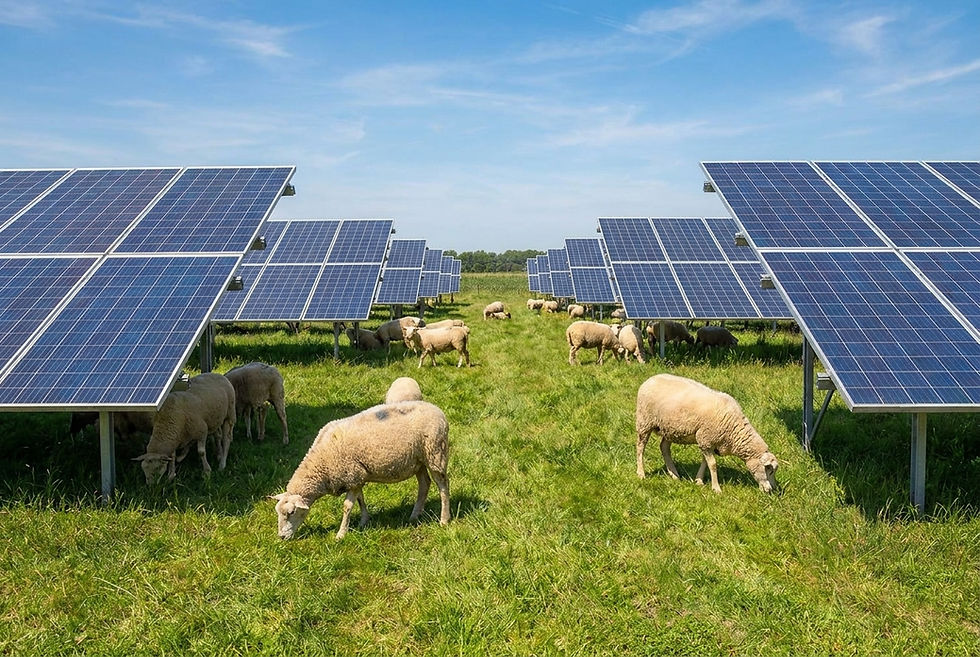
The UK agrivoltaics market is in an early but accelerating phase. As of April 2025, there are 15 commercial operational projects in the UK, most between 1 and 5 MW and primarily involving sheep grazing (CMS Law, 2025). The market is projected to grow at 11.96% annually, driven by the intersection of renewable energy targets and the agricultural income pressures that rising energy costs intensify (GreenMatch, 2025).
A University of Sheffield study published in February 2025 found that approximately 55.5% of UK land is suitable for agri-PV deployment — enough, theoretically, to meet UK electricity demand more than four times over without land use conflict (The Planner, 2025). The most suitable regions — Cambridgeshire, Essex, Lincolnshire, and the wider East and South East of England — are also among the areas with the highest energy cost exposure due to their agricultural energy intensity.
The financial benefits for participating landowners are substantial. Net income for farmers can increase by up to 142% through agrivoltaics, with combined agrivoltaic income 30 to 50% higher than farming alone (GreenMatch, 2025). Water usage falls by around 30% as panel shade reduces evaporation — reducing irrigation energy costs alongside the direct energy bill saving. And the energy price context of mid-2026 — with bills rising and no clear near-term ceiling — means the financial modelling for agrivoltaic projects prepared today will be more conservative than the actual returns delivered across the asset's operational life if energy prices remain structurally elevated.

Why the Mounting Infrastructure Matters as Much as the Panel
An agrivoltaic installation is a 25 to 30-year asset. The panels carry a 25-year performance warranty. The mounting structure — the elevated frames holding panels above crops at a height that allows machinery to pass beneath, the cable trays routing DC power to inverters across active farmland, and the structural profiles managing the interface between solar generation and agricultural production — must perform for the same period.
An agrivoltaic farm operates in an environment that is specifically hostile to conventional galvanised steel mounting infrastructure. Fertilisers, pesticides, herbicides, slurry, and organic soil acids attack zinc coatings at ground contact points from the first growing season. Persistent moisture from irrigation and rainfall creates the wet-dry cycling that degrades galvanised coatings fastest at fixing points and cut edges. In the most chemically active agricultural soils — intensive arable and horticultural production zones, which are precisely the locations where the land value and energy intensity makes agrivoltaics most financially compelling — galvanised coatings can begin to fail within three to five years of installation.
A mounting frame that requires recoating or structural assessment within five years of a 30-year asset life represents a maintenance liability that was entirely avoidable at the point of specification. It disrupts farming operations for access. It adds unbudgeted capital expenditure to an asset financed on a 30-year cash flow model. And it compounds — each maintenance intervention in an active agricultural environment carries access costs, permit requirements, and operational disruption that steel frames generate repeatedly and FRP frames never generate at all.
What FRP Mounting Infrastructure Delivers for Agrivoltaic Farms
1. Corrosion Immunity Across the Agrochemical Spectrum
FRP manufactured in vinyl ester resin provides broad-spectrum resistance to the full range of agricultural chemicals encountered in an active farming environment. Fertiliser compounds, pesticide and herbicide residues, organic soil acids, slurry, and animal waste products that accelerate galvanised steel corrosion do not attack the FRP composite matrix. This chemical resistance is intrinsic to the material — not a coating that can be physically damaged by agricultural machinery contact, animal rubbing, or the repeated application of agrochemicals across 30 annual farming cycles (IntechOpen, 2022).
In the coastal and near-coastal locations that dominate the UK's agrivoltaic pipeline in the South West and South East — where salt air adds a further corrosion mechanism on top of the agricultural chemical environment — FRP's inherent salt resistance provides an additional advantage over galvanised steel that compounds across the full operational life of the installation.
2. Lightweight Frames on Agricultural Soils
Agrivoltaic mounting frames must be founded in agricultural soils that were not designed to carry structural loads. On softer and wetter agricultural ground — lowland arable, flood-plain adjacent, and irrigated horticultural soils — heavy steel structures require deeper and more extensive foundations that disturb more soil, compact more crop root zones, and leave larger permanent obstacles to agricultural operations than the farming calendar can easily work around.
FRP structural profiles are approximately 75 to 80% lighter than equivalent steel sections (IntechOpen, 2022). Lighter frames mean smaller foundation requirements, less soil disturbance during installation, less compaction around crop root zones, and smaller permanent obstacles to farm machinery operations across the site. For an agrivoltaic system designed for active arable or horticultural production, this weight advantage is a genuine agronomic benefit that directly supports the agricultural productivity case that planning applications and lender assessments require to be demonstrated.
3. Non-Conductive Around Precision Farming Technology
Modern UK farming increasingly relies on precision agriculture technology — GPS-guided machinery, soil moisture sensors, yield mapping systems, and autonomous equipment that uses electromagnetic signals for navigation and control. FRP mounting frames are electrically non-conductive and non-magnetic. They do not interfere with electromagnetic signals from precision farming equipment operating in proximity to the solar array, and they do not require the earthing and bonding programme that metal frames demand around DC electrical systems (IntechOpen, 2022).
As UK farms invest in precision agriculture technology — driven in part by the energy cost pressures that are making operational efficiency a competitive necessity — the compatibility of agrivoltaic mounting infrastructure with that technology becomes progressively more important. FRP's electromagnetic neutrality is an advantage that compounds with each new generation of precision farming equipment deployed on the site across its 30-year operational life.
4. FRP Cable Trays — Managing DC Power Across Active Farmland
DC cable management on an agrivoltaic site faces the same agrochemical corrosion environment as the mounting frames, combined with the specific electrical safety requirements of high-voltage DC systems operating alongside irrigation infrastructure, livestock, and farm machinery. FRP cable trays are corrosion-immune, non-conductive, and resistant to the full range of agricultural chemical exposure that ground-level cable management on an active farm encounters.
Non-conductive cable trays eliminate the risk of accidental current paths through irrigation water in the event of a cable fault — a specific safety concern in systems where irrigation infrastructure and DC solar cables operate in close proximity. They require no earthing and bonding, simplifying the electrical safety design of the installation and reducing the ongoing compliance burden across the operational life of the site.
The Whole-Life Financial Case: Energy Bills, Farm Income, and Infrastructure Cost
The financial case for an agrivoltaic installation in 2026 rests on three compounding income and cost streams across a 30-year operational horizon.
Energy income from solar generation — both self-consumed electricity at avoided grid cost and exported electricity at wholesale price — is valued at prices that are currently rising and structurally elevated by the shift away from gas. The typical agrivoltaic installation in the UK South East generates between 800 and 1,100 kWh per installed kWp annually, providing a predictable and largely weatherproof income stream across the asset's operational life.
Agricultural income from continued food production on the same land — whether from livestock grazing, soft fruit, leafy vegetables, or biodiversity planting — continues alongside solar generation. Net farm income increases of up to 142% have been reported in agrivoltaic systems, with the combined income exceeding farming-alone returns by 30 to 50% (GreenMatch, 2025). As energy costs for agricultural operations also rise — irrigation pumping, grain drying, temperature-controlled storage — the value of on-farm generation against those costs compounds further.
Infrastructure cost — the mounting frames, cable management, and structural systems of the installation — is where the specification decision determines whether the first two income streams are sustained across the full 30-year horizon or interrupted by maintenance liabilities. A peer-reviewed lifecycle cost analysis found approximately 50% cost savings for GFRP versus steel over a 100-year study period, driven by the elimination of corrosion-related maintenance (Younis, Ebead and Judd, 2018). The break-even point — where FRP's lower lifetime maintenance cost offsets its higher purchase price — typically falls within 8 to 12 years. For a 30-year agrivoltaic asset, that means approximately two-thirds of the operational period is spent in net positive territory for FRP before a single energy or agricultural income figure is counted.
Rising energy bills make the case for agrivoltaics more financially compelling with each price cap increase. Specifying FRP mounting infrastructure makes the financial case sustainable across the full 30 years that the installation is designed to deliver it.
Reinforce Technology FRP Products for Agrivoltaic Installations
Reinforce Technology supplies FRP structural profiles and cable management systems for agrivoltaic solar farm applications across the UK. Our products for agrivoltaic installations include pultruded I-beams, C-channels, box sections, and angle profiles for elevated and ground-level mounting frames, and FRP cable tray systems for DC cable management across active agricultural sites. All pultruded FRP profiles are independently tested by SGS and TÜV Rheinland, providing verified performance data for structural specification and project approval submissions.
Available in polyester and vinyl ester resin systems — we recommend vinyl ester for agrivoltaic applications where active agrochemical use creates a chemically demanding ground-level environment. Contact us to discuss your installation and the correct FRP specification for the agricultural environment and operational horizon of your site.
Final confirmation of structural suitability for any specific agrivoltaic application — including frame loading under agricultural machinery clearance requirements and post foundation design for the specific ground conditions of the site — remains the responsibility of the appointed project engineer. Reinforce Technology provides material guidance based on information supplied to us, but structural design sign-off should always sit with the qualified professional responsible for the engineering. We are happy to provide full technical data sheets and application-specific support to assist with that process.
References
Big Issue (2026) Energy Price Cap Reveals Energy Bills to Rise by £221 in July 2026. Available at: https://www.bigissue.com/news/social-justice/energy-bills-price-cap-july-2026/ [Accessed: 26 May 2026]. [Average household energy debt £2,270 in 2025 to 2026].
CMS Law (2025) Expert Guide on Agrivoltaics and Floating Photovoltaics UK. Available at: https://cms.law [Accessed: May 2026]. [15 commercial operational agrivoltaic projects in the UK as of April 2025].
Cornwall Insight (2026) cited in The British Eye (2026) UK Energy Bills Set to Rise by £200. Available at: https://thebritisheye.com/2026/05/25/uk-energy-bills-set-to-rise-by-200/ [Accessed: 26 May 2026]. [Price cap rising to approximately £1,850 in July; elevated prices likely to persist into autumn].
Energy UK (2026) UK Energy Transition: Supporting Statistics and Evidence. Available at: https://www.energy-uk.org.uk/insights/uk-energy-transition-supporting-statistics-and-evidence/ [Accessed: 26 May 2026]. [Household energy bills £166 higher than 2021; wind power lowered UK electricity prices by 31% in 2025].
GreenMatch (2025) Agrovoltaics: Solar Energy for Sustainable Farming. Available at: https://www.greenmatch.co.uk/blog/agrovoltaics-solar-energy-for-sustainable-farming [Accessed: May 2026]. [Net farm income increase up to 142%; combined income 30–50% higher than farming alone; water usage reduction ~30%].
The Planner (2025) Solar Technology Could Meet UK Power Needs Without Losing Farmland. Available at: https://www.theplanner.co.uk [Accessed: May 2026]. [University of Sheffield: 55.5% of UK land suitable for agri-PV].
Younis, A., Ebead, U. and Judd, S. (2018) 'Life cycle cost analysis of structural concrete using seawater, recycled concrete aggregate, and GFRP reinforcement', Construction and Building Materials, 175, pp. 135–144. doi: 10.1016/j.conbuildmat.2018.04.183.


Comments