
FRP vs steel material properties comparison secondary infrastructure
The FRP versus steel comparison is not a verdict in favour of one material across all applications. It is a property by property analysis that identifies where each material performs better and why. FRP wins clearly on corrosion resistance, weight, electrical non-conductivity, and thermal expansion in outdoor infrastructure. Steel wins clearly on modulus of elasticity, compressive strength, fire resistance, and purchase price. Understanding precisely which properties matter for a specific application is the foundation of a correct specification decision. This blog presents the comparison in full, with the actual numbers, for the properties that matter in UK secondary infrastructure.
Published by Reinforce Technology | 31 August 2026
Structural steel has been the default secondary infrastructure material in UK energy, water, and industrial construction for more than a century. Its material properties are well-understood by every structural engineer in the UK, its supply chain is mature, its unit cost is lower than FRP, and its installation methodology is familiar to every electrical and structural subcontractor in the market. These are genuine advantages that a correct FRP specification case must acknowledge and address rather than dismiss.
FRP, specifically pultruded GFRP to EN 13706 E23 quality classification, has properties that structural steel does not share: corrosion immunity across the full cross-section of the material, electrical non-conductivity throughout, non-magnetic and non-sparking behaviour in classified environments, and a thermal expansion coefficient approximately half that of steel. These properties are not marginal improvements over steel in the applications where they matter. They are categorical differences that determine whether secondary infrastructure performs maintenance free across 25 to 50-year design lives or accumulates the maintenance liabilities that drive the whole life cost case for FRP.
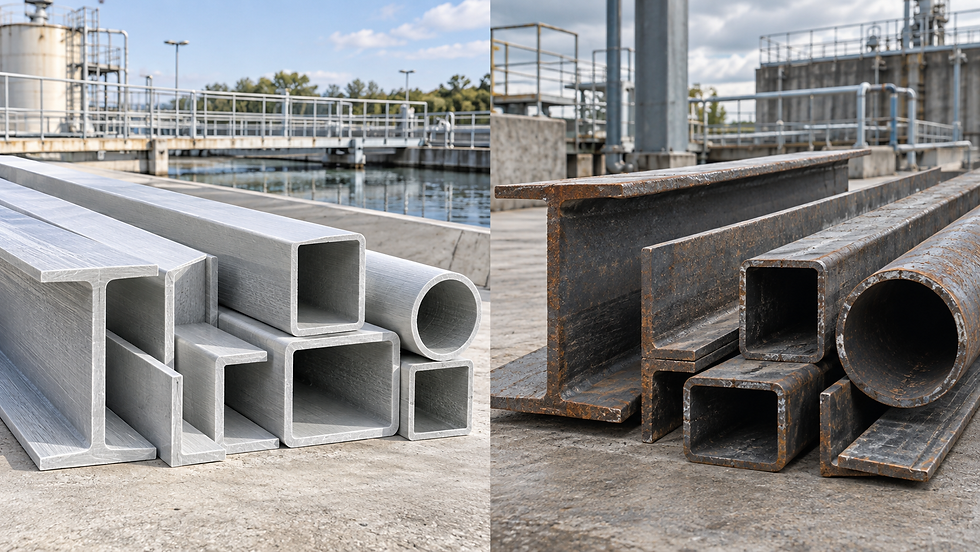
The comparison below covers the ten material properties most relevant to secondary infrastructure specification in UK energy, water, and industrial applications. Each property is presented with the actual values for both materials, a plain English explanation of what the difference means in practice, and an honest assessment of which material the property favours.
Reading the Comparison: What It Means for Secondary Infrastructure Specification
The ten-property comparison resolves to a clear pattern for secondary infrastructure specification in the environments where FRP is most commonly considered. FRP wins decisively on the properties that determine whole-life cost in corrosive, electrically sensitive, and magnetically sensitive infrastructure environments: corrosion resistance, electrical non-conductivity, magnetic neutrality, lower thermal expansion, and lower thermal conductivity. These properties are not incremental improvements over steel. They are categorical differences that determine whether a secondary infrastructure installation requires maintenance in year 8, 15, and 25 of a 30-year design life or requires none (IncomePultrusion, 2026).
Steel wins decisively on modulus of elasticity and fire resistance. The modulus advantage matters for every secondary structural application where deflection governs the design — which in many secondary framing and cable tray support applications means FRP requires a deeper section than steel to achieve the same deflection performance at the same span. This is not a reason to specify steel in corrosive or electrically sensitive environments: it is a reason to design FRP secondary structures with appropriate section depths, which qualified structural engineers account for as a standard part of FRP structural design. The fire resistance advantage of steel matters specifically in enclosed occupied buildings and process facilities where fire resistance classification drives the specification.
Steel wins on purchase price. The unit cost of FRP secondary profiles and cable management is typically 1.5 to 2 times the unit cost of equivalent galvanised steel sections. This purchase price premium is the primary objection to FRP specification at procurement stage. A peer-reviewed lifecycle cost analysis found approximately 50% lifecycle cost savings for GFRP versus steel over long study periods (Younis, Ebead and Judd, 2018). The purchase price premium is offset by eliminated maintenance across 25 to 50-year design lives in corrosive environments, reduced installation cost from FRP's lighter weight and faster assembly, and eliminated earthing and bonding cost in electrical environments.
The Applications Where the Comparison Points Clearly to FRP
Secondary cable management in DC solar farm environments: non-conductivity and corrosion immunity in outdoor agricultural environments across 30-year design lives. FRP wins clearly on electrical non-conductivity, corrosion resistance, and thermal expansion.
Grating and walkways in water treatment, sewage treatment, and chemical process environments: corrosion immunity in H2S, chlorine, and chemical process atmospheres. FRP wins clearly on corrosion resistance and non-conductivity in wet electrical environments.
Secondary structural framing in coastal, marine, and offshore environments: corrosion immunity in marine atmospheric chloride and saltwater splash, non-magnetic behaviour near navigation instrumentation, non-sparking in hydrocarbon atmosphere zones, and 70 to 75% weight reduction improving topside payload capacity. FRP wins clearly on all four properties that matter most in this environment.
Secondary infrastructure in MRI suite environments, radar proximity zones, and naval degaussing facilities: non-magnetic behaviour. FRP wins categorically. Steel is disqualified by its ferromagnetic properties regardless of its other advantages in these specific applications.
FRP and steel are both capable structural materials for secondary infrastructure. The specification decision between them is a property matching exercise. Match the properties of each material against the specific demands of the application environment and the design life required. In the environments where UK infrastructure is being built and upgraded at the largest scale in 2026, water treatment, sewage treatment, solar energy, offshore, and electrically sensitive energy infrastructure, the property matching exercise points clearly and consistently toward FRP.
Reinforce Technology FRP Secondary Infrastructure Products
Reinforce Technology supplies FRP cable trays, grating, structural profiles, fencing, and drainage for UK infrastructure applications. EN 13706 E23 classified pultruded structural profiles. Vinyl ester resin systems for chemical, marine, and water treatment environments. Fire retardant formulations for classified fire performance requirements. Full material property data sheets and EN 13706 test certificates available for project QA submissions.

Contact us to discuss your project and the correct FRP specification for your application environment, design life, and structural requirements.
Material property values cited in this comparison are published ranges for standard pultruded GFRP profiles to EN 13706 E23 and for structural steel S275. Actual values for specific products should be confirmed from manufacturer-certified test data. Structural design using FRP profiles must be carried out by a qualified structural engineer using certified material property data for the specific profiles specified.
References
Bedford Reinforced Plastics (2025) FRP vs Traditional Materials Comparison. Available at: https://bedfordreinforced.com/wp-content/uploads/2017/08/BRP-FRP-vs-Traditional-Materials.pdf [Accessed: 31 August 2026]. [Pultruded GFRP density; tensile strength; thermal conductivity 4 BTU in/hr ft2 F versus steel 323; thermal expansion 7 to 8 x 10⁻⁶ in/in/F].
IncomePultrusion (2026) FRP vs Steel: Performance, Cost and Application Comparison Guide. Available at: https://incomepultrusion.com/frp-vs-steel-comparison/ [Accessed: 31 August 2026]. [Tensile strength 300 to 600 MPa for glass fiber pultruded profiles; modulus 17 to 50 GPa versus steel 200 GPa; FRP outperforms steel in tension by factor 2 to 4 per weight].
IntechOpen (2022) 'Fibre-Reinforced Polymer (FRP) in Civil Engineering', in IntechOpen Engineering Series. Available at: https://www.intechopen.com/chapters/84203 [Accessed: 31 August 2026]. [Non-conductive volume resistivity 10^12 to 10^16 ohm metres; non-magnetic; non-sparking; density 1,750 to 2,100 kg/m3; thermal conductivity 0.3 to 0.5 W/mK; thermal expansion 6 to 8 ppm/°C longitudinal].
Reinforce Technology (2026) FRP/GRP vs Steel: The Complete Comparison for UK Infrastructure Projects. Available at: https://www.reinforcetechnology.com/post/frp-vs-steel-comparison-uk-infrastructure [Accessed: 31 August 2026]. [GFRP density approximately 1,750 to 2,100 kg/m3; 70 to 80% lighter than steel; tensile strength comparable to or greater than steel; lower modulus deflection-governed design].
ScienceDirect (2025) 'Sustainable composites for metal replacement: Environmental assessment and material selection of fiber-reinforced polymer across industries', ScienceDirect, doi: 10.1016/S2667-3789(25)00051-3. Available at: https://www.sciencedirect.com/science/article/pii/S2667378925000513 [Accessed: 31 August 2026].
Younis, A., Ebead, U. and Judd, S. (2018) 'Life cycle cost analysis of structural concrete using seawater, recycled concrete aggregate, and GFRP reinforcement', Construction and Building Materials, 175, pp. 135-144. doi: 10.1016/j.conbuildmat.2018.04.183.


Comments