
Kew Gardens Hit 38.1°C on 13 August. Steel Infrastructure Is Buckling. Here Is Why FRP Handles the Heat Better.
Kew Gardens hit 38.1 degrees Celsius on 13 August 2026, the fifth heatwave of a summer on track to break the UK annual record for days above 30 degrees. Steel rails reach 20 degrees hotter than the surrounding air. Roughly 20% of existing UK infrastructure is at risk of overheating. UK infrastructure was designed for a climate that no longer exists. FRP was not designed for that climate either, but its thermal expansion coefficient is approximately half that of steel, it does not conduct heat at steel's rate, and it does not buckle under thermal stress in the way that steel secondary infrastructure does when the thermometer climbs past what British engineering standards anticipated.
Published by Reinforce Technology | 19 August 2026
The UK has experienced five heatwaves in 2026, including a Red Warning event in June that produced record temperatures across multiple sites, and an Amber Warning event in August that saw Kew Gardens provisionally reach 38.1 degrees Celsius on 13 August, the fifth highest temperature ever recorded in the United Kingdom (The Ecologist, 2026). By 9 August, the UK had already recorded 33 days in 2026 where temperatures surpassed 30 degrees somewhere in the country, one day short of the single-year national record set in 1995 (Wikipedia, 2026). Parliament's own research service has acknowledged what structural engineers have known for years: heatwaves pose risks to infrastructure that were never factored into original design standards (CCE Online News, 2026).
The consequence of that design gap is visible every summer. Rail tracks buckle when steel rails reach temperatures 20 degrees hotter than the surrounding air, because UK rails are pre-stressed to summer temperatures of 27 degrees, not to the 40-plus degree air temperatures that have now become a recurring event (London Daily, 2026). Roads soften and deform when bitumen approaches its flow temperature in direct solar exposure. Bridge expansion joints reach their designed limit of travel and transmit stress into adjacent structural elements. Overhead catenary lines sag. Water mains fail under thermal pressure. Roughly 20% of existing UK infrastructure is at risk of overheating, and this proportion is projected to rise as average temperatures continue to climb (The Conversation, 2026).
The secondary infrastructure of energy, water, and industrial facilities faces the same thermal challenge as transport infrastructure, but with an additional dimension: secondary structural materials at ground and low level on solar farms, in water treatment works, and on industrial plant are directly exposed to solar radiation that can raise surface temperatures 20 to 30 degrees above air temperature on clear summer days. A galvanised steel cable tray on a solar farm, directly exposed to solar radiation on a 38 degree August day, can reach surface temperatures of 55 to 65 degrees. At those temperatures, steel's thermal expansion, its electrical resistance increase, and the accelerated degradation of any zinc coating under combined heat and UV exposure combine to create a secondary infrastructure stress environment that UK steel was not designed for. FRP's thermal behaviour in the same conditions is demonstrably different, and demonstrably better suited to the hotter summers that UK infrastructure now faces.
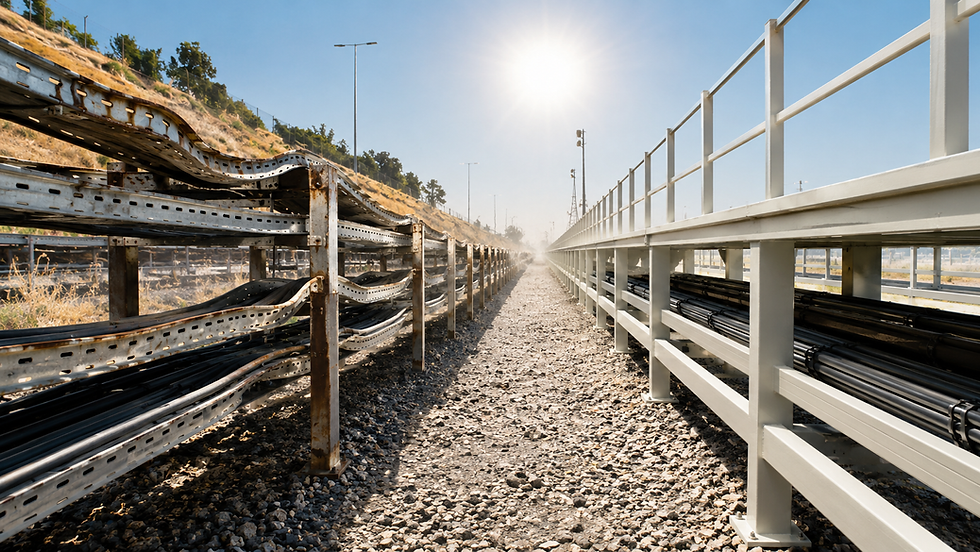
Why Steel Struggles in Heat and How FRP Is Different
Steel's behaviour under extreme heat is determined by two physical properties: its high thermal conductivity and its thermal expansion coefficient. Both create problems for secondary infrastructure in the UK's intensifying heatwaves, and both are substantially more benign in FRP.
Structural steel has a thermal conductivity of approximately 50 watts per metre kelvin, meaning it absorbs and transfers heat rapidly from any surface in contact with a heat source, including direct solar radiation and hot ambient air. This high thermal conductivity is why steel rails can reach 20 degrees above air temperature in full sunlight: the steel absorbs solar radiation efficiently and retains it, building up a surface temperature that far exceeds the surrounding air. Secondary steel cable trays, walkways, and structural profiles in direct solar exposure on energy infrastructure sites experience the same surface temperature amplification, generating thermal stresses within the section and at connection interfaces that accumulate over repeated daily heating and cooling cycles (The Conversation, 2026).
FRP's thermal conductivity is approximately 0.3 to 0.5 watts per metre kelvin, one to two orders of magnitude lower than structural steel. FRP sections in the same direct solar exposure absorb less heat, retain it less efficiently, and reach lower surface temperatures than equivalent steel sections in the same conditions. The surface temperature of an FRP cable tray in direct solar exposure on a 38 degree day is substantially lower than a steel cable tray in the same location, reducing the thermal stress within the section and at connection interfaces that repeated daily thermal cycling generates over a 30-year service life (IntechOpen, 2022).
Thermal Expansion: The Half-Rate Advantage
The thermal expansion coefficient of structural steel is approximately 12 parts per million per degree Celsius. For pultruded GFRP in the longitudinal direction, the thermal expansion coefficient is approximately 6 to 8 parts per million per degree Celsius, roughly half that of steel. This difference in expansion rate has direct and measurable consequences for the behaviour of secondary infrastructure connections and fixings under the thermal cycling of a UK heatwave summer.
A 10-metre run of steel cable tray at a UK average temperature of 10 degrees Celsius will expand by approximately 10.8 millimetres when heated to 40 degrees Celsius in a heatwave day, and contract by the same amount when it cools overnight to 15 degrees. That daily expansion and contraction cycle, repeated across 33 days above 30 degrees in a 2026 summer, accumulates thermal fatigue at the bolted connection interfaces of the cable tray, progressively working bolts loose and generating micro-cracking at the contact surfaces where the bolt bearing load is concentrated.
The equivalent 10-metre FRP cable tray run expands by approximately 5.5 to 7 millimetres across the same temperature rise, generating approximately half the thermal movement at connection interfaces and proportionally less thermal fatigue accumulation across the same summer of heat events. Over a 30-year installation life in which each successive summer delivers more days above 30 degrees than the previous one, the reduction in thermal fatigue accumulation from FRP's lower expansion coefficient translates directly into longer connection integrity and lower maintenance requirements at the secondary structural level (CCE Online News, 2026).
UV Stability: The Solar Exposure Dimension
Ultraviolet radiation from the sun drives surface degradation in polymer materials and zinc coatings simultaneously. In the UK's increasingly hot and sunny summers, with 2025 confirmed as the sunniest year on record and 2026 on track to challenge that record, the UV exposure experienced by secondary infrastructure in outdoor energy, water, and agricultural settings is measurably higher than historical design assumptions.
Galvanised steel coatings degrade under UV exposure through the photo-oxidation of the organic components in the zinc coating passivation layer, reducing the coating's barrier properties and accelerating the electrochemical corrosion that the coating is designed to prevent. In the combined UV and heat environment of a UK heatwave day, the rate of galvanised coating degradation is higher than in the overcast, moderate-temperature conditions that dominated UK summer weather for most of the twentieth century.
FRP with UV-stable resin formulations and UV-resistant surface veils is designed to maintain its mechanical properties and surface integrity under prolonged UV exposure. UV-stable FRP formulations used in outdoor infrastructure applications retain their structural performance and surface quality across 25 to 30-year service lives in direct solar exposure, with no surface treatment maintenance required to maintain UV stability. The increasing UV intensity of UK summer heatwaves accelerates the degradation of galvanised steel coatings while leaving UV-stable FRP formulations unaffected (GRP Grating Systems, 2025).
The Long-Term Infrastructure Performance Argument
The significance of the UK's intensifying heatwaves for secondary infrastructure is not primarily about catastrophic failure. Steel cable trays do not buckle and collapse at 38 degrees in the way that rail tracks buckle or roads soften. The significance is about the cumulative effect of repeated thermal cycling at temperatures and UV intensities that secondary steel infrastructure was not designed to handle routinely, across 30-year service lives that extend further into an increasingly warm future.
UK engineering standards for secondary structural materials were developed based on historical temperature distributions that assumed UK summers would occasionally exceed 30 degrees but would rarely approach or exceed 38 degrees for extended periods. The 2026 summer, with 33 days above 30 degrees and multiple events approaching 38 degrees, represents a new normal that those standards did not anticipate. Infrastructure specified and installed in 2026 on a 30-year design life will operate until 2056. The temperature distribution of UK summers in 2056 is projected by climate models to be substantially more extreme than 2026, with scenarios showing median summer temperatures 2 to 4 degrees above today's already record-breaking baseline (House of Commons Library, 2026).
Secondary infrastructure specified in 2026 must therefore be evaluated not only against the thermal conditions of current UK summers but against the thermal conditions that UK summers will present across the full 30-year design life. FRP's lower thermal conductivity, lower thermal expansion coefficient, and UV-stable formulations maintain their relevant properties throughout that 30-year horizon regardless of what the temperature distribution does. The thermal fatigue advantage of FRP over steel compounds with every additional year of hotter summers, because each year of additional heat events adds incremental fatigue to steel connection interfaces that FRP connection interfaces do not accumulate at the same rate.
The Infrastructure Investment Case Under Climate Change
The Committee on Climate Change's 2026 Well-Adapted UK report identified cooling and protection from heat as among the highest adaptation priorities for UK infrastructure, calling for vulnerable infrastructure to be made more resilient through a combination of active and passive measures (House of Commons Library, 2026). The Verdant economic-policy think tank estimated the direct economic consequences of the June 2026 heatwave, and the Committee on Climate Change recommends expenditure of £3.85 billion per year on adaptation to extreme heat over the coming decades (The Ecologist, 2026).
For infrastructure owners and operators specifying secondary materials on projects that will operate across the next 30 years of UK climate change, the thermal resilience case for FRP is not a peripheral consideration. It is a component of the whole life performance assessment that the CCC's adaptation framework requires. A secondary structural specification that performs better under the thermal conditions UK infrastructure will face in 2030, 2040, and 2050 than under the conditions of 2000 has a climate resilience value that compounds across the service life of the installation in ways that a specification optimised only for 2026 conditions does not capture.
The UK's fifth heatwave of 2026 brought 38.1 degrees to Kew Gardens on 13 August. The infrastructure built for a milder Britain is showing the strain. Rail lines buckle. Roads soften. Twenty percent of existing infrastructure is at risk of overheating. FRP secondary infrastructure, with half the thermal expansion of steel, a fraction of steel's thermal conductivity, and UV-stable formulations that maintain their properties across 30 years of intensifying UV exposure, is the secondary specification that the UK's changing climate is making progressively more correct with every summer that breaks another record.
Reinforce Technology FRP Products for Climate Resilient Infrastructure
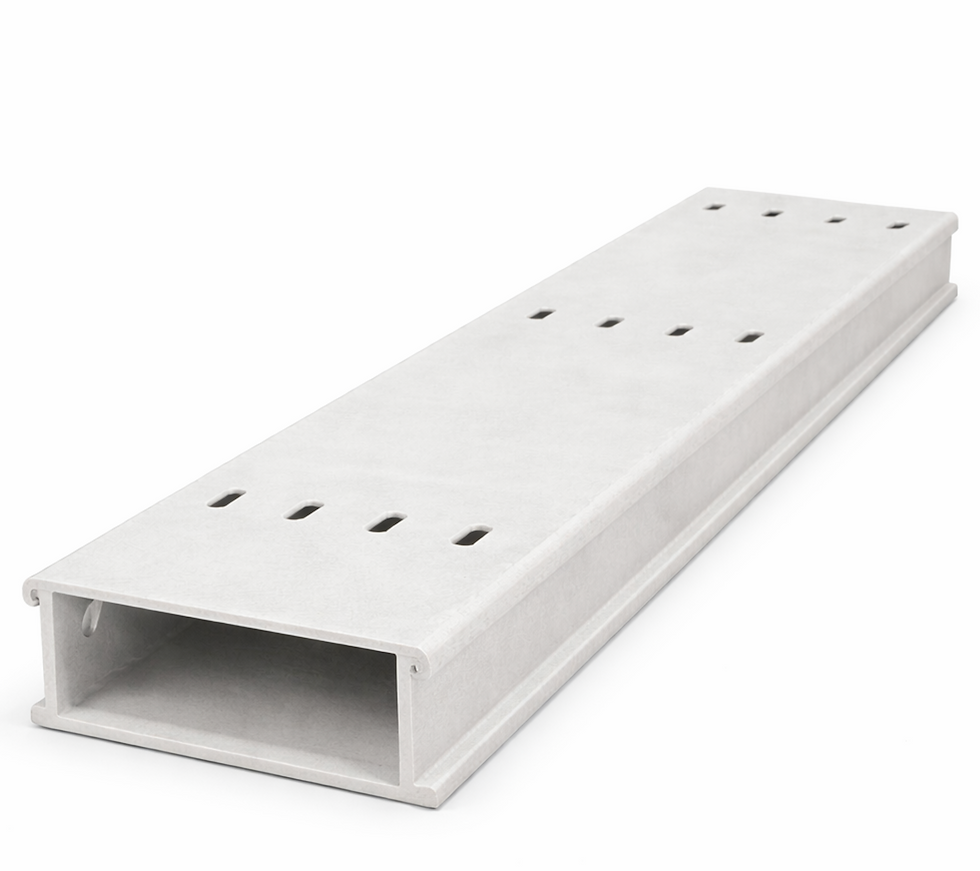
Reinforce Technology supplies FRP cable trays, structural profiles, grating, fencing, and drainage for infrastructure across the UK, in UV-stable resin formulations with lower thermal expansion and lower thermal conductivity than equivalent steel secondary infrastructure. Maintenance free across 25 to 30-year design lives in the outdoor solar exposure and elevated temperature conditions of UK energy, water, and industrial infrastructure in a warming climate.
Contact us to discuss your project and the correct FRP specification for your application, environment, and 30-year operational horizon.
Temperature data cited is provisional where indicated and sourced from published meteorological records at the time of writing. Final confirmation of suitability for any specific application, including thermal performance under elevated temperature service conditions, remains the responsibility of the appointed project engineer.
References
CCE Online News (2026) Britain's Rail Crisis Is a Construction Warning: Heat-Proofing Infrastructure Can No Longer Wait. Available at: https://cceonlinenews.com [Accessed: 19 August 2026]. [UK experienced record-breaking heat events in 2022, 2025, and twice in 2026; Parliament acknowledged structural risks to infrastructure never factored into original design standards].
GRP Grating Systems (2025) GRP in Renewable Energy and Offshore Applications. Available at: https://www.grpgratingsystems.co.uk [Accessed: 19 August 2026]. [UV-stable resins prevent degradation under constant sunlight].
House of Commons Library (2026) Is the UK Prepared for Heatwaves? Available at: https://commonslibrary.parliament.uk/research-briefings/cbp-10956/ [Accessed: 19 August 2026]. [CCC Well-Adapted UK report 2026: cooling and protection from heat among highest adaptation priorities].
IntechOpen (2022) 'Fibre-Reinforced Polymer (FRP) in Civil Engineering', in IntechOpen Engineering Series. Available at: https://www.intechopen.com/chapters/84203 [Accessed: 19 August 2026]. [FRP thermal conductivity 0.3 to 0.5 W/mK; thermal expansion coefficient 6 to 8 ppm/°C longitudinal versus steel 12 ppm/°C; UV-stable formulations; 25 to 30-year design life in direct solar exposure].
London Daily (2026) Why Do Britain's Roads Melt and Its Rails Buckle in Heat? Available at: https://londondaily.com [Accessed: 19 August 2026]. [UK steel rails pre-stressed to 27°C; rails reach 60°C when air temperature hits 40°C; 20°C above surrounding air temperature in direct sunlight].
ScienceDirect (2025) 'Sustainable composites for metal replacement: Environmental assessment and material selection of fiber-reinforced polymer across industries', ScienceDirect, doi: 10.1016/S2667-3789(25)00051-3. Available at: https://www.sciencedirect.com/science/article/pii/S2667378925000513 [Accessed: 19 August 2026].
The Conversation (2026) Britain Isn't Built to Withstand 40°C: Here Is Where Infrastructure Is Most Likely to Fail. Available at: https://theconversation.com [Accessed: 19 August 2026]. [Steel high thermal conductivity; rails reach up to 20°C hotter than surrounding air; 20% of existing UK infrastructure at risk of overheating].
The Ecologist (2026) Heatwaves Will Scorch British Economy. Available at: https://theecologist.org [Accessed: 19 August 2026]. [CCC recommends £3.85bn per year on extreme heat adaptation; record-breaking June 2026 heatwave].
The Ecologist (2026) Heat Not Fit for Humans Hits Britain. Available at: https://theecologist.org [Accessed: 19 August 2026]. [Amber warning August 2026; fifth heatwave of the year; potential impacts to railway lines, roads, infrastructure].
Weather Blog (2026) Scorching Europe, Shrinking Danube: The 2026 European Heatwave. Available at: https://blog.worldweatheronline.com [Accessed: 19 August 2026]. [Kew Gardens provisionally reached 38.1°C on 13 August 2026; UK's hottest of 2026 and fifth highest on record; 40 locations across central and southern England reached at least 36°C].
Wikipedia (2026) 2026 United Kingdom Heatwaves. Available at: https://en.wikipedia.org/wiki/2026_United_Kingdom_heatwaves [Accessed: 19 August 2026]. [33 days above 30°C recorded by 9 August 2026; one day short of 1995 single-year record].


Comments