
GBE-N Just Published the £1.1bn SMR Early Works Package. The MEP Scope Is Where the 60-Year Specification Decisions Are Being Made.
Great British Energy Nuclear published a preliminary market engagement notice on 20 August 2026 for an early works package valued at £730 million to £1.1 billion, covering civils, infrastructure, buildings, MEP, and earthworks for the UK's first SMR site. The MEP scope within that package is where the secondary infrastructure specification decisions for the UK's first commercial SMR are being made. Those decisions will define 60 years of operational performance. They will also set the specification template replicated across every subsequent SMR in the planned fleet. Here is the FRP case for the early works MEP scope.
Published by Reinforce Technology | 25 August 2026
The preliminary market engagement notice published by Great British Energy Nuclear on 20 August 2026 marks a significant programme milestone. The early works package, valued at £730 million to £1.1 billion, covers the civils, infrastructure, buildings, and MEP scope required to prepare the SMR site for the main construction programme that follows the Final Investment Decision, currently targeted for 2029 (New Civil Engineer, 2026). This is not a conceptual announcement. It is a market engagement for a procurement programme that will result in contracts being let for the physical enabling work that makes the UK's first Small Modular Reactor site ready for the Rolls-Royce SMR installation. The supply chain teams responding to this engagement notice are evaluating specifications, materials, and methodologies for the early works scope right now.
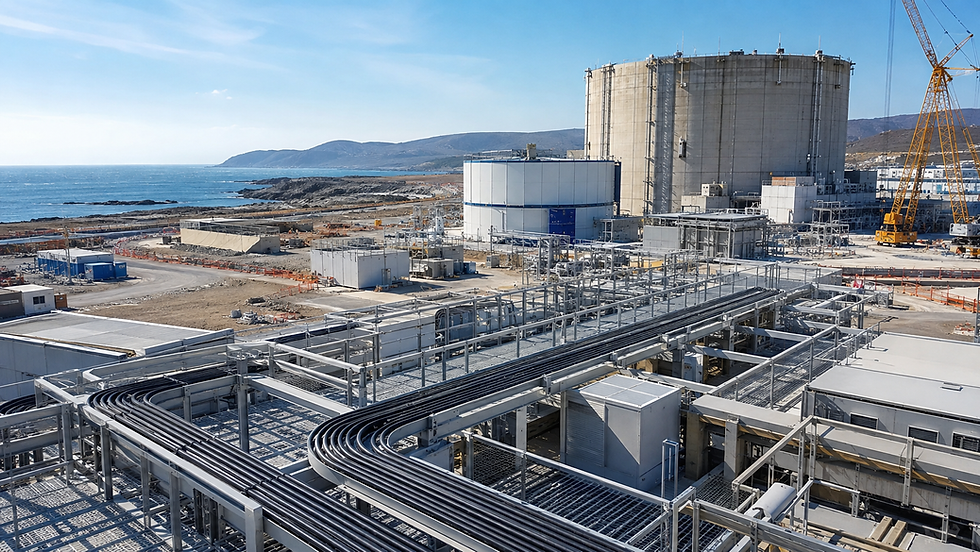
The MEP scope within the early works package, buildings and mechanical, electrical, and plumbing systems, encompasses the secondary infrastructure of the early site facilities: the construction camp and welfare buildings that will support a peak construction workforce, the temporary and permanent electrical distribution infrastructure of the site, the site services buildings and their associated cable management, drainage, and structural secondary systems. These early works facilities are not temporary throwaway structures. Many of the permanent buildings and infrastructure elements constructed in the early works phase will form part of the operational facility for the 60-year life of the SMR installation. The specification decisions made for the early works MEP scope will determine the maintenance liabilities of that infrastructure across those 60 years.
GBE-N has already awarded more than £350 million in contracts across the supply chain in the past year, involving some of the UK's leading engineering, manufacturing, and infrastructure firms (Public Sector Executive, 2026). The planned three-unit SMR project at Wylfa will generate at least 1.4 gigawatts of electricity, providing enough stable, clean power for the equivalent of around three million homes for more than 60 years. Against that operational horizon, the secondary infrastructure specification decisions in the early works MEP scope are not minor procurement details. They are the decisions that will define whether the facility's secondary infrastructure performs without maintenance intervention across 60 years of nuclear operation, or generates the access events in a radiologically controlled environment that correct initial specification would have eliminated.
Why the Early Works MEP Scope Is the Specification Moment
The early works package for a major nuclear construction programme is structurally different from the early works on a conventional infrastructure project. On a road or a water treatment works, the early works are predominantly enabling infrastructure that will be removed or modified before the operational facility is complete. On an SMR programme, the early works include permanent site buildings, permanent electrical distribution infrastructure, and permanent site services that will transition from construction support to operational facility elements as the main construction programme advances. Getting the specification of those permanent elements right in the early works phase is significantly more effective than revising them during the main construction programme, when the operational nuclear environment creates access, dose, and safety constraints on modification work that the early works phase does not share.
The MEP scope within the early works package covers the mechanical, electrical, and plumbing systems of the early site buildings and infrastructure. For the secondary structural and cable management elements of that MEP scope, the specification decision between FRP and galvanised steel secondary infrastructure is being made now, by the supply chain teams responding to GBE-N's preliminary market engagement notice and preparing their responses to the forthcoming competitive tender. The same specification decision that is being made for the early works MEP scope will inform the specification approach for the main construction MEP scope that follows, because programme teams developing nuclear facility specifications prefer consistency across phases and will carry forward specification standards established in the early works to the main construction unless there is a specific reason to change them.
This is the leverage point. The FRP specification established in the early works MEP scope becomes the template for the main construction MEP specification. The main construction MEP specification at Wylfa becomes the template for the subsequent SMRs in GBE-N's planned fleet. A correct FRP specification in the early works MEP scope at Wylfa does not just eliminate the maintenance liabilities of the early works facilities across 60 years. It creates a specification precedent that propagates across the full UK SMR fleet, compounding the value of the initial specification decision at the scale of the national nuclear programme.
What FRP Provides in the Nuclear MEP Environment
The specific properties of FRP that are most directly relevant to the nuclear MEP environment of the early works scope are non-magnetic behaviour, non-conductivity, corrosion immunity in the controlled chemistry environments of nuclear site services, and the maintenance-free design life that the ALARA principle requires of secondary materials in nuclear operational environments.
Nuclear sites use radiation survey instrumentation throughout their operational lives to monitor dose rates, contamination levels, and the integrity of radiological controls. These instruments rely on sensitive detectors that can be affected by the magnetic fields generated by ferromagnetic materials in close proximity. FRP is entirely non-magnetic. Secondary structural profiles, grating, and cable management specified in FRP do not generate or interact with magnetic fields at any point in the material, eliminating the magnetic interference risk that steel secondary infrastructure creates in the vicinity of radiation monitoring instrumentation (IntechOpen, 2022).
The electrical distribution infrastructure of the early works site buildings routes high-voltage AC supply cables and the DC battery backup systems that provide emergency power to safety-classified equipment on the site. Non-conductive FRP cable management in these high-voltage environments eliminates the earthing and bonding programme that metallic cable management demands, reduces the risk of accidental current paths through secondary structural elements, and simplifies the electrical safety management of the site's power distribution infrastructure during both the construction programme and the subsequent operational life of the permanent facility elements (IntechOpen, 2022).
The controlled chemistry environments of nuclear site services, including the water treatment systems that provide demineralised water for primary circuit chemistry, the cooling water circuits of nuclear plant equipment, and the liquid waste treatment systems that handle process effluent from the facility, create specific chemical exposure conditions for secondary infrastructure in the plant room areas of the site services buildings. FRP in vinyl ester resin provides chemical resistance to the controlled chemistry of nuclear water treatment environments, including boric acid solutions, pH adjustment chemicals, and the oxidising agents used in water conditioning, without the corrosion mechanism that depletes galvanised steel coatings in the same conditions.
The ALARA principle, As Low As Reasonably Achievable, which governs radiation dose management in nuclear facilities, specifically drives specification toward materials that minimise the frequency and duration of maintenance access across the facility's operational life. Secondary materials that require no maintenance across 60 years deliver a directly quantifiable ALARA benefit over galvanised steel, which requires periodic recoating and structural inspection in the controlled areas of a nuclear facility where every access event is regulated, logged, and associated with radiation dose accumulation for the personnel involved. For the permanent elements of the early works facility that will transition into the operational nuclear environment, FRP's maintenance-free design life is not just a lifecycle cost advantage. It is a radiation dose management advantage that the nuclear safety case values independently of the financial saving.
The Fleet Replication Argument
GBE-N's programme extends well beyond the three-unit SMR installation at Wylfa. GBE-N has been tasked with identifying suitable sites that could potentially host further large-scale reactor projects beyond the current deployments at Hinkley Point C and Sizewell C, with a report to government due by autumn 2026 (World Nuclear News, 2026). The government's ambition for a fleet of SMRs across multiple UK sites, with the standardised, modular construction methodology of the Rolls-Royce design enabling cost reduction through repetition, means that every specification decision made at Wylfa will be evaluated for replication at subsequent sites.
Standardised plant design is the economic foundation of the SMR business case. The Rolls-Royce SMR design achieves cost competitiveness against large-scale nuclear by manufacturing 90% of the reactor module in factory conditions and replicating the same design across multiple sites with minimal site-specific modification. Secondary infrastructure specifications within that standardised design follow the same logic: a specification established and validated at Wylfa will be carried forward to subsequent sites as the baseline, avoiding the cost and time of re-engineering each site's secondary infrastructure specification from scratch.
This creates a multiplier effect for the FRP specification decision that is made in the early works MEP scope at Wylfa. A correct FRP specification for cable management, grating, and secondary structural profiles in the early works scope, validated through the construction and initial operation of the facility, becomes the endorsed specification standard for the main construction MEP scope, and subsequently for every SMR site in GBE-N's fleet. The maintenance liabilities avoided at Wylfa are the maintenance liabilities avoided at every subsequent site. The ALARA dose saving at Wylfa is the ALARA dose saving replicated at every subsequent site. The specification decision made now, in response to GBE-N's 20 August market engagement notice, is the specification decision whose consequences compound across the full UK nuclear fleet.
The Supply Chain Response Window
GBE-N's preliminary market engagement notice published on 20 August 2026 initiates the supply chain engagement process for the early works package. The notice covers the scope, programme, and anticipated contract structure of the early works procurement, inviting supply chain organisations to register their interest and capabilities ahead of the formal competitive tender process that will follow. Supply chain organisations with relevant capabilities in civils, infrastructure, MEP, and earthworks for nuclear construction programmes are responding to this notice now.
For FRP secondary infrastructure suppliers, the early works market engagement window is the point at which the FRP specification case can most effectively be made. The engineering and procurement teams assembling the early works supply chain are evaluating materials and specification standards before the tender documents are issued, before the specifications are locked, and before the procurement decisions that will determine what goes into the facility are made. Making the FRP specification case in this window, with the technical evidence, the nuclear environment property profile, and the maintenance-free design life argument fully presented, is substantially more effective than making it after the tender specifications are issued with galvanised steel cable management already written in as the default.
GBE-N published its early works market engagement notice on 20 August 2026. The MEP scope within that package encompasses the secondary infrastructure specification decisions that will define 60 years of nuclear operational performance at Wylfa and set the template for the UK SMR fleet. Non-magnetic, non-sparking, corrosion-immune, maintenance-free across 60 years. FRP cable management, grating, structural profiles, and drainage in the nuclear MEP environment are the specification that the ALARA principle, the radiation monitoring environment, and the controlled chemistry of nuclear site services all point toward. The specification window for the early works MEP scope is now.
Reinforce Technology FRP Products for Nuclear and SMR Infrastructure
Reinforce Technology supplies FRP cable trays, grating, pultruded structural profiles, and drainage channels for nuclear and SMR infrastructure across the UK. Available in vinyl ester and epoxy resin systems for the controlled chemistry environments of nuclear site services, with fire retardant formulations tested to relevant fire performance classifications for nuclear facility applications. Non-magnetic, non-sparking, and corrosion-immune across 60-year operational design lives. Full material traceability documentation and quality management system certification available for nuclear project QA submissions.
Contact us to discuss your SMR or nuclear early works project and the correct FRP specification for your MEP scope, process chemistry, and operational horizon.
Final confirmation of suitability for any specific nuclear application, including fire performance classification requirements under the facility's nuclear safety case and radiological environment assessments, remains the responsibility of the appointed nuclear project engineer and safety case holder. Reinforce Technology provides technical guidance and material recommendations based on information supplied to us. Specification and nuclear safety sign-off should always sit with the qualified professionals responsible for the engineering and nuclear safety of the installation.
References
IntechOpen (2022) 'Fibre-Reinforced Polymer (FRP) in Civil Engineering', in IntechOpen Engineering Series. Available at: https://www.intechopen.com/chapters/84203 [Accessed: 25 August 2026]. [Non-magnetic and non-sparking properties; non-conductive; corrosion-immune in controlled chemistry environments; maintenance-free across 60-year design life; ALARA principle application to secondary material specification].
New Civil Engineer (2026) GBE-N Outlines £730M to £1.1bn Early Works Package. Available at: https://www.newcivilengineer.com/latest/gbe-n-outlines-730m-1-1bn-early-works-package-21-08-2026/ [Accessed: 25 August 2026]. [Preliminary market engagement notice published 20 August 2026; scope covers civils, infrastructure, buildings, MEP and earthworks; key enabling activities for SMR main construction; scope, dates, values and sequencing subject to change as programme matures].
Public Sector Executive (2026) Great British Energy Nuclear Signs Contract to Deliver UK's First Small Modular Reactors. Available at: https://www.publicsectorexecutive.com [Accessed: 25 August 2026]. [GBE-N has awarded more than £350 million in contracts across the supply chain in the past year; three-unit SMR project at Wylfa to generate at least 1.4 GW; equivalent of three million homes for more than 60 years; standardised modular components manufactured in factories].
ScienceDirect (2025) 'Sustainable composites for metal replacement: Environmental assessment and material selection of fiber-reinforced polymer across industries', ScienceDirect, doi: 10.1016/S2667-3789(25)00051-3. Available at: https://www.sciencedirect.com/science/article/pii/S2667378925000513 [Accessed: 25 August 2026]. [Pultruded GFRP manufacturing emissions approximately 60 to 70% lower per tonne than primary steel, cradle-to-gate].
World Nuclear News (2026) GBE-N Granted Licence to Generate Electricity. Available at: https://www.world-nuclear-news.org [Accessed: 25 August 2026]. [GBE-N tasked with identifying sites for further large-scale reactor projects; report to government by autumn 2026; sites across UK including Scotland; fleet ambition beyond Wylfa].
Younis, A., Ebead, U. and Judd, S. (2018) 'Life cycle cost analysis of structural concrete using seawater, recycled concrete aggregate, and GFRP reinforcement', Construction and Building Materials, 175, pp. 135-144. doi: 10.1016/j.conbuildmat.2018.04.183.


Comments