
BEVs Just Hit 30% of the UK New Car Market. There Are Now 123,677 Public Chargers. The Infrastructure Needs FRP.
BEVs took 30% of all new UK car registrations in August 2026, making electric cars the largest single fuel type in the market for the month. More than 366,000 EVs have joined UK roads so far this year. There are now 123,677 public EV chargers in the UK, with ultra-rapid units above 150kW up more than 26% since January. Every one of those chargers, and every hub that groups them, is a high-voltage DC installation in an outdoor environment with a 20-year design life. The secondary infrastructure of that network is being specified and installed right now, at pace, under significant programme pressure. Here is what Reinforce Technology supplies for it, and why FRP is the correct secondary specification.
Published by Reinforce Technology | 8 September 2026
New AutoMotive data published on 3 September 2026 confirmed that battery electric vehicles accounted for 30% of all new UK car registrations in August 2026, with 27,876 new BEVs registered during the month — making electric cars the largest single fuel type in the market for the first time (Motor Trade News, 2026). Sales rose 30% year on year. Year-to-date BEV market share reached 25.5%, ahead of the effective 2026 ZEV Mandate target of 24.6% after scheme flexibilities. More than 366,000 EVs have joined UK roads in the first eight months of 2026 (Transport and Energy, 2026).
Zapmap data published alongside the sales figures confirmed 123,677 public EV chargers in the UK at the end of August 2026, an increase of 953 during August alone. Ultra-rapid charging capacity above 150kW has grown more than 26% since the start of 2026 to surpass 15,000 units, driven by the industry's strategic shift from individual chargers to clustered high-power hubs at motorway service areas, retail parks, and strategic en-route locations (EV Infrastructure News, 2026).
The growth in EV sales and the growth in charging infrastructure are connected but not perfectly aligned. Industry experts and the SMMT have both identified charging infrastructure availability and public charging costs as the primary remaining barriers to continued BEV adoption at scale. The direction is clear: the UK needs significantly more public charging infrastructure, faster, to keep pace with the EV fleet growth that 30% monthly market share represents. That infrastructure is being built now, across the UK's road network, in outdoor environments that will operate for 20 years. The secondary material specification decisions for that infrastructure are being made at the same pace.
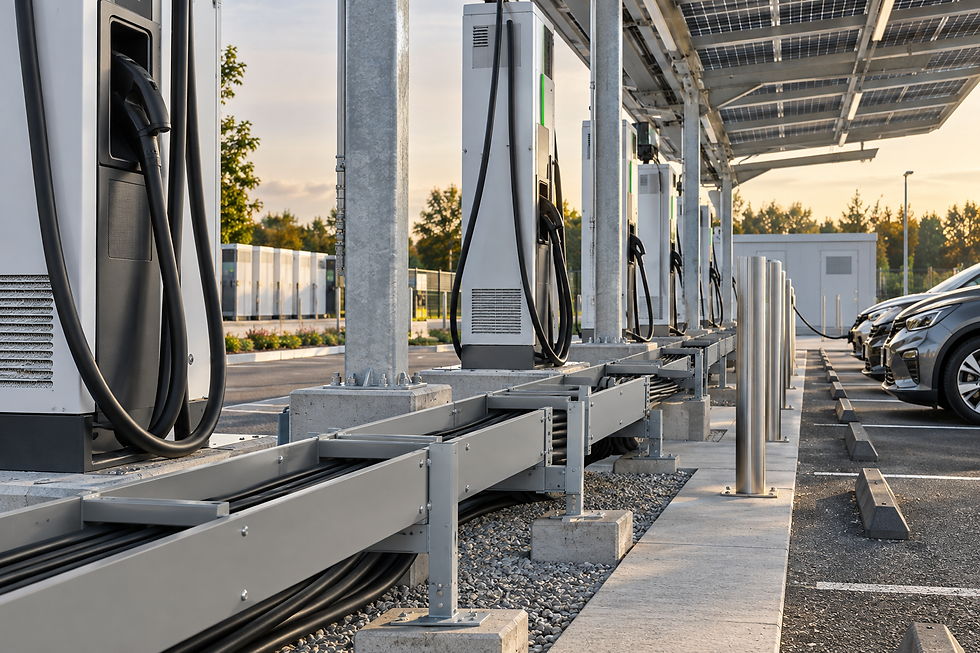
What EV Charging Infrastructure Actually Needs From Secondary Materials
A public EV charging hub is a deceptively demanding secondary infrastructure environment. On the surface it looks like a car park with some equipment in it. In practice it is a high-voltage DC installation in an outdoor setting, exposed to UV, road salt, temperature cycling, and in coastal locations marine atmospheric chloride, across a 20-year asset life with no acceptable maintenance downtime. The secondary cable management, structural framing, and ground-level containment of that hub must perform in all of those conditions, continuously, without creating the rust staining, corrosion products, or earthing compliance failures that would signal to the hub operator and its customers that the infrastructure is deteriorating.
The DC voltage environment is the most specific and least commonly understood secondary specification requirement for EV charging hubs. Ultra-rapid chargers now operating at 150kW to 400kW deliver DC power at voltages of 400V to 1,000V at the charger output. The cable management routing DC power from the hub's power electronics to individual charger units carries these voltages continuously. DC fault current in metallic cable management does not extinguish at natural zero-crossings as AC fault current does — a DC arc initiated in a steel cable tray sustains itself and propagates along the tray until the protective device interrupts it. FRP cable management is non-conductive throughout its full cross-section, eliminating the conductive fault current path through the tray and containing any arc event at the fault location rather than allowing it to propagate (IntechOpen, 2022).
The earthing and bonding programme that metallic cable management requires in a DC charging environment adds installation cost, commissioning time, and ongoing periodic inspection to every hub. FRP cable management requires no earthing, no bonding, and no continuity verification at any voltage encountered in an EV charging installation. On a network now approaching 124,000 chargers, the aggregate commissioning and compliance cost of metallic cable management across the full UK EV charging estate is a significant and entirely avoidable expenditure.
The Outdoor Road Environment and 20-Year Performance
UK road salt applied between October and March creates a chloride-rich environment at ground level across every motorway service area, retail park, and on-street charging location in the country. Road salt spray from passing vehicles reaches the cable containment, ground-level drainage, and low-level structural elements of every hub installation at every site that experiences winter gritting. Steel secondary infrastructure in road salt environments accumulates corrosion at cut edges, fixing holes, and connection interfaces from the first winter of operation. Over 20 years, this accumulation produces the rust staining visible on virtually every older piece of outdoor steel infrastructure in the UK — a cosmetic failure that in a customer-facing hub environment becomes a brand problem as much as a maintenance liability.
FRP cable management and ground-level containment is immune to road salt corrosion across a 20-year design life. It does not rust. It does not shed corrosion products onto the hub surface or the vehicles using it. It maintains the clean appearance of a new installation across the full 20 years without the recoating or replacement programme that steel accumulates in the same road environment. For hub operators whose commercial model depends on the quality of the customer experience at each site, the visual performance of FRP secondary infrastructure across 20 years is a commercial advantage that the purchase price comparison with steel does not capture.
UV exposure across a 20-year hub life in direct outdoor sunlight degrades surface coatings on steel and standard polymer formulations progressively. FRP cable trays and structural profiles in UV-stable resin formulations maintain their mechanical properties and visual integrity in direct solar exposure across 20-year design lives without surface treatment maintenance. In the increasingly intense UV environment of UK summers — with 2026 recording some of the highest sustained UV intensities in the UK's meteorological record alongside the heatwave episodes of June and August — the UV stability of FRP in outdoor hub environments is a more practically significant specification property than it was when hub design standards were first written.
What Reinforce Technology Supplies for EV Charging Infrastructure
Reinforce Technology supplies the complete range of FRP secondary infrastructure products for EV charging hub installations across the UK.
For DC cable management, our FRP ladder trays and perforated cable trays route DC power cables from hub power electronics to individual charger units in non-conductive, road-salt-immune, UV-stable cable management that requires no earthing, no bonding, and no recoating across 20-year hub design lives. Available in widths from 75mm for single cable routes to 300mm for high-density DC distribution in large hub configurations, in snap-fit accessory systems that eliminate hot work from the installation programme.
For hub canopy secondary framing, our FRP pultruded structural profiles provide corrosion-immune secondary structural sections for canopy frames, signage supports, and lighting mounts that maintain their structural performance and visual quality across 20 years of outdoor road exposure without the rust staining that galvanised steel secondary framing accumulates in vehicle environments from the first years of operation.
For ground-level cable containment and drainage, our FRP channel sections and drainage systems provide chemical resistance to the road salt-contaminated surface water of hub car park drainage, without the lining maintenance that steel drainage channels require in the same road environment.
All Reinforce Technology FRP products for EV charging hub applications are non-conductive throughout, eliminating earthing and bonding requirements at every voltage encountered in public charging installations. All are available in UV-stable polyester resin formulations for outdoor hub environments. And all are 70 to 75% lighter than equivalent steel sections, enabling manual installation by two-person teams without crane support across the full hub installation programme — reducing the installation labour cost and programme duration that partially offsets the higher purchase price of FRP at procurement stage.
The Forward Pipeline: Why This Matters Now
BEV market share at 30% in August 2026 means the UK's EV fleet is growing faster than at any previous point in the transition. SMMT and industry analysts agree that the primary constraint on continued BEV adoption is now charging infrastructure availability rather than vehicle supply or consumer demand. The government's target of 300,000 public chargers by 2030, against 123,677 at the end of August 2026, implies that the number of public chargers in the UK must more than double in under four years.
Every new charger added to the UK's public network is part of a hub installation that will operate for 20 years in an outdoor road environment. The secondary infrastructure specification decisions made for that installation determine whether it performs without maintenance intervention across those 20 years or accumulates the maintenance liabilities that the road salt, UV, and DC electrical environment of a UK charging hub generates for steel secondary infrastructure from the first years of operation. The pace of hub deployment that 30% BEV market share demands makes getting those specification decisions right a matter of some urgency — because the hubs being specified and installed today will be operational until 2046.
BEVs took 30% of the UK new car market in August 2026. There are 123,677 public chargers in the UK. Ultra-rapid capacity is up 26% in 2026 alone. The charging infrastructure that this EV fleet demands is being built now, at pace, in outdoor road environments with 20-year design lives and DC electrical environments where non-conductive cable management is the correct specification. Reinforce Technology's FRP cable management, structural profiles, and ground-level containment are the secondary infrastructure specification that EV charging hubs need — corrosion-immune, non-conductive, UV-stable, and maintenance-free across the full 20 years.
Contact Reinforce Technology

Reinforce Technology supplies FRP cable trays, structural profiles, and drainage for EV charging hub secondary infrastructure across the UK. Non-conductive throughout, eliminating earthing and bonding requirements in DC charging environments. UV-stable in outdoor road environments. Maintenance-free across 20-year hub operational lives. Contact us to discuss your EV charging hub project and the correct FRP specification for your site, power level, and design horizon.
Final confirmation of suitability for any specific EV charging application, including cable management fire performance requirements and structural loading assessment, remains the responsibility of the appointed project engineer. Reinforce Technology provides technical guidance and material recommendations based on information supplied to us, but specification sign-off should always sit with the qualified professional responsible for the design.
References
EV Infrastructure News (2026) BEVs Hit Record 30% UK Market Share in August as Sales Outpace ZEV Mandate Target. Available at: https://www.evinfrastructurenews.com/ev-technology/bevs-hit-record-30-uk-market-share-in-august-as-sales-outpace-zev-mandate-target [Accessed: 8 September 2026]. [123,677 public EV chargers at end August 2026; ultra-rapid 150kW+ up more than 26% since start of 2026 to surpass 15,000 units; 953 chargers added during August].
IntechOpen (2022) 'Fibre-Reinforced Polymer (FRP) in Civil Engineering', in IntechOpen Engineering Series. Available at: https://www.intechopen.com/chapters/84203 [Accessed: 8 September 2026]. [Non-conductive; volume resistivity 10¹² to 10¹⁶ ohm metres; no earthing or bonding required; corrosion-immune in outdoor road salt environments; UV-stable; 70 to 75% lighter than steel].
Motor Trade News (2026) BEVs Take 30% of New Car Market in August, Outpace ZEV Trajectory. Available at: https://www.motortradenews.com/dealer-insights/bevs-take-30-of-new-car-market-in-august-outpace-zev-trajectory/ [Accessed: 8 September 2026]. [27,876 new BEVs registered August 2026; electric cars largest single fuel type in market; 30% year on year growth; 366,000+ EVs joined UK roads year to date; year to date BEV share 25.5% ahead of ZEV effective target 24.6%].
ScienceDirect (2025) 'Sustainable composites for metal replacement: Environmental assessment and material selection of fiber-reinforced polymer across industries', ScienceDirect, doi: 10.1016/S2667-3789(25)00051-3. Available at: https://www.sciencedirect.com/science/article/pii/S2667378925000513 [Accessed: 8 September 2026].
Transport and Energy (2026) Sales of BEVs in August Reach 30% of Market Share. Available at: https://transportandenergy.com/2026/09/03/sales-of-bevs-in-august-reach-30-of-market-share/ [Accessed: 8 September 2026]. [366,000+ EVs joined UK roads year to date; BEVs accounting for quarter of all new car registrations; ZEV Mandate consultation launched].


Comments