
Net Zero Teesside Is Under Construction. Here Is Why FRP Is the Specification for Carbon Capture Infrastructure.
Balfour Beatty has been awarded an £833 million contract to build the world's first gas-fired power station with carbon capture and storage at Teesside. The post-combustion carbon capture system will capture up to 2 million tonnes of CO₂ per year using Shell's CANSOLV amine scrubbing technology. The CO₂ is then compressed and stored under the North Sea by bp, Equinor, and Total Energies. Post-combustion carbon capture creates a secondary infrastructure environment unlike any other in UK energy: concentrated amine solvents, high-pressure CO₂ compression, corrosive condensate streams, and a 25-year operational design life. The secondary material that was designed for exactly this environment is FRP.
Published by Reinforce Technology | 1 August 2026
Balfour Beatty's £833 million contract to construct Net Zero Teesside Power, awarded by Technip Energies, makes the UK the location of one of the world's first commercial-scale gas-fired power stations with integrated post-combustion carbon capture and storage (New Civil Engineer, 2025). The project is a joint venture between bp and Equinor, with construction now underway in Teesside and completion anticipated by 2028. At its peak, Balfour Beatty will employ approximately 1,500 people on site. The combined cycle gas turbine plant, powered by GE Vernova's 9HA.02 gas turbine, will generate up to 742MW of flexible, dispatchable low-carbon electricity, enough to supply more than one million UK homes (Balfour Beatty, 2025).
The carbon capture element of the project uses Technip Energies' Canopy by T.EN solution, powered by Shell Catalysts and Technologies' CANSOLV CO₂ capture system — an amine-based post-combustion capture technology that scrubs CO₂ from the flue gas of the gas turbine exhaust. The captured CO₂ is then compressed and fed into an offshore pipeline for permanent geological storage under the North Sea, managed by the Northern Endurance Partnership, a joint venture between bp, Equinor, and Total Energies that forms the transport and storage backbone of the East Coast Cluster (Balfour Beatty, 2025). The UK government has pledged £21.7 billion to support CCUS projects in energy, industrial, and hydrogen sectors, placing Net Zero Teesside at the centre of the UK's decarbonisation infrastructure strategy.
Post-combustion carbon capture using amine solvents is a well-established industrial chemistry. It has been used in industrial gas processing for decades. What is new at Net Zero Teesside is its application at power station scale, integrated with a combined cycle gas turbine, and connected to a permanent offshore CO₂ storage network. The engineering and construction challenge of that integration is significant. And embedded within it is a secondary infrastructure specification challenge that is entirely fresh territory for UK energy construction: the chemical environment of a large-scale amine-based carbon capture plant is one of the most corrosive and chemically complex secondary infrastructure environments in industrial chemistry, and specifying the grating, walkways, cable management, and structural supports of that environment correctly is the difference between a plant that runs for 25 years without secondary infrastructure maintenance events and one that generates them from the first years of operation.
The Carbon Capture Chemical Environment — and Why It Is Uniquely Demanding
Post-combustion carbon capture using amine solvents works by absorbing CO₂ from flue gas into an amine solution in an absorption column, then regenerating the amine by heating it in a stripper column to release concentrated CO₂ for compression and storage. The chemistry is effective and proven. The environment it creates for secondary infrastructure is among the most chemically complex in industrial processing.
The primary chemical exposure is the amine solvent itself. CANSOLV uses an aqueous amine solution — a mixture of primary, secondary, or tertiary amines in water — that circulates continuously between the absorber and stripper columns at elevated temperatures, typically 40 to 60°C in the absorber and 100 to 120°C in the stripper.
Amines are alkaline compounds that attack zinc coatings on galvanised steel through a saponification reaction, producing zinc salts and stripping the protective zinc layer from the steel surface. This mechanism is the same one that causes rapid galvanised coating failure in food processing caustic cleaning environments, but at the elevated temperatures of amine regeneration, the reaction rate is substantially higher. Secondary galvanised steel infrastructure in the amine-exposed areas of a carbon capture plant will lose its protective coating within years of operation at stripper temperatures.
The secondary chemical exposures compound the primary amine attack. Flue gas entering the absorber column carries particulate contamination, nitrogen oxides, sulphur oxides, and trace metals from the combustion process that degrade amine solution quality over time and generate a range of acidic degradation products. Heat stable amine salts, formed by the irreversible reaction of amines with acid gases, accumulate in the solvent and require periodic reclaiming operations that expose secondary infrastructure to concentrated acidic waste streams. Condensate from the flue gas cooling process before the absorber is mildly acidic and creates persistent moisture in the lower sections of the absorber and inlet ducting. The combination of alkaline amine exposure at elevated temperatures, periodic acid degradation product exposure, and persistent condensate moisture creates a corrosion environment that attacks galvanised steel secondary infrastructure through multiple simultaneous mechanisms.
Above the absorber and stripper, the CO₂ compression train creates a further set of secondary infrastructure demands. High-pressure CO₂ in the presence of residual moisture forms carbonic acid, a weak but persistent acid that attacks zinc coatings and, once the coating fails, corrodes steel at a rate determined by the moisture content and temperature of the compressed CO₂ stream. The secondary infrastructure of CO₂ compression trains, including grating and walkways around compressor skids, cable management for the electrical systems of compression drives, and structural supports for compression train pipework, sits in an environment of high-pressure CO₂, intermittent carbonic acid condensate, and the elevated temperatures of compression heat dissipation.
Where FRP Is Specified in Carbon Capture Infrastructure
1. Grating and Walkways in the Absorber and Stripper Areas
The absorber and stripper columns of a post-combustion carbon capture plant are process vessels of substantial height, requiring access platforms, walkways, and grating at multiple elevations for operations, maintenance, and inspection access. These platforms and walkways operate in the amine-exposed atmosphere of the absorber and stripper areas, where amine mist, vapour, and condensate create a persistent alkaline surface exposure on secondary structural materials at every elevation of the access system.
FRP moulded grating and pultruded structural profiles for access platforms in amine process environments provide corrosion-immune access infrastructure that does not react with amine solutions at any concentration or temperature encountered in the absorber and stripper operating zones. Vinyl ester resin FRP provides specific resistance to alkaline environments across the pH range of aqueous amine solutions, without the coating degradation mechanism that attacks galvanised steel in the same conditions. The non-sparking property of FRP grating and structural sections is also relevant in areas where amine vapour concentrations could create a flammable atmosphere in the event of a process upset, eliminating the ignition risk from the secondary structural elements of the access system (IntechOpen, 2022).
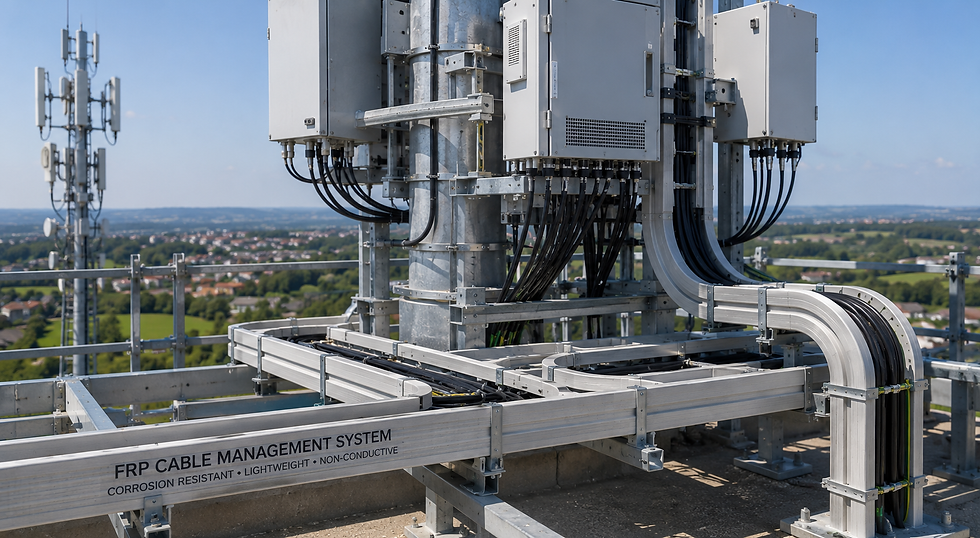
2. Cable Management in the Carbon Capture Process Area
The electrical infrastructure of a post-combustion carbon capture plant includes the drives for absorber packing solvent pumps, stripper reboiler heating systems, cooling water pumps, and the instrumentation and control systems that govern the process chemistry of CO₂ capture. The cable management routing these electrical systems runs through the process area in the same amine-exposed atmosphere as the access infrastructure, at elevations and in orientations determined by the process plant layout rather than by the convenience of the cable management specification.
FRP cable trays in the amine process area provide non-conductive cable management that does not require earthing and bonding in the elevated-voltage environment of large motor drives for solvent pumping and circulation, is corrosion-immune in the amine-exposed process atmosphere, and is compatible with the cleaning and washdown chemicals used for process plant maintenance in a carbon capture environment. The non-conductivity of FRP cable management is particularly relevant in the high-voltage motor drive environment of the solvent circulation pumps, where fault current in a metallic cable tray in a potentially flammable amine vapour atmosphere creates a combined electrical and fire risk that non-conductive cable management eliminates at source (IntechOpen, 2022).
3. Structural Profiles for CO₂ Compression Train Support
The CO₂ compression train at Net Zero Teesside is a multi-stage compression system that takes the relatively low-pressure CO₂ from the stripper column overhead and compresses it to the supercritical pressures required for offshore pipeline transport and geological storage. The compression train occupies substantial plot area and requires secondary structural framing for pipework supports, cable management supports, and the access platforms around individual compressor stages.
This secondary structural framing operates in the high-pressure CO₂ and carbonic acid condensate environment described above, in addition to the elevated temperatures generated by the heat of CO₂ compression between stages. FRP pultruded structural profiles for CO₂ compression train secondary framing provide corrosion-immune structural sections that do not react with carbonic acid condensate, do not corrode in the high-pressure CO₂ environment of the compression area, and maintain their structural performance across the temperature range of the compression train's operating envelope without the coating maintenance that secondary galvanised steel framing in the same conditions requires (IntechOpen, 2022).
4. Drainage and Containment in Amine Spill Areas
Amine solvent spills are an operational reality in large-scale post-combustion capture plants: pump seal failures, piping joint leaks, and maintenance activities that require draining process vessels all create amine-contaminated drainage that must be contained, collected, and treated before disposal. The bunded areas, drainage channels, and containment infrastructure of the amine process area sit in continuous potential amine contact, at the concentrations and temperatures of the process solvent rather than the diluted concentrations of atmospheric exposure.
FRP drainage channels and bunding in vinyl ester resin for amine spill containment areas provide chemical resistance to aqueous amine solutions at process concentrations and temperatures, without the coating failure that alkaline attack creates in steel drainage channels or the cracking and delamination that high-pH environments cause in some conventional GRP drainage products specified without appropriate resin system selection. The resin system selection for amine environments is the single most important specification decision in FRP drainage and containment for carbon capture applications: vinyl ester, not polyester, is the correct resin system for the alkaline, elevated-temperature amine exposure of post-combustion capture process drainage.

The East Coast Cluster and the UK CCUS Pipeline
Net Zero Teesside Power is not an isolated project. It is the power generation component of the East Coast Cluster, the UK's first operational carbon capture, utilisation, and storage cluster, which includes industrial carbon capture facilities at bp's Teesside acetyls plant, Linde's hydrogen production facility, and other industrial emitters connected to the Northern Endurance Partnership's offshore CO₂ transport and storage network. The £21.7 billion government pledge to CCUS projects in energy, industrial, and hydrogen sectors will fund additional capture facilities across the East Coast Cluster and the HyNet North West Cluster in Lancashire and Cheshire over the coming decade.
Each industrial carbon capture facility in these clusters creates the same secondary infrastructure specification challenge as the Net Zero Teesside Power plant: amine-based or alternative solvent capture chemistry, CO₂ compression trains, process drainage, and access systems that must perform in the corrosive chemical environment of carbon capture for 25-year operational design lives. The UK's CCUS pipeline is creating a new category of secondary infrastructure specification demand that did not exist in UK energy construction three years ago, and that the FRP industry is uniquely positioned to address with the chemical resistance, non-sparking behaviour, and maintenance-free performance that post-combustion capture environments require.
The HyNet North West Cluster, which includes carbon capture at the EET Hydrogen blue hydrogen production facility in Cheshire and industrial carbon capture at facilities across the Liverpool Bay area, is advancing toward construction under the same East Coast Cluster financial model that Net Zero Teesside has established. Merseyrail's Merseyside and Liverpool Bay carbon capture facilities will create the same amine process environment secondary specification requirements as Teesside, in the first phase of what the government's CCUS programme expects to become a national network of industrial decarbonisation infrastructure.
Why Getting the Specification Right Now Matters
Net Zero Teesside is a first-of-a-kind project. The engineering decisions made during its construction will establish the specification standards that subsequent carbon capture projects, at Teesside, at HyNet, and across the East Coast Cluster's industrial carbon capture expansion, will reference and replicate. Getting the secondary infrastructure specification right at Net Zero Teesside means that the specification will be carried forward into every subsequent CCUS facility built on the same engineering basis, compounding the benefit of a correct first specification across a growing national programme.
Getting it wrong at Net Zero Teesside means that the same specification error is replicated across subsequent East Coast Cluster facilities, creating a national CCUS maintenance programme that accumulates across all of the industrial decarbonisation infrastructure that the UK government has pledged £21.7 billion to build. The secondary infrastructure of the world's first commercial-scale post-combustion carbon capture power station will be studied by engineers designing every subsequent CCUS facility. The specification that goes into the ground at Teesside in 2025 to 2028 will be referenced in specifications being written in 2030, 2035, and beyond. FRP's correct specification in the amine process environment at Net Zero Teesside is not just a project-level decision. It is a precedent for the secondary specification of an entire new category of UK infrastructure.
Net Zero Teesside Power is the world's first commercial-scale gas-fired power station with post-combustion carbon capture. It is under construction now, with completion in 2028, using Shell's CANSOLV amine technology to capture 2 million tonnes of CO₂ per year. The amine scrubbing environment, CO₂ compression chemistry, and process drainage conditions it creates are the most chemically demanding secondary infrastructure environment in UK energy construction. FRP — non-sparking, non-conductive, corrosion-immune in amine solutions and carbonic acid environments, maintenance-free across 25 years — is the specification that this environment demands. And the specification decisions made at Teesside will define the secondary infrastructure standards of the UK's entire CCUS programme.
Reinforce Technology FRP Products for Carbon Capture Infrastructure
Reinforce Technology supplies FRP moulded grating, pultruded structural profiles, cable trays, and drainage channels for carbon capture and industrial process infrastructure across the UK. Vinyl ester resin systems are specified for amine solvent and carbonic acid environments. All products are non-sparking under impact and friction, non-conductive in process electrical environments, and corrosion-immune in the alkaline and acidic chemical exposure conditions of post-combustion carbon capture facilities across a 25-year operational design life.
Contact us to discuss your carbon capture or CCUS process infrastructure project and the correct FRP specification for your specific process chemistry, temperature, and operational horizon.
Final confirmation of suitability for any specific carbon capture or process industry application, including resin system selection for specific solvent chemistries and temperature ranges, remains the responsibility of the appointed project engineer. Reinforce Technology provides technical guidance and material recommendations based on information supplied to us, but specification sign-off should always sit with the qualified professional responsible for the design.
References
Balfour Beatty (2025) Balfour Beatty Secures £833 Million Net Zero Teesside Contract. Available at: https://www.balfourbeatty.com/media-centre/latest/balfour-beatty-secures-833-million-net-zero-teesside-contract/ [Accessed: 1 August 2026]. [£833m EPC contract awarded by Technip Energies; joint venture bp and Equinor; 742MW low-carbon power; 2 million tonnes CO₂ per year; Northern Endurance Partnership offshore storage; 1,500 peak employment; completion 2028].
Balfour Beatty (2025) Balfour Beatty and Partners Get Green Light to Deliver Contract for Net Zero Teesside Power. Available at: https://www.balfourbeatty.com/media-centre/latest/balfour-beatty-and-partners-get-green-light-to-deliver-major-contract-for-the-net-zero-teesside-power-project-which-aims-to-be-the-world-s-first-gas-fired-power-station-with-carbon-capture-and-storage/ [Accessed: 1 August 2026]. [Notice to Proceed following financial close; Shell CANSOLV CO₂ capture technology; Canopy by T.EN solution; GE Vernova 9HA.02 gas turbine; government £21.7bn CCUS pledge].
IntechOpen (2022) 'Fibre-Reinforced Polymer (FRP) in Civil Engineering', in IntechOpen Engineering Series. Available at: https://www.intechopen.com/chapters/84203 [Accessed: 1 August 2026]. [Non-sparking properties; non-conductive; corrosion-immune in alkaline and acidic environments; vinyl ester resistance to pH 1 to pH 13; maintenance-free across operational life].
NACE International (2016) International Measures of Prevention, Application and Economics of Corrosion Technology (IMPACT). Houston, TX: NACE International. Available at: http://impact.nace.org/economic-impact.aspx [Accessed: 1 August 2026].
New Civil Engineer (2025) Balfour Beatty Secures £833M Contract for World's First Gas Power Station With Carbon Capture. Available at: https://www.newcivilengineer.com/latest/balfour-beatty-secures-833m-contract-for-worlds-first-gas-power-station-with-carbon-capture-26-06-2025/ [Accessed: 1 August 2026]. [£833M contract; combined cycle gas turbine plant with post-combustion CCS; East Coast Cluster; Northern Endurance Partnership; Shell Catalysts and Technologies; Costain FEED 2023 to 2024].
ScienceDirect (2025) 'Sustainable composites for metal replacement: Environmental assessment and material selection of fiber-reinforced polymer across industries', ScienceDirect, doi: 10.1016/S2667-3789(25)00051-3. Available at: https://www.sciencedirect.com/science/article/pii/S2667378925000513 [Accessed: 1 August 2026]. [Pultruded GFRP manufacturing emissions approximately 60 to 70% lower per tonne than primary steel, cradle-to-gate].
Younis, A., Ebead, U. and Judd, S. (2018) 'Life cycle cost analysis of structural concrete using seawater, recycled concrete aggregate, and GFRP reinforcement', Construction and Building Materials, 175, pp. 135-144. doi: 10.1016/j.conbuildmat.2018.04.183.


Comments