
FRP Cable Tray for UK Solar Farms: What EPC Contractors Need to Know
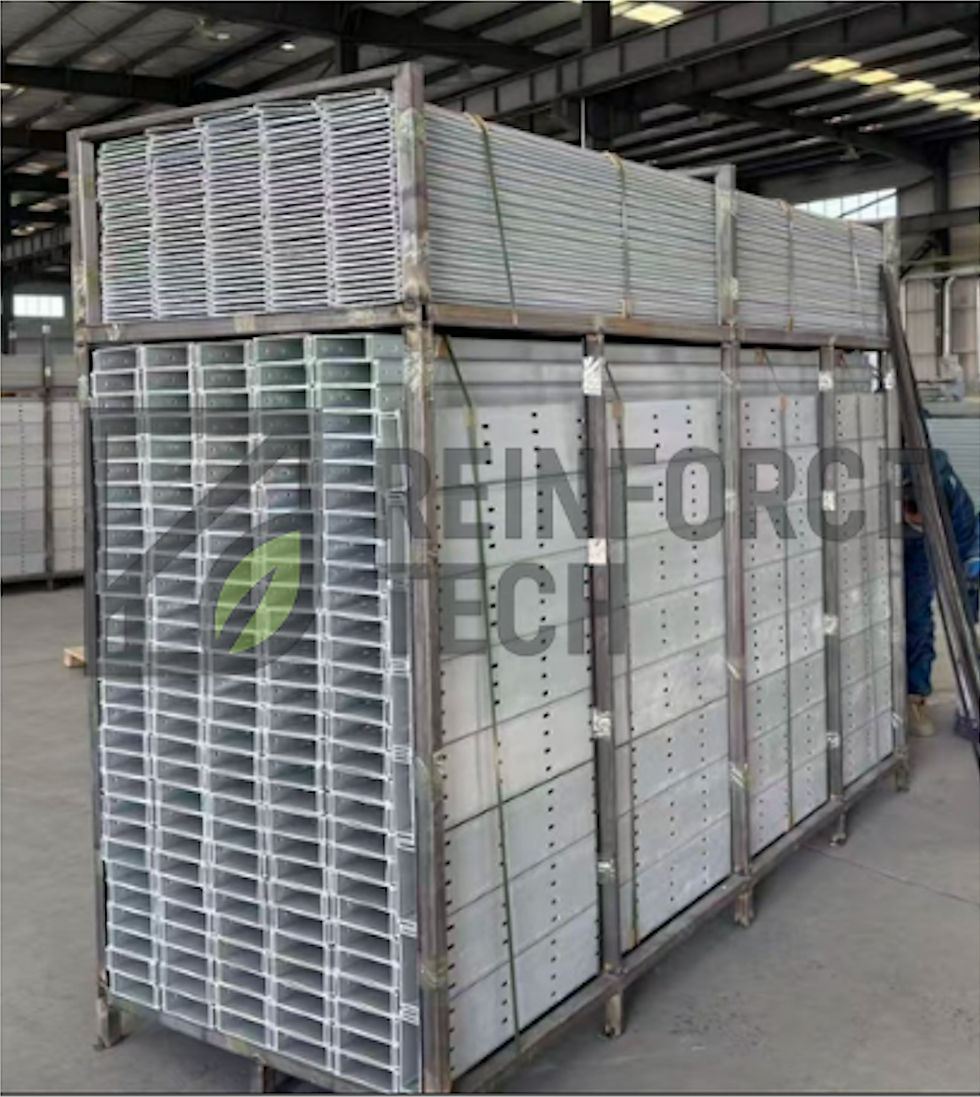
With over 5GW of solar NSIPs consented in England and asset design lives of 30–40 years, the cable management specification made at construction stage will define operational maintenance costs for decades. This guide sets out the full technical case for FRP/GRP cable tray — covering corrosion performance, lifecycle economics, resin selection, and underground applications.
On 8 April 2026, the UK government granted Springwell Solar Farm its 800MW Development Consent Order — the latest addition to a consented pipeline in which more than a dozen solar National Significant Infrastructure Projects (NSIPs) now hold development consent in England, with combined capacity exceeding 5,000MW (Silver Fox Ltd, 2026).
These are not speculative schemes. They are going into the ground, and the procurement decisions being made right now — including cable management specification — will shape operational expenditure across asset lives that the House of Commons Library confirms are typically 30 to 40 years (House of Commons Library, 2026). A cable tray system specified without reference to whole-life performance is a risk that compounds silently, and one that the developer or asset owner will eventually ask questions about.
Fibre Reinforced Polymer (FRP) cable tray — also referred to as GRP (Glass Reinforced Plastic) cable tray — has moved from a niche specification in offshore and chemical processing environments into mainstream adoption on utility-scale solar projects globally. This article sets out the technical rationale, market context, and practical specification guidance relevant to UK EPC contractors working on ground-mount solar installations.
Why Metal Cable Tray Underperforms on Solar Sites
Ground-mounted solar farms are outdoor environments characterised by sustained UV exposure, wide temperature cycling, moisture, agricultural runoff, and in many UK locations, residual salt-laden air from coastal proximity. Metal cable tray products that are hot-dip galvanised steel in particular, are designed and priced for general industrial and commercial building use. Their performance on an outdoor solar site over 30 to 40 years is a different proposition entirely.
Hot-dip galvanised steel
Hot-dip galvanised (HDG) steel is the most common default specification on renewable energy cable management, and it performs better than pre-galvanised steel in outdoor conditions — the post-fabrication zinc coating provides full coverage of structural sections (Shielden Strut, 2026). However, the protection mechanism is sacrificial: the zinc layer is consumed over time by electrochemical reaction with moisture and atmospheric oxygen, and in damp or chemically aggressive soil conditions, this process accelerates significantly (Buildmatt, 2025). Cut edges produced during on-site fabrication are unprotected from day one. Once the zinc layer is compromised, steel corrosion begins and structural integrity degrades. The critical issue for solar EPC contractors is that galvanised steel can last 20 years or more with minimal maintenance in controlled conditions (Shielden Strut, 2026) — but solar farm design lives now routinely extend to 35 and even 40 years (Vectore Renewables, 2022), creating a structural mismatch between specification and asset life expectation.
Aluminium
Aluminium offers natural oxidation resistance and is significantly lighter than steel, making it a common secondary specification. However, it is electrically conductive — requiring the same bonding and earthing regime as steel tray — has lower mechanical strength for heavy cable loads, and in certain soil chemistry conditions is susceptible to pitting corrosion. Its higher upfront material cost relative to steel typically results in it being used on mid-scale commercial applications rather than heavy-duty utility-scale solar installations (Shielden Strut, 2026).
Material choice isn't only about strength — it's about total lifecycle cost. Environmental conditions such as humidity, UV exposure, salt air, and temperature swings determine whether your cable tray will still be performing in year thirty. -Cable tray Fab 2025
The Technical Case for FRP/GRP Cable Tray on Solar Sites
FRP cable tray is manufactured from glass fibre reinforcement embedded within a polymer resin matrix — typically unsaturated polyester resin (UPR) for standard outdoor applications, with isophthalic polyester or epoxy resin used where enhanced chemical resistance or fire performance is required. The manufacturing process — most commonly pultrusion — produces a composite profile with consistent mechanical properties throughout its cross-section (MP Husky, 2024). The result is a material that is structurally stiff, dimensionally stable, and inherently resistant to the specific failure modes that affect metal tray in outdoor renewable energy environments.
Corrosion resistance
FRP does not corrode. Unlike galvanised steel, there is no protective coating layer to deplete, no zinc to sacrifice, and no unprotected substrate at cut edges. The corrosion resistance of FRP is an intrinsic material property — it arises from the chemical inertness of the glass fibre and resin matrix combination rather than from a surface treatment that can be damaged, depleted, or degraded over time (NHC FRP, 2024). This is the same characteristic that has made FRP the standard specification in offshore oil and gas platforms, chemical processing facilities, and water treatment infrastructure — environments where metal degradation has repeatedly proven the lifecycle cost case for composites. On a UK ground-mount solar farm with a 30 to 40 year asset life, this is the single most consequential material property to evaluate at specification stage.
Electrical non-conductivity
FRP is inherently non-conductive. On a solar site where DC voltage is present across significant cable runs connecting arrays to inverters, a non-conductive cable tray system eliminates the need for bonding and earthing continuity along the tray run — a requirement that applies to all metallic cable tray systems under BS 7671 (the IET Wiring Regulations) (Silver Fox Ltd, 2026). This simplifies installation, removes a category of ongoing inspection obligation, and represents a meaningful safety benefit during maintenance activities over the operational life of the asset. It also reduces material take-off and installation time at construction stage (MP Husky, 2024).
Weight and installation efficiency
70-80%
Lighter than equivalent steel sections
30-40 Yr
Typical UK solar farm design life
1 operative
vs 2–3 for equivalent steel sections on site
5.2%
Global FRP cable tray market CAGR to 2034
FRP sections are typically 75 to 80% lighter than equivalent steel — and approximately one-third the weight of steel on a like-for-like basis (MP Husky, 2024). On a large ground-mount solar installation running hundreds of metres of cable tray across multiple array zones, that weight differential reduces lifting requirements, compresses the installation programme, and lowers the operative count per section. A steel cable tray section of meaningful span typically requires two to three operatives to position, lift, and fix safely. An equivalent FRP section is routinely handled by a single operative without mechanical assistance. Across a large site with tens of kilometres of cable management, the cumulative effect on programme, headcount, and welfare costs is material. Shipping and transport costs are also reduced proportionally — relevant when procurement is international or when remote site logistics are factored in.
UV stability
FRP cable tray manufactured to quality standards incorporates UV stabilisers within the resin system and a UV-resistant surface veil applied during the pultrusion process. This dual-layer protection prevents both photodegradation of the resin matrix and the surface condition known as fibre blooming — the gradual exposure of glass fibres at the surface caused by UV-driven resin erosion (MP Husky, 2024). Solar farm sites, by their nature, provide maximum year-round UV exposure — exactly the condition for which FRP surface veils and UV inhibitors are engineered. The material does not bleach, embrittle, or lose structural integrity under sustained UV exposure across the temperature range experienced in UK outdoor environments (typically -20°C to +60°C) (Aeron Composite, n.d.)
FRP vs Steel vs Aluminium: A Specification Comparison
Property | FRP / GRP | Hot-Dip Galvanised Steel | Aluminium |
Corrosion resistance | ✓ Inherent — no coating required | ✗ Zinc coating depletes over time; cut edges unprotected | ~ Oxidation resistant; pitting risk in certain soil conditions |
Electrical conductivity | ✓ Non-conductive — no bonding/earthing required | ✗ Conductive — bonding continuity required under BS 7671 | ✗ Conductive — bonding continuity required |
Weight vs steel | ✓ ~75–80% lighter | Baseline | ~ ~60% lighter than steel |
UV performance (outdoor) | ✓ Excellent with UV stabiliser + surface veil | ✗ Surface degrades; periodic coating/treatment required | ~ Good; surface dulls progressively |
On-site cut edges | ✓ Chemically inert — no post-treatment required | ✗ Unprotected metal — immediate corrosion risk | ~ Rapid surface oxide forms; not a structural risk |
Underground performance | ✓ Unaffected by soil electrochemistry | ✗ Galvanic corrosion from soil; accelerated vs above ground | ~ Soil-dependent; pitting risk |
Fire performance (FR grades) | ✓ FR grades available — ASTM E84 Class A rated options | ✓ Non-combustible | ✓ Non-combustible |
Upfront material cost | ~ Higher than HDG steel; lower than stainless | ✓ Lowest initial cost | ✗ Typically highest |
Whole-life cost (30–40yr) | ✓ Lowest — negligible maintenance, no replacement | ✗ Highest when maintenance and partial replacement factored in | ~ Moderate — better than HDG steel over full life |

Market Context: Why This Matters Now
The scale of UK utility-scale solar construction being commissioned and built in 2025–2026 is significant. (Silver Fox Ltd, 2026) Springwell Solar Farm — 800MW, with its DCO granted 8 April 2026 — joins a pipeline that includes Cleve Hill Solar Park in Kent (300MW, operational July 2025) and Botley West (840MW, construction commenced 2025 targeting commercial operation in 2027) (Black Ridge Research, 2026). These projects alone represent multiple hundreds of kilometres of cable management. The cumulative cable tray requirement across all consented UK solar NSIPs is substantial, and the specification decisions are active.
Globally, the fibre reinforced polymer cable tray market was valued at USD 1.27 billion in 2025 and is projected to grow to USD 1.80 billion by 2034, at a compound annual growth rate of 5.2% — with renewable energy infrastructure cited as a primary growth driver (Intel Market Research, 2026). The wider FRP cable tray systems market, including all composite variants, is forecast to grow at a CAGR of 11.71% through 2032, reaching USD 10.3 billion from a 2023 base of USD 3.24 billion (Wise Guy Reports, 2025). That trajectory reflects a global shift in how large-scale infrastructure projects — solar farms, offshore wind, data centres — are specifying cable management: away from default steel and towards whole-life-cost-driven material selection.
For UK EPC contractors, the commercial context is straightforward. When a developer or asset owner asks their O&M team at year fifteen why cable tray condition surveys are returning adverse findings, the answer "we specified hot-dip galvanised steel" is increasingly difficult to defend against a readily available FRP alternative that would still be in as-installed condition at year forty.
Resin Selection: What System Do You Need?
Resin selection is a point of uncertainty at specification stage for many contractors and clients. It should not be — it is a supplier-led decision based on application conditions, and for most UK ground-mount solar applications, the answer is straightforward. The following framework is based on standard industry practice and is consistent with how Reinforce Technology specifies its cable tray products for solar projects.
Resin System Guide — Solar Applications
Unsaturated Polyester Resin (UPR) — StandardAppropriate for the majority of UK ground-mount solar applications, including above-ground cable tray runs and buried or partially buried installations in standard soil conditions. Provides good all-round corrosion and UV resistance at the most competitive price point. This is the resin system used on Reinforce Technology's 21km+ cable tray supply across a US utility-scale solar project. As a general rule, isophthalic polyester resin provides resistance to most acidic conditions, while vinyl ester extends this to alkaline environments — though UPR is sufficient for typical solar site soil chemistry (MP Husky, 2024).
Isophthalic Polyester (ISO) — EnhancedRecommended where site conditions include aggressive soil chemistry, prolonged groundwater contact, acidic peat or clay soils, or coastal/marine atmospheric exposure. Provides enhanced water and chemical resistance relative to standard UPR.
Fire-Retardant (FR) Grades — Where SpecifiedAvailable across resin systems for applications where fire performance requirements apply to the cable management specification. FR grades manufactured with fire-retardant additives within the resin matrix — not surface coatings — achieve ASTM E84 Class A classification (equivalent to Class 1 in UK fire test terminology). Performance is maintained through the full material thickness, not limited to a surface layer (MP Husky, 2024).
If in doubt: a brief conversation with your FRP supplier about site conditions will resolve resin selection. The correct answer is always application-specific, and a competent supplier will advise rather than up-specify.

Underground Cable Tray: A Specific Note
Ground-mounted solar projects routinely route cable management below ground — either in ducted systems, open trenches, or buried tray runs connecting array strings to combiner boxes and inverter skids. This application environment deserves separate consideration.
Below ground, hot-dip galvanised steel faces a corrosion challenge that is qualitatively different from above-ground atmospheric exposure. Soil electrochemistry drives galvanic corrosion through direct contact between the zinc coating and soil moisture containing dissolved salts and organic acids. Depending on soil type, pH, moisture content, and the proximity of dissimilar metals in the ground, galvanised steel below ground can corrode significantly faster than the same product in above-ground atmospheric conditions (Buildmatt, 2025). Importantly, this damage is not visible during routine site inspections, and the first indication of advanced corrosion is often structural failure rather than surface rust — the opposite of the above-ground failure mode that allows condition-based maintenance.
FRP in below-ground applications is unaffected by soil electrochemistry. The material does not participate in galvanic reactions, does not require cathodic protection, and does not need specialist coatings or wrapping systems for buried installation. Standard UPR is the appropriate and cost-effective resin system for most underground solar cable tray applications in UK soils — it is not necessary to specify the more expensive isophthalic or vinyl ester systems unless site investigation confirms aggressive soil chemistry.
Practical Specification Notes for EPC Contractors
On-site fabrication
FRP cable tray is cut on-site using a standard circular saw or angle grinder with a masonry or diamond blade. There is no hot work, no grinding sparks, and no requirement for a hot-work permit beyond what would routinely apply on any live construction site. Critically, cut edges are chemically inert — there is no unprotected metal substrate that requires post-cut treatment or sealed end caps to prevent corrosion initiation (Creative Composites Group, n.d.). For solar EPC contractors managing large installations in remote or exposed locations, this simplifies site logistics and eliminates a category of installation error that can compromise metal tray performance.
Accessories and complete systems
A structurally sound FRP cable management installation requires GRP accessories throughout — matching bends, tees, reducers, risers, and covers where specified. Mixing FRP tray with metallic fittings or support hardware reintroduces the corrosion and conductivity issues that FRP specification is intended to eliminate. Ensure your procurement package covers the complete accessory set from a single compatible system (NHC FRP, 2024).
Load tables and span design
FRP cable tray products are supplied with manufacturer load tables covering span, fill weight, and mid-span deflection values. These tables are application-specific and should not be substituted with equivalent steel load data — the materials have different stiffness characteristics and require separate engineering validation. For atypical spans or high cable fill weights, request application-specific load calculations from your supplier. In standard solar farm applications — typically 1.5m to 3m support spacing — commercially available FRP cable tray products provide adequate load capacity for AC and DC cable management without structural modification.
Standards and documentation for vendor submissions
For projects requiring formal vendor qualification, ensure your FRP cable tray supplier can provide third-party test reports to relevant ISO and IEC standards, material data sheets specifying resin system and glass fibre content, and manufacturer load and deflection tables for the specific profiles specified. Reinforce Technology's products are TÜV Rheinland tested, with full technical documentation available for procurement and vendor submission processes.
Project Reference — US Utility-Scale Solar: 21km+ FRP Cable Tray
Reinforce Technology supplied over 21km of FRP cable tray across a utility-scale solar project in the United States, delivered across three phased Maersk container shipments. The project involved ground-mount installation across a large open-air site with above-ground and below-ground cable management runs across multiple array zones. Resin system specified: standard unsaturated polyester resin, selected on the basis of site soil conditions and manufacturer recommendation — not client specification. As is typical on large solar projects, the client's electrical engineering team were unfamiliar with FRP resin selection options. That is a normal starting point, and it is exactly the technical conversation that a competent FRP cable tray supplier should be leading, not the contractor or client.
Summary: Key Specification Points for UK Solar EPC Contractors
FRP/GRP cable tray is the appropriate whole-life specification for ground-mount solar in the UK. Corrosion resistance, UV stability, electrical non-conductivity, and maintenance performance are all superior to hot-dip galvanised steel across a 30–40 year asset life (House of Commons Library, 2026).
The upfront material cost premium over HDG steel is real. When O&M expenditure, inspection costs, and potential partial replacement over 30–40 years are modelled, FRP is consistently the lower whole-life cost option (Shielden Strut, 2026).
For below-ground applications — cable trenches, buried tray runs — standard UPR FRP is the correct specification for most UK soil conditions. It eliminates the galvanic corrosion risk that affects HDG steel in direct soil contact without overspecifying to more expensive resin systems (Buildmatt, 2025).
Electrical non-conductivity eliminates bonding and earthing continuity requirements along the tray run, simplifying installation and reducing ongoing compliance obligations under BS 7671 (Silver Fox Ltd, 2026).
Resin system selection is a supplier responsibility. Brief your FRP supplier on site conditions — soil type, groundwater exposure, atmospheric classification — and ask them to confirm the appropriate system. Do not select resin based on upfront cost alone.
Specify complete GRP accessory sets. Do not mix FRP tray with metallic fittings — this compromises the corrosion and conductivity benefits of the FRP specification.
Request third-party test documentation (ISO/IEC standards, TÜV or equivalent) for vendor submissions and project quality dossiers.
The UK's utility-scale solar pipeline is not a future market condition. It is a present one. The EPC contractors winning and retaining work in this sector are those whose material specifications hold up under developer scrutiny, whose maintenance forecasts are defensible across the full asset life, and who can demonstrate that specification decisions were made on whole-life cost grounds rather than lowest upfront price. FRP/GRP cable management is an established part of how that standard is being met on serious projects.
Technical Enquiries & Quotations
Reinforce Technology supplies FRP cable tray, GRP cable ladder, and complete cable management systems for utility-scale solar, data centre infrastructure, and civil projects across the UK and internationally.
References
Aeron Composite (n.d.) FRP/GRP Structure Mounting — Ideal for Mounting Solar Panels. Available at: https://www.aeroncomposite.com/frp-grp-solar-application.html [Accessed 14 April 2026].
Black Ridge Research (2026) Top 5 Upcoming Solar Power Plants in the UK (2026). Available at: https://www.blackridgeresearch.com [Accessed 14 April 2026].
Buildmatt (2025) Common Issues in Steel Cable Tray Installations & Troubleshooting. Available at: https://www.buildmatt.net [Accessed 14 April 2026].
Cable Tray Fab (2025) Designing Cable Tray Systems for Large Solar Farms. Available at: https://www.cabletrayfab.com [Accessed 14 April 2026].
Creative Composites Group (n.d.) Fiberglass (FRP) Cable Tray for Extreme Conditions. Available at: https://www.creativecompositesgroup.com [Accessed 14 April 2026].
House of Commons Library (2026) Planning for Solar Farms. Available at: https://commonslibrary.parliament.uk/research-briefings/cbp-7434/ [Accessed 14 April 2026].
Intel Market Research (2026) Fiberglass Cable Tray Market Outlook 2026–2034. Available at: https://www.intelmarketresearch.com [Accessed 14 April 2026].
MP Husky (2024) Fiberglass Cable Tray. Available at: https://mphusky.com/cable-tray/fiberglass/ [Accessed 14 April 2026].
NHC FRP (2024) Advantages of FRP/GRP Cable Trays. Available at: https://www.nhcfrp.com [Accessed 14 April 2026].
Shielden Strut (2026) Best Cable Tray for Solar, BESS & Wind Projects (Selection Guide + Cost Tips). Available at: https://shieldenstrut.com [Accessed 14 April 2026].
Silver Fox Ltd (2026) Springwell Solar Farm: 800MW of Renewables and Why Every Cable Needs a Label. Available at: https://silverfox.co.uk [Accessed 14 April 2026].
Vectore Renewables (2022) Solar PV Power Plant Lifespan. Available at: https://www.vectorenewables.com [Accessed 14 April 2026].
Wise Guy Reports (2025) FRP Cable Tray Systems Market Research Report 2032. Available at: https://www.wiseguyreports.com [Accessed 14 April 2026].


Comments