
FRP and GRP Cable Trays vs Steel: Performance, Cost and Lifecycle Comparison

The Case for Re-examining Steel
Steel has been the default material for cable tray specification on industrial and infrastructure projects for decades. It is familiar, it is available, and on paper it is cheap. What the upfront price does not reflect is the cost of corrosion, maintenance, earthing, and installation labour that accumulates over the life of an asset. This article sets out a direct, data-backed comparison of FRP and GRP cable trays against hot-dip galvanised steel, drawing on independent research and published lifecycle cost modelling, to help engineers and procurement teams make a more informed specification decision.
NACE International, the global authority on corrosion engineering, estimated in its 2016 IMPACT study that the global cost of corrosion stands at US $2.5 trillion annually, equivalent to 3.4% of global GDP (NACE International, 2016). A University of Edinburgh study placed the combined annual cost of corrosion and wear to the UK economy at approximately £80 billion (Relinea, 2022). These figures are the aggregate consequence of specification decisions made across infrastructure projects in every sector. Cable management is one of those decisions.
1. What Are FRP and GRP Cable Trays?
FRP (Fibre Reinforced Polymer) is a composite material combining reinforcing fibres with a thermosetting resin matrix. GRP (Glass Reinforced Polymer) is the specific category where the reinforcing fibre is fibreglass. In the cable tray market the two terms are used interchangeably. The resin system governs chemical resistance: unsaturated polyester resin (UPR) covers the vast majority of industrial and commercial applications; vinyl ester is specified for more aggressive chemical environments.
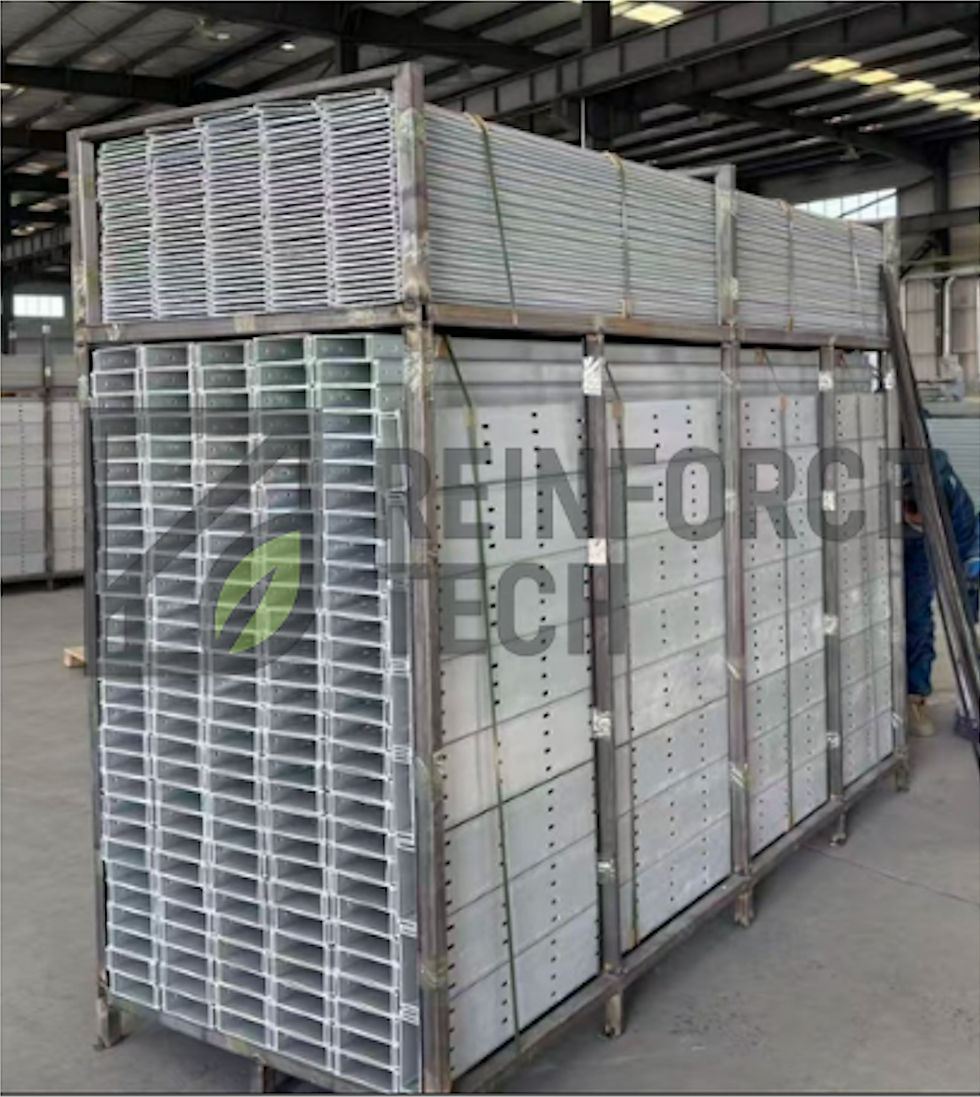
Reinforce Technology supplies GRP cable trays manufactured with fibreglass reinforcement and a UPR matrix, produced through the pultrusion process. Pultrusion draws continuous glass fibre rovings through a resin bath and a heated steel die to create constant cross-section profiles at consistent, independently verifiable mechanical properties. Fibre volume fractions typically sit between 50 and 60% by weight.
The density of FRP material is approximately 1.8 to 2.1 g/cm3, compared to 7.85 g/cm3 for structural steel (NHCFRP, 2025). That four-to-one density differential is the foundation of every weight and installation cost advantage that follows.
2. FRP and GRP vs Steel: The Direct Comparison
2.1 Weight and Installation Cost
GRP cable trays are approximately one third the weight of equivalent steel sections (Aeroncomposite, 2024). GRP sections of up to 70% lower mass than steel have been documented in published product comparisons (EPP Composites, 2024). At the project level, this reduces crane requirements, structural support loading, scaffolding requirements, and operative count on site.
A steel cable tray section typically requires two to three operatives to position and fix safely. An equivalent GRP section can generally be handled by a single operative without mechanical assistance (Income Pultrusion, 2025). Installation of FRP systems is typically 30% faster than equivalent steel configurations, rising to 60% faster with modular snap-in connector systems (Income Pultrusion, 2025). No welding, angle grinding, or hot work permits are required. GRP is cut and modified on site using standard hand tools (Creative Composites Group, 2024). On live industrial sites, the absence of hot work requirements is a direct commercial and safety advantage.
Shipping costs for GRP sections are 80 to 90% lower than steel due to the weight saving (Income Pultrusion, 2025). On large infrastructure projects or logistically constrained sites, that differential is material before a single section is installed.
2.2 Corrosion Resistance and Service Life
FRP and GRP cable trays do not rust, pit, or corrode. The composite matrix does not react with most industrial chemicals, acids, alkalis, or atmospheric moisture (Creative Composites Group, 2024). In environments with pH between 2 and 12, the annual corrosion rate of GRP material is less than 0.01 millimetres per year, with a design service life in excess of 30 years (NHCFRP, 2025). In corrosive process environments, structural integrity is typically maintained for 20 to 30 or more years, with near-zero maintenance intervention required (Income Pultrusion, 2025).
Hot-dip galvanised steel cable trays rely on a sacrificial zinc coating. In mild indoor environments the coating can perform adequately for a decade or more. In saltwater, chemical vapour, high-humidity, or acidic condensate environments, zinc depletion accelerates significantly. Once the zinc is depleted, the steel substrate is exposed directly to the corrosive environment and structural section replacement becomes necessary. FRP has no sacrificial coating: corrosion resistance is inherent to the composite matrix itself and does not wear away.
Across a 50-year lifecycle in a corrosive environment, GRP cable trays save an estimated 57 to 63% of total cost compared to steel, accounting for the higher upfront material cost but crediting near-zero maintenance demand and avoided replacement cycles (Income Pultrusion, 2025; Reinforce Technology, 2025). A municipal water authority cited by Income Pultrusion (2025) eliminated USD $45,000 in annual replacement costs after switching from galvanised steel to FRP in a coastal water treatment facility.
2.3 Electrical Properties
GRP cable trays are inherently non-conductive. Volume resistivity is at or above 1013 ohm-centimetres and dielectric strength reaches 25 kV per inch (NHCFRP, 2025; Income Pultrusion, 2025). Steel and aluminium cable trays are conductive and require a continuous earth bond throughout the tray run, adding material cost and installation labour at every joint. GRP eliminates this requirement entirely.
The non-conductive property resolves a documented problem in instrumentation-intensive environments. A chief electrical engineer at a petrochemical facility cited by Income Pultrusion (2025) reported a 28% improvement in process measurement accuracy after switching from steel to FRP cable trays, attributing the result to the elimination of ground loops through the tray system. GRP trays are also non-magnetic and non-sparking, making them suitable for ATEX classified hazardous areas.
2.4 Fire Performance
Steel is non-combustible. That is a real advantage and it should be stated plainly. GRP is not non-combustible by default. Standard GRP without flame retardant additives will burn. This is the single most important thing to understand about GRP fire performance: it is not inherent to the material, it must be specified.
Fire retardant GRP, produced with halogen-free additives such as aluminium hydroxide, can achieve an oxygen index (LOI) above 32, which means it will not sustain combustion in normal atmospheric oxygen concentrations (NHCFRP, 2025). Smoke density ratings at or below SDR 75 are achievable, meeting BS 6853 requirements (NHCFRP, 2025). Reinforce Technology can supply fire retardant GRP cable trays however this will need to be mentioned at specification / quotation stage.
If your project has a fire rating requirement, that requirement must be written into the specification and confirmed in writing with your supplier before manufacture. Do not assume. Ask for the third-party test certificate. Any credible GRP supplier should be able to provide it without hesitation.
2.5 Maintenance
Steel cable trays in exposed or corrosive environments need recoating, inspection, and periodic section replacement. The frequency depends on the environment but the cost is recurring and compounds over time. GRP needs none of that. No painting. No coating. No rust treatment (Creative Composites Group, 2024; Fibrograts, 2025). The only maintenance GRP requires is a visual inspection. Over the life of the asset, the maintenance cost is effectively zero (Income Pultrusion, 2025).

Attribute | FRP / GRP (Reinforce Technology) | Hot-Dip Galvanised Steel |
Weight vs steel | Approx. one third the mass | Baseline |
Corrosion rate (pH 2 to 12) | Less than 0.01 mm per year | Zinc depletion; substrate exposed |
Design service life (corrosive) | 25 to 30+ years | 10 to 15 years with maintenance |
Earthing / earth bond | None required: non-conductive | Continuous earth bond mandatory |
Dielectric strength | 25 kV per inch | Not applicable (conductor) |
Fire rating | All Classification on request | Non-combustible (steel) |
Site fabrication | Standard hand tools; no hot work | Angle grinder and welder required |
Installation speed vs steel | 30% to 60% faster | Baseline |
Operative requirement | Single operative in most cases | Two to three operatives typically |
Maintenance demand | Routine visual inspection only | Periodic recoating and replacement |
50-year lifecycle saving vs steel | 57 to 63% lower total cost (corrosive) | Baseline (higher total cost of ownership) |
3. Standards, Certification and What They Actually Mean
There is no single mandatory standard for FRP or GRP cable trays. This surprises a lot of people. Unlike some electrical components where certification is a legal prerequisite for supply, the frameworks that exist for FRP cable trays are all voluntary.
That does not mean standards are irrelevant. It means procurement teams cannot assume compliance. They have to require it explicitly, as a contract condition, with third-party evidence.
The practical implication is straightforward. If your project has a fire rating requirement, a load rating requirement, or a corrosion resistance requirement, write it into the specification. Then ask your supplier for the independent test certificate from a recognised body such as SGS, TUV Rheinland, DEKRA, or Bureau Veritas. Self-declared compliance is not the same thing. Reinforce Technology products are independently tested by SGS. Those certificates are available on request.
4. When Steel Is Still the Right Call
Steel belongs on this list and it would be dishonest to leave it off. In dry, temperature-controlled indoor environments with no chemical exposure and a short design life, the lifecycle cost argument for GRP simply does not materialise. Steel is cheaper upfront and if the environment is benign enough that it never corrodes, you may never see the consequence of that choice.
Steel is also non-combustible by nature. Where fire engineering is complex and specifying fire-rated GRP requires additional design justification, steel removes that conversation. And at the extreme end of structural loading, across very long unsupported spans with heavy cable fills, steel section geometry can carry loads that GRP struggles to match without significantly increasing tray depth or reducing span.
The honest guidance: choose GRP where the environment is outdoor, coastal, chemical, industrial, or persistently wet, and where the design life is ten years or more. Choose steel where conditions are controlled, the design life is short, and corrosion risk is genuinely minimal. Let the environment and the lifecycle economics make the decision, not habit.
5. The Market Is Already Moving
The shift from steel to GRP cable trays is not a prediction. It is already reflected in market data. The GRP cable tray market was valued at USD 710.4 million in 2023 and is projected to reach USD 1.21 billion by 2030 at a CAGR of 8.0% (Valuates Reports, 2024). The broader FRP cable tray systems market was valued at approximately USD 2.0 billion in 2024 and is forecast to reach USD 3.5 billion by 2035 (WiseGuy Reports, 2025). The electrical distribution segment alone accounted for USD 900 million of that in 2024 (WiseGuy Reports, 2025). The drivers are consistent: corrosion cost in industrial and coastal environments, the expansion of data centres, the growth of renewable energy, and tightening safety legislation that raises the consequence of steel cable tray failure in chemical and offshore settings.
6. Reinforce Technology Group Ltd
Reinforce Technology Group Ltd is a UK-based GRP and FRP infrastructure supplier. We are backed by UCL Innovation and Enterprise, and recognised by the UK Business Awards 2026. Our cable tray products are manufactured under an ISO 9001 certified quality management system, independently tested by SGS. We have delivered FRP cable management infrastructure at scale, including a 21-kilometre utility project in the United States.
Conclusion
GRP cable trays are one third the weight of steel, corrode at less than 0.01 millimetres per year in aggressive environments, last 25 to 30 or more years with near-zero maintenance, require no earthing, and cost 57 to 63% less than steel in total over a 50-year corrosive lifecycle. There is no mandatory standard governing GRP cable tray supply in the UK, so independent third-party certification from SGS is the reliable basis for procurement assurance. Steel still makes sense in dry, controlled, short-life applications. For everything else, the numbers speak for themselves.
References
1. Aeroncomposite (2024). Advantages of FRP Cable Trays. Aeroncomposite.com. Available at: https://www.aeroncomposite.com/articles/advantages-frp-cable-trays.html [Accessed April 2025].
2. Creative Composites Group (2024). Fiberglass (FRP) Cable Tray for Extreme Conditions. Creativecompositesgroup.com. Available at: https://www.creativecompositesgroup.com/industries-products/electrical-cable-management/cable-management/cable-tray [Accessed April 2025].
3. Fibrograts (2025). FRP Cable Tray: Advantages, Applications and Why Industries Prefer It. Fibrograts.com. Available at: https://fibrograts.com/frp-cable-tray-advantages/ [Accessed April 2025].
4. Income Pultrusion (2025). Advanced FRP Cable Tray Systems for Industrial Applications. Incomepultrusion.com. Available at: https://incomepultrusion.com/product-category/corrosion-resistant-frp-cable-trays/ [Accessed April 2025].
5. Infinity Market Research (2025). Global FRP Cable Tray Systems Market Growth (Status and Outlook) 2025 to 2031. Infinitymarketresearch.com. Available at: https://infinitymarketresearch.com/report/frp-cable-tray-systems-market/31921 [Accessed April 2025].
6. NACE International (2016). IMPACT: International Measures of Prevention, Application and Economics of Corrosion Technology Study. NACE International. Available at: http://impact.nace.org/economic-impact.aspx [Accessed April 2025].
7. NHCFRP (2025). What is FRP Cable Tray? Ultimate Guide to Lightweight Cable Management Solutions. NHCFRP.com. Available at: https://www.nhcfrp.com/What-is-FRP-Cable-Tray-Ultimate-Guide-to-Lightweight-Cable-Management-Solutions.html [Accessed April 2025].
8. Reinforce Technology Group Ltd (2025). Why Does FRP / GRP Cost More Than Steel? The Truth About FRP Pricing. Reinforcetechnology.com. Available at: https://www.reinforcetechnology.com/post/industry-insight-why-does-frp-cost-more-than-steel-the-truth-about-frp-pricing [Accessed April 2025].
9. Relinea (2022). The Cost of Corrosion. LinkedIn Pulse. Available at: https://www.linkedin.com/pulse/cost-corrosion-relinea [Accessed April 2025].
10. Valuates Reports (2024). GRP Cable Trays Market, Report Size, Worth, Revenue, Growth, Industry Value, Share 2024. Reports.valuates.com. Available at: https://reports.valuates.com/market-reports/QYRE-Auto-0B17094/global-grp-cable-trays [Accessed April 2025].
11. WiseGuy Reports (2025). FRP Cable Tray Systems Market Insights: Size and Outlook 2035. Wiseguyreports.com. Available at: https://www.wiseguyreports.com/reports/frp-cable-tray-systems-market [Accessed April 2025].


Comments